Advertisements
Advertisements
प्रश्न
Answer the following in short.
Mention any two methods by which we can take care of machines.
Advertisements
उत्तर
Taking care of machines: Some of the ways in which machines should be cared for are given below.
- Machines should be kept in a clean environment, which is free from dust and moisture.
- When not in use, machines should be kept covered to prevent the collection of dust on them.
- Machines made of iron should be protected from rust by coating them with paint.
- The moving parts of a machine should be regularly oiled with good-quality machine oil to reduce friction and wear and tear.
APPEARS IN
संबंधित प्रश्न
What is the principle on which a machine works?
Give a reason for the following.
Machines are able to make our work convenient.
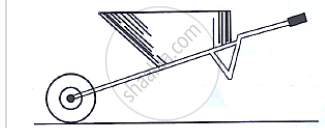
The diagram below shows a wheel barrow. Mark position of fulcrum F and draw arrows to show the directions of load L and effort E. What class of lever is the whell barrow? Give one more example of the same class of lever.
State whether the mechanical advantage of an inclined plane is equal to 1, less than 2 or greater than 1?
Fig. shows a spade. It is being used to lift soil weighing 30N from the ground.
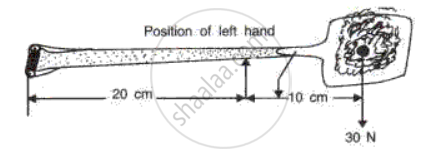
(a) Mark the direction of the least force on the handle necessary to keep the spade balanced.
(b) Calculate the least force on the handle necessary to keep the spade balanced (the weight of the spade is negligible).
(c) If the left hand was move towards the soil on the spade, would the force on the handle necessary to keep the soil balance the greater or less? Give a reason for your answer.
(d) To which class of lever does the spade belong?
What is the efficiency of a machine?
Classify the following as a lever, a pulley and an inclined plane:
A crane
The ______ in the centre, the ______ on one side and the ______ on the other side make a lever of the first order.
Which machine will you use to do the following work? Write their type.
To draw water from a well.
The idea of a simple machine originated with the Greek philosopher Archimedes.
