Advertisements
Advertisements
प्रश्न
Answer in brief.
State the law of simple pendulum.
Advertisements
उत्तर
At a given place, the period of a simple pendulum is
T = 2π `sqrt("L"/"g")`
where,
L - length of the simple pendulum,
g - is the acceleration due to gravity at that place.
From the above expression, the laws of a simple pendulum are as follows:
- Law of length: The period of a simple pendulum at a given place (g constant) is directly proportional to the square root of its length.
- Law of acceleration due to gravity: The period of a simple pendulum of a given length (L constant) is inversely proportional to the square root of the acceleration due to gravity.
- Law of mass: The period of a simple pendulum does not depend on the mass.
- Law of isochronism: The period of a simple pendulum does not depend on its amplitude (for small amplitude).
APPEARS IN
संबंधित प्रश्न
Define an ideal simple pendulum.
A simple pendulum performs S.H.M. of period 4 seconds. How much time after crossing the mean position, will the displacement of the bob be one-third of its amplitude.
What is a second pendulum?
Obtain an expression for a time period of the simple pendulum.
A simple pendulum of length L has mass m and it oscillates freely with amplitude A. At the extreme position, its potential energy is (g = acceleration due to gravity)
A simple pendulum of length I has a bob of mass m. It executes SHM of small amplitude A. The maximum tension in the string is (g = acceleration due to gravity)
The length of a simple pendulum is increased by 44%. The percentage change in its time period is ______.
Work done in stretching a wire through 1 mm is 2 J. What amount of work will be done for elongating another wire of same material, with half the length and double the radius of cross-section, by 1 mm?
A simple pendulum has a time period T1 when on the earth's surface and T2 when taken to a height R above the earth's surface, where R is the radius of the earth. The value of T2 / T1 is ______.
Two pendulums begin to swing simultaneously. The first pendulum makes nine full oscillations when the other makes seven. The ratio of the lengths of the two pendulums is ______.
Two light balls are suspended as shown in figure. When a stream of air passes through the space between them, the distance between the balls will ______.
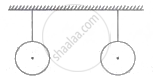
The period of simple pendulum is measured as T in a stationary lift. If the lift moves upward with an acceleration of 5 g, the period will ____________.
If a pendulum which gives correct time beats second on ground at a certain place is moved to the top of a tower 320 m high, then the loss of time of the pendulum clock in one day, in second, is ______.
Two simple pendulums A and B are made to oscillate simultaneously and it is found that A completes 10 oscillations in 20 sec and B completes 8 oscillations in 10 sec. The ratio of the lengths of A and B is ____________.
A person measures a time period of a simple pendulum inside a stationary lift and finds it to be T. If the lift starts accelerating upwards with an acceleration `("g"/3)`, the time period of the pendulum will be ______.
Two simple pendulums of lengths 1.44 m and 1.96 m start swinging together. After how many vibrations will they again start swinging together?
The length of a seconds pendulum is 1m on the earth. If the mass and diameter of the planet is double than that of the earth, then the length of the second's pendulum on the planet will be ______
The maximum kinetic energy of a simple pendulum is 'K'. Its displacement in terms of amplitude 'a', when kinetic energy becomes `(K/2)` is ______.
The ratio of frequencies of two oscillating pendulums is 3 : 2. Their lengths are in the ratio.
A pendulum bob is swinging in a vertical plane, such that its angular amplitude is less than 90°. At its highest point, the string is cut. Which trajectory is possible for bob afterwards?
Two weights w1 and w2 are suspended from the ends of light string over a smooth fixed pulley. If the pulley is pulled up with acceleration g, the tension in the string will be ______.
At the highest point of its swing, a simple pendulum has maximum potential energy and minimum kinetic energy. What is the total mechanical energy of the pendulum at any point during its motion?
A simple pendulum is used to investigate the dissipation of energy. Which quantity is plotted against time to analyse this dissipation?
A student measures time for 20 oscillations of a simple pendulum as 30 s, 32 s, 35 s and 35 s. If the minimum division in the measuring clock is 1 s, then correct mean time (in second) is ______.
