An open metal bucket is in the shape of a frustum of a cone, mounted on a hollow cylindrical base made of the same metallic sheet. The diameters of the two circular ends of the bucket are 45 cm
Advertisements
प्रश्न
An open metal bucket is in the shape of a frustum of a cone, mounted on a hollow cylindrical base made of the same metallic sheet. The diameters of the two circular ends of the bucket are 45 cm and 25 cm, the total vertical height of the bucket is 40 cm and that of the cylindrical base is 6 cm. Find the area of the metallic sheet used to make the bucket. Also, find the volume of water the bucket can hold, in litres.
Advertisements
उत्तर
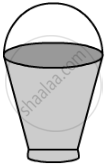
We have,
Radius of the upper end of the furstum, =` "R" = 45/2 "cm"`
Radius of the lower end of the frustum = Radius of the cylinder`="r"="25"/2 "cm"`
Height of the cylinder, = h = 6 m and
Total height of the bucket = 40 cm
And, the height of the frustum, `"l" = sqrt(("R"-r)^2 + H^2`
`=sqrt((45/2 - 25/2)^2+34^2)`
`= sqrt(10^2 + 34^2)`
`=sqrt(100+1156)`
`=sqrt(1256)`
≈ 35.44 cm
Now,
The area of the metallic sheet used to make the bucket = CSA of the frustum + CSA of the cylinder + Area of the base of
`=22/7xx(45/2 + 25/2)xx35.44+2xx22/7xx25/2xx25/2`
`=22/7xx35xx35.44+22/7xx150+22/7xx625/4`
`=22/7xx(1240.4+150+156.25)`
`=22/7xx1546.65`
= 4860.9 cm2
Also,
The volume of the water that the bucket can hold = Volume of the frustum
`=1/3pi"H"("R"^2 + "r"^2+"Rr")`
`=1/3xx22/7xx34xx[(45/2)^2 +(25/2)^2 + (45/2)(25/2)]`
`=748/21xx(2025/4+625/4+1125/4)`
`=748/21xx3775/4`
= 33615.48 cm3
= 33.61548 L (As, 1000 cm3 = 1 L)
≈ 33.61 L
APPEARS IN
संबंधित प्रश्न
A drinking glass is in the shape of a frustum of a cone of height 14 cm. The diameters of its two circular ends are 4 cm and 2 cm. Find the capacity of the glass. [use π=22/7]
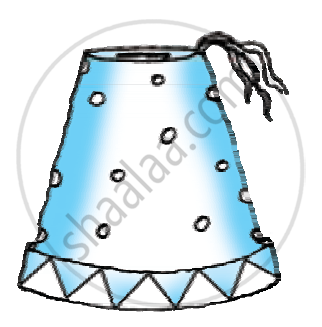
A fez, the cap used by the Turks, is shaped like the frustum of a cone (see the figure given below). If its radius on the open side is 10 cm, radius at the upper base is 4 cm and its slant height is 15 cm, find the area of material use for making it. [use π=22/7]
A container, opened from the top and made up of a metal sheet, is in the form of a frustum of a cone of height 16 cm with radii of its lower and upper ends as 8 cm and 20 cm respectively. Find the cost of the milk which can completely fill the container, at the rate of Rs.20 per litre. Also find the cost of metal sheet used to make the container, if it costs Rs.8 per 100 cm2. [Take π = 3.14]
A metal container, open from the top, is in the shape of a frustum of a cone of height 21 cm with radii of its lower and upper circular ends as 8 cm and 20 cm respectively. Find the cost of milk which can completely fill the container at the rate of Rs 35 per litre.\[\left[ Use \pi = \frac{22}{7} \right]\]
A metallic bucket, open at the top, of height 24 cm is in the form of the frustum of a cone, the radii of whose lower and upper circular ends are 7 cm and 14 cm respectively. Find :
(i) the volume of water which can completely fill the bucket.
(ii) the area of the metal sheet used to make the bucket.
[Use π =\[\frac{22}{7}\]
A cone of height 20 cm and radius of base 5 cm is made up of modeling clay. A child reshapes it in the form of a sphere. Find the diameter of the sphere.
If a cone and a sphere have equal radii and equal volumes. What is the ratio of the diameter of the sphere to the height of the cone?
The slant height of the frustum of a cone is 5 cm. If the difference between the radii of its two circular ends is 4 cm, write the height of the frustum.
A cone of height 20 cm and radius of base 5 cm is made up of modelling clay. A child reshapes it in the form of a sphere. Find the diameter of the sphere.
A solid metal cone with radius of base 12 cm and height 24 cm is melted to form solid spherical balls of diameter 6 cm each. Find the number of balls thus formed.
The radii of the circular ends of a solid frustum of a cone are 18 cm and 12 cm and its height is 8 cm. Find its total surface area. [Use π = 3.14.]
A metallic bucket, open at the top, of height 24 cm is in the form of the frustum of a cone, the radii of whose lower and upper circular ends are 7 cm and 14 cm, respectively. Find
- the volume of water which can completely fill the bucket;
- the area of the metal sheet used to make the bucket.
A bucket is in the form of a frustum of a cone. Its depth is 15 cm and the diameters of the top and the bottom are 56 cm and 42 cm respectively. Find how many litres of water the bucket can hold. `["Take" π = 22/7.]`
A milk container is made of metal sheet in the shape of frustum of a cone whose volume is `"10459" 3/7 "cm"^3`. The radii of its lower and upper circular ends are 8 cm and 20 cm, respectively. Find the cost of metal sheet used in making the container at the rate of ₹ 1.40 per cm2.
A funnel is the combination of ______.
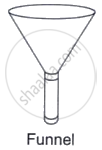
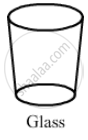
The shape of a glass (tumbler) is usually in the form of ______.
The diameters of two circular ends of a bucket are 44 cm and 24 cm, and the height of the bucket is 35 cm. The capacity of the bucket is ______.
A shuttle cock used for playing badminton has the shape of the combination of ______.
Read the following passage and answer the questions given below.
|
A 'circus' is a company of performers who put on shows of acrobats, clowns etc. to entertain people started around 250 years back, in open fields, now generally performed in tents. One such 'Circus Tent' is shown below. The tent is in the shape of a cylinder surmounted by a conical top. If the height and diameter of cylindrical part are 9 m and 30 m respectively and height of conical part is 8 m with same diameter as that of the cylindrical part, then find |
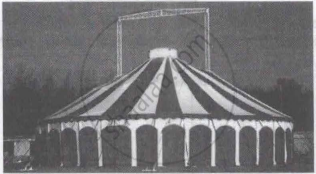
- the area of the canvas used in making the tent;
- the cost of the canvas bought for the tent at the rate ₹ 200 per sq m, if 30 sq m canvas was wasted during stitching.
