Advertisements
Advertisements
प्रश्न
An electron and a positron are released from (0, 0, 0) and (0, 0, 1.5R ) respectively, in a uniform magnetic field B = B0î, each with an equal momentum of magnitude p = e BR. Under what conditions on the direction of momentum will the orbits be non-intersecting circles?
Advertisements
उत्तर
As B is along the x-axis, for a circular orbit the momenta of the two particles are in the y - z plane. Let p1 and p2 be the momentum of the electron and positron, respectively. Both of them define a circle of radius R. They shall define circles of opposite sense. Let p1 make an angle θ with the y-axis p2 must make the same angle. The centres of the respective circles must be perpendicular to the momenta and at a distance R. Let the center of the electron be at Ce and of the positron at Cp. The coordinates of Ce is
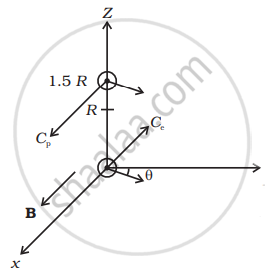
The coordinates of Ce is `Ce ≡ (0, - R sin θ, R cos θ)`
The coordinates of Cp is `Cp ≡ (0, - R sin θ, 3/2 R - R cos θ)`
The circles of the two shall not overlap if the distance between the two centers are greater than 2R.
Let d be the distance between Cp and Ce.
Then `d^2 = (2RSinθ)^2 + (3/2 R - 2Rcosθ)^2`
= `4R^2sin θ + 9^2/4 R - 6R^2 cos θ + 4R^2 cos^2 θ`
= `4R^2 + 9/4 R^2 - 6R^2 cos θ`
Since d has to be greater than 2R
`d^2 > 4R^2`
⇒ `4R^2 + 9/4R^2 - 6R^2 cos θ > 4R^2`
⇒ `9/4 > 6 cos θ`
Or, `cos θ < 3/8`.
