Advertisements
Advertisements
प्रश्न
An a.c. source of voltage V = V0 sin ωt is connected to a series combination of L, C, and R. Use the phasor diagram to obtain the expression for an impedance of a circuit and the phase angle between voltage and current. Find the condition when current will be in phase with the voltage. What is the circuit in this condition called?
Advertisements
उत्तर
i)
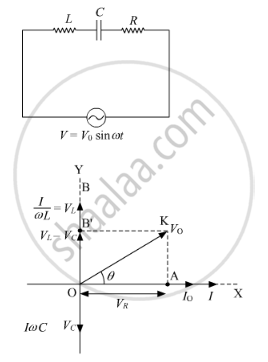
Voltage of the source is given as
I0→" data-mce-style="position: relative;">V=V0sinωtI0→
Let current of the source be " data-mce-style="position: relative;">I=I0sinωt
The maximum voltage across R is `vec(V_R)=vec(V_0)R` represented along OX.
The maximum voltage across L is `vec(V_L)=vec(I_0) X_L`represented along OY and is 90° ahead of `vec(I_0)`
The maximum voltage across C is `vec(V_C)=vec(I_0) X_C`represented along OC and is lagging behind `vec(I_0)`by 900
The voltage across L and C has a phase difference of 180°
Hence, reactive voltage is`vec(V_L)-vec(V_C)`represented by OB
The vector sum of`vec(V_R), vec(V_L) "and "vec(V_C)`resultant of OA and OB', represented along OK
`OK=V_0=sqrt(OA^2+OB^2)`
`=>V_0=sqrt(V_R2+(V_L-V_C)^2)=sqrt(I_0R^2+(I_0X-V_C)^2)`
`=>V_0=I_0sqrt(R^2+(X_L-X_C)^2)`
The impedance can be calculated as follows:
`Z=V_0/I_0=sqrt(R^2+(X_L-X_C)^2)`
When XL = XC, the voltage and current are in the same phase. In such a situation, the circuit is known as the non-inductive circuit.
