Advertisements
Advertisements
प्रश्न
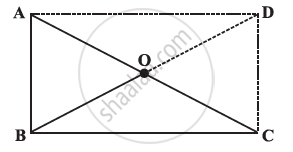
ABC is a right-angled triangle and O is the mid point of the side opposite to the right angle. Explain why O is equidistant from A, B and C. (The dotted lines are drawn additionally to help you)
Advertisements
उत्तर
ABCD is a rectangle as opposite sides are equal and parallel to each other, and all the interior angles are 90º.
In a rectangle, diagonals are of equal length and also these bisect each other.
Since MBC is right-angled at B. So ∠D = 90°, AD||BC and AB||DC
ABCD is a rectangle where AB = CD and AD=BC
AC and BD are the diagonals which bisect each other.
Hence, AO = OC = BO = OD
Thus, O is equidistant from A, B, and C.
संबंधित प्रश्न
In the following figure, BDEF and DCEF are each a parallelogram. Is it true that BD = DC? Why or why not?
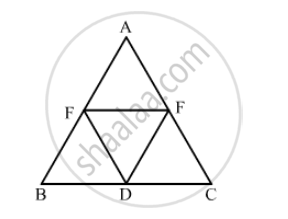
In Fig. 17.29, suppose it is known that DE = DF. Then, is ΔABC isosceles? Why or why not?
Which of the following statement is true for a rectangle?
All rectangles are squares.
Find the length of the diagonal of a rectangle whose sides are 12 cm and 5 cm.
A mason has made a concrete slab. He needs it to be rectangular. In what different ways can he make sure that it is rectangular?
Draw a rectangle ABCD such that l(AB) = 6.0 cm and l (BC) = 4.5 cm.
Show that the bisectors of angles of a parallelogram form a rectangle
If the diagonals of a quadrilateral are equal and bisect each other, then the quadrilateral is a ______.
In a rectangle ABCD, AB = 25 cm and BC = 15. In what ratio does the bisector of ∠C divide AB?
Construct a rectangle whose one side is 3 cm and a diagonal equal to 5 cm.
