Advertisements
Advertisements
प्रश्न
A transformer has 400 turns in the primary winding and 10 turns in the secondary winding. The primary e.m.f. is 250 V and the primary current is 2.0 A. calculate:
(a) The secondary voltage,
(b) The secondary current, assuming 100% efficiency.
Advertisements
उत्तर
Since, the number of turns in the primary is more than the no. of turns in the secondary it is a step-down transformer.
Given, NP= 400, Ns = 10, EP=250 V, IP= 2A
(a) Let Es be the secondary voltage.
We know that for transformer turn ratio `"N"_"s"/"N"_"p" = "I"_"p"/"I"_"s" = "E"_"s"/"E"_"P"`
Es = `"N"_"s"/"N"_"P" xx "E"_"P" = 10/400 xx 250 = 6.25 "V"`
(b) Let Is be the current though secondary
We know that for transformer turn ratio `"N"_"s"/"N"_"P" = "I"_"P"/"I"_"s"`
Is = `400/10 xx 2= 80 "A"`
APPEARS IN
संबंधित प्रश्न
The magnetic flux through a loop is varying according to a relation `phi = 6t^2 + 7t + 1` where `phi` is in milliweber and t is in second. What is the e.m.f. induced in the loop at t = 2 second?
When an electric current is passed through any wire, a magnetic field is produced around it. Then why an electric iron connecting cable does not attract nearby iron objects when electric current switched on through it?
State the factors on which the strength of an electromagnet depends. How does it depend on these factors?
L, C and R represent the physical quantities inductance, capacitance and resistance respectively. Which of the following combinations have dimensions of frequency?
(a) `1/(RC)`
(b) `R/L`
(c) `1/sqrt(LC)`
(d) C/L
Fill in the blanks by writing (i) Only soft iron, (ii) Only steel, (iii) Both soft-iron and steel for the material of core and/or magnet.
D.C. motor ______.
You have been provided with a solenoid AB.
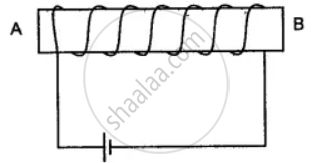
(i) What is the polarity at end A?
(ii) Give one advantage of an electromagnet over a permanent magnet.
A 50 cm long solenoid has 400 turns per cm. The diameter of the solenoid is 0.04 m. Find the magnetic flux linked with each turn when it carries a current of 1 A.
The charge will flow through a galvanometer of resistance 200Ω connected to a 400Ω circular coil of 1000 turns wound on a wooden stick 20 mm in diameter, if a magnetic field B = 0.012 T parallel to the axis of the stick decreased suddenly to zero, is near ______.
What is the current produced in a coil due to electromagnetic induction called?
Which device used for using electricity developed from Faraday’s and Henry’s experiments?
