Advertisements
Advertisements
प्रश्न
A student said that the ratios `3/4` and `9/16` were proportional. What error did the student make?
Advertisements
उत्तर
Two ratios a : b and c : d are said to be proportional
if `a/b = c/d` or ad = bc.
But the given ratios `3/4` and `9/16, 3 × 6 ≠ 4 × 9`
Hence, the ratios are not proportional. To make a ratio proportional to another ratio, we just simply multiply both numerator and denominator by the same number.
Here, the student had multiply numerator by 3 and denominator by 4, which is incorrect.
APPEARS IN
संबंधित प्रश्न
If q is the mean proportional between p and r, show that: pqr(p + q + r)3 = (pq + qr + rp)3.
If `a/b = c/d` prove that each of the given ratios is equal to
`(5a + 4c)/(5b + 4d)`
Find the fourth proportion to the following:
3,5 and 15
Find the value of x in the following proportions : 3 : x = 24 : 2
Determine if the following ratio form a proportion:
200 mL : 2.5 L and Rs 4 : Rs 50
If b is the mean proportional between a and c, prove that (ab + bc) is the mean proportional between (a² + b²) and (b² + c²).
5 : `square` : : 10 : 8 : : 15 : `square`
Write the mean and extreme terms in the following ratios and check whether they are in proportion.
400 gm is to 50 gm and 25 rupees is to 625 rupees
10 g of caustic soda dissolved in 100 mL of water makes a solution of caustic soda. Amount of caustic soda needed for 1 litre of water to make the same type of solution is ______.
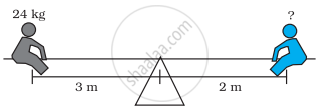
Unequal masses will not balance on a fulcrum if they are at equal distance from it; one side will go up and the other side will go down.
Unequal masses will balance when the following proportion is true:
`("mass"1)/("length"2) = ("mass"2)/("length"1)`

Two children can be balanced on a seesaw when
`("mass"1)/("length"2) = ("mass"2)/("length"1)`. The child on the left and child on the right are balanced. What is the mass of the child on the right?