Advertisements
Advertisements
प्रश्न
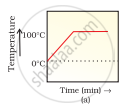
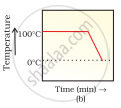
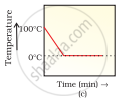
A student heats a beaker containing ice and water. He measures the temperature of the content of the beaker as a function of time. Which of the following (Fig. 1.1) would correctly represent the result? Justify your choice.
विकल्प
Advertisements
उत्तर
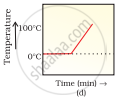
Since ice and water are in equilibrium, the temperature would be zero. When we heat the mixture, ‘energy supplied is utilised in melting the ice and the temperature does not change till the ice melts because of latent heat of fusion. On further heating the temperature of the water would increase. Therefore (d) is the correct option.
APPEARS IN
संबंधित प्रश्न
Explain the term Melting Point.
Describe an experiment to demonstrate that a substance absorbs heat during melting without change in its temperature.
State the melting point of ice.
The fixed temperature at which matter changes state from solid to liquid is called ______.
A glass tumbler containing hot water is kept in the freezer compartment of a refrigerator (temperature < 0°C). If you could measure the temperature of the content of the tumbler, which of the following graphs (Fig.1.2) would correctly represent the change in its temperature as a function of time.
In an endothermic process, the speed of the molecules is ______ hence they move faster.
______ is the changing of a liquid into its solid state and it happens by cooling.
Ice does not melt rapidly because of ______.
Define latent heat of fusion?
Explain the following effects of heat.
Change in state
