Advertisements
Advertisements
प्रश्न
A solid sphere rolls down two different inclined planes of the same heights but different angles of inclination. (a) Will it reach the bottom with the same speed in each case? (b) Will it take longer to roll down one plane than the other? (c) If so, which one and why?
Advertisements
उत्तर १
(a) Yes (b) Yes (c) On the smaller inclination
(a)Mass of the sphere = m
Height of the plane = h
Velocity of the sphere at the bottom of the plane = v
At the top of the plane, the total energy of the sphere = Potential energy = mgh
At the bottom of the plane, the sphere has both translational and rotational kinetic energies.
Hence, total energy = `1/2mv^2 + 1/2Iomega^2`
Using the law of conservation of energy, we can write:
`1/2mv^2 + 1/2 Iomega^2 = mgh` ....(I)
For a solid sphere, the moment of inertia about its centre, `I = 2/3 mr^2`
Hence, equation (i) becomes:
`1/2 mv^2 + 1/2 (2/5 mr^2)omega^2 = mgh`
`1/2v^2 + 1/5r^2omega^2 =gh`
But we have the relation `v= r omega`
`:.1/2v^2 + 1/5v^2 = gh`
`v^2(7/10) = gh`
`v = sqrt(10/7 gh)`
Hence, the velocity of the sphere at the bottom depends only on height (h) and acceleration due to gravity (g). Both these values are constants. Therefore, the velocity at the bottom remains the same from whichever inclined plane the sphere is rolled.
(b), (c)Consider two inclined planes with inclinations θ1 and θ2, related as: θ1 < θ2
The acceleration produced in the sphere when it rolls down the plane inclined at `theta_1` is g sin `theta_1`
The various forces acting on the sphere are shown in the following figure.
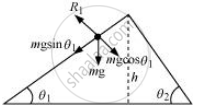
R1 is the normal reaction to the sphere.
Similarly, the acceleration produced in the sphere when it rolls down the plane inclined at θ2is:
g sin θ2
The various forces acting on the sphere are shown in the following figure.
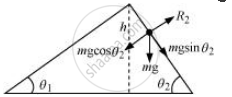
R2 is the normal reaction to the sphere.
θ2 > θ1; sin θ2 > sin θ1 ... (i)
∴ a2 > a1 … (ii)
Initial velocity, u = 0
Final velocity, v = Constant
Using the first equation of motion, we can obtain the time of roll as:
v = u + at
`:. t prop 1/a`
`[("For inclination" theta_1: t_1 prop 1/a_1), ("For inclination" theta_2 : t_2 prop 1/a_2)]` ...(iii)
From equations (ii) and (iii), we get:
t2 < t1
Hence, the sphere will take a longer time to reach the bottom of the inclined plane having the smaller inclination
उत्तर २
(a) Using law of conservation of energy,
`1/2mv^2 + 1/2Iomega^2 = mgh`
or `1/2mv^2 + 1/2(2/5 mR^2) v^2/R^2 = mgh`
or 7/10v^2 = gh or v = `sqrt((10gh)/7)`
Since h is same for both the inclined planes therefore v is the same.
b) `l = 1/2((g sin theta)/(1+K^2/R^2)) t^2 = (g sin theta)/2(1+2/5) t^2 = (5g sin theta)/14 t^2`
or t = `sqrt((14l)/(5g sin theta)`
Now, `sin theta = h/l` or l = `h/sin theta`
`:. t= 1/sin theta sqrt((14h)/"5g")`
Lesser the value of `theta` more will be t
c) Clearly, the solid sphere will take longer to roll down the plane with smaller inclination.
संबंधित प्रश्न
Read each statement below carefully, and state, with reasons, if it is true or false;
The instantaneous speed of the point of contact during rolling is zero.
Read each statement below carefully, and state, with reasons, if it is true or false;
For perfect rolling motion, work done against friction is zero.
A solid sphere of mass 1 kg rolls on a table with linear speed 2 m/s, find its total kinetic energy.
Can an object be in pure translation as well as in pure rotation?
A sphere cannot roll on
In rear-wheel drive cars, the engine rotates the rear wheels and the front wheels rotate only because the car moves. If such a car accelerates on a horizontal road the friction
(a) on the rear wheels is in the forward direction
(b) on the front wheels is in the backward direction
(c) on the rear wheels has larger magnitude than the friction on the front wheels
(d) on the car is in the backward direction.
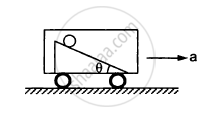
The following figure shows a smooth inclined plane fixed in a car accelerating on a horizontal road. The angle of incline θ is related to the acceleration a of the car as a = g tanθ. If the sphere is set in pure rolling on the incline, _____________.
A cylinder rolls on a horizontal place surface. If the speed of the centre is 25 m/s, what is the speed of the highest point?
A string is wrapped over the edge of a uniform disc and the free end is fixed with the ceiling. The disc moves down, unwinding the string. Find the downward acceleration of the disc.
A solid sphere of mass 0⋅50 kg is kept on a horizontal surface. The coefficient of static friction between the surfaces in contact is 2/7. What maximum force can be applied at the highest point in the horizontal direction so that the sphere does not slip on the surface?
The speed of a solid sphere after rolling down from rest without sliding on an inclined plane of vertical height h is, ______
What is the condition for pure rolling?
Discuss rolling on an inclined plane and arrive at the expression for acceleration.
A solid sphere rolls down from top of inclined plane, 7m high, without slipping. Its linear speed at the foot of plane is ______. (g = 10 m/s2)
The angular velocity of minute hand of a clock in degree per second is ______.
A circular disc reaches from top to bottom of an inclined plane of length 'L'. When it slips down the plane, it takes time ' t1'. when it rolls down the plane, it takes time t2. The value of `t_2/t_1` is `sqrt(3/x)`. The value of x will be ______.
Solid spherical ball is rolling on a frictionless horizontal plane surface about is axis of symmetry. The ratio of rotational kinetic energy of the ball to its total kinetic energy is ______.
The kinetic energy and angular momentum of a body rotating with constant angular velocity are E and L. What does `(2E)/L` represent?
