Advertisements
Advertisements
प्रश्न
A slab of material of dielectric constant k has the same area A as the plates of a parallel plate capacitor and has a thickness (3/4d), where d is the separation of the plates. The change in capacitance when the slab is inserted between the plates is ______.
विकल्प
`C = (Aε_0)/d ((k + 3)/(4k))`
`C = (Aε_0)/d ((2k)/(k + 3))`
`C = (Aε_0)/d ((k + 3)/(2k))`
`C = (Aε_0)/d ((4k)/(k + 3))`
Advertisements
उत्तर
A slab of material of dielectric constant k has the same area A as the plates of a parallel plate capacitor and has a thickness (3/4d), where d is the separation of the plates. The change in capacitance when the slab is inserted between the plates is `bbunderline(C = (Aε_0)/d ((4k)/(k + 3)))`.
Explanation:
The diagrammatic representation of the capacitor when the slab is inserted is shown below.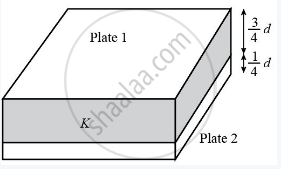
The above configuration can be considered as two capacitors C1 and C2 placed in series with each other, as shown in the diagram below.
Circuit configuration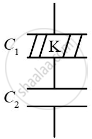
The capacitance C1 s the one with a dielectric with dielectric constant K and plate separation 3/4 d
C1 = `(kε_0 A)/((3/4)d)`
C1 = `(4kε_0 A)/(3d)`
The capacitance C2 is the one with no dielectric and plate separation `(1/4)` d
C2 = `(epsilon_0 A)/((1/4) d)`
C2 = `(4epsilon_0 A)/d`
When two capacitors are placed in series with each other, the equivalent capacitance C is given as follows:
C = `(C_1C_2)/(C_1 + C_2)`
Substitute the values of capacitances of C1 and C2.
C = `(((kε_0 A)/((3/4)d)) * ((4ε_0 A)/d))/((kε_0 A)/((3/4) d) + (4ε_0 A)/d)`
C = `(((4k)/3) * (4) * ((ε_0 A)/d)^2)/(((4k)/3 + 4) * ((ε_0 A)/d))`
C = `(((4k)/3) * ((ε_0 A)/d))/((k + 3)/5)`
C = `(Aε_0)/d ((4k)/(k + 3))`
