Advertisements
Advertisements
प्रश्न
A slab of material of dielectric constant K has the same area as that of the plates of a parallel plate capacitor but has the thickness d/2, where d is the separation between the plates. Find out the expression for its capacitance when the slab is inserted between the plates of the capacitor.
Advertisements
उत्तर
Initially when there is vacuum between the two plates, the capacitance of the two parallel plate is, `C_0 = (epsi_0A)/d`
Where, A is the area of parallel plates.
Suppose that the capacitor is connected to a battery, an electric field E0 is produced.
Now if we insert the dielectric slab of thickness t=d/2 the electric field reduces to E.
Now the gap between plates is divided in two parts, for distance t there is electric field E and for the remaining distance (d-t) the electric field is E0.
If V be the potential difference between the plates of the capacitor, then V=Et+E0(d-t)
`V=(Ed)/2 + (E_0d)/2 =d/2 (E +E_0) (therefore t =d/2)`
`=> V=d/2 ((E_0)/K +E_0) (dE_0)/(2K) (K+1) (As,(E_0)/E = K)`
Now, `E_0 =σ/epsi_0 = q/(epsiA )=>V = d/(2K) q/(epsi_0A) (K +1)`
we know, `C = q/V = (2Kepsi_0A)/(d(K+1))`
APPEARS IN
संबंधित प्रश्न
Show that the force on each plate of a parallel plate capacitor has a magnitude equal to `(1/2)` QE, where Q is the charge on the capacitor, and E is the magnitude of the electric field between the plates. Explain the origin of the factor `1/2`.
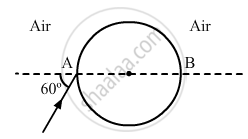
A ray of light falls on a transparent sphere with centre C as shown in the figure. The ray emerges from the sphere parallel to the line AB. Find the angle of refraction at A if the refractive index of the material of the sphere is \[\sqrt{3}\].
In a parallel plate capacitor with air between the plates, each plate has an area of 6 × 10⁻³m2 and the separation between the plates is 3 mm.
- Calculate the capacitance of the capacitor.
- If this capacitor is connected to 100 V supply, what would be the charge on each plate?
- How would charge on the plates be affected, if a 3 mm thick mica sheet of k = 6 is inserted between the plates while the voltage supply remains connected?
Two identical capacitors are joined in parallel, charged to a potential V, separated and then connected in series, the positive plate of one is connected to the negative of the other. Which of the following is true?
A parallel plate capacitor is charged by connecting it to a battery through a resistor. If I is the current in the circuit, then in the gap between the plates:
For two plates separated by distance \[d\], what is the capacitance of a parallel plate capacitor without a dielectric medium?
When a dielectric slab of dielectric constant \[K\] is inserted between the plates, what is the electric field \[E'\] due to polarisation of the dielectric?
When the electric field is reduced to \[E'=\frac{E}{K}\] by a dielectric, what happens to potential difference and capacitance?
Where is electrical energy stored in a parallel plate capacitor, and how can it be used?
For the same voltage, what change allows more charge to be stored and more energy to be stored in the capacitor?
