Advertisements
Advertisements
प्रश्न
A sample contains a mixture of 108Ag and 110Ag isotopes each having an activity of 8.0 × 10⁸ disintegration per second. 110Ag is known to have larger half-life than 108Ag. The activity A is measured as a function of time and the following data are obtained.
| Time (s) |
Activity (A) (108 disinte- grations s−1) |
Time (s) |
Activity (A 108 disinte-grations s−1) |
| 20 40 60 80 100 |
11.799 9.1680 7.4492 6.2684 5.4115 |
200 300 400 500 |
3.0828 1.8899 1.1671 0.7212 |
(a) Plot ln (A/A0) versus time. (b) See that for large values of time, the plot is nearly linear. Deduce the half-life of 110Ag from this portion of the plot. (c) Use the half-life of 110Ag to calculate the activity corresponding to 108Ag in the first 50 s. (d) Plot In (A/A0) versus time for 108Ag for the first 50 s. (e) Find the half-life of 108Ag.
Advertisements
उत्तर
(a) Activity, A0 = 8 × 10⁸ dis/sec
(i) `"In" (A_1/A_0) = "In" (11.794/8) = 0.389`
(ii) `"In" (A_2/A_0) = "In" (9.1680/8) = 0.12362`
(iii) `"In" (A_3/A_0) = "In" (7.4492/8) = -0.072`
(iv) `"In" (A_4/A_0) = "In" (6.2684/6) = -0.244`
(v) `"In" (A_5/A) = "In" (5.4115/8) = -0.391`
(vi) `"In" (A_6/A_0) = "In" (3.0828/8) = -0.954`
(vii) `"In" (A_7/A_0) = "In" (91.8899/8) = -1.443`
(viii) `"In" (1.1671/8) = "In" (90.7212/8) = -1.93`
(ix) `"In" (0.7212/8) = "In" (90.7212/8) = -2.406`
The required graph is given below.
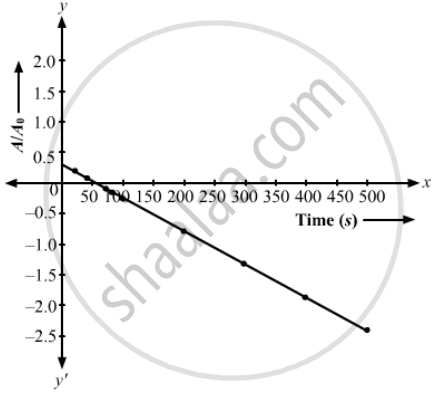
(b) Half-life of 110Ag = 24.4 s
(c) Half-life of 110Ag, `T_"1/2"`= 24.4 s
Decay constant, `lambda = 0.693/T_"1/2"`
⇒ `lambda = 0.63/24.4 = 0.0284`
`therefore t = 50 sec`
Activity , `"A" = "A"_0e^(-lambdat)`
= `8 xx 10^8 xx e^(-0.0284 xx 50)`
= `1.93 xx 10^8`
(d)
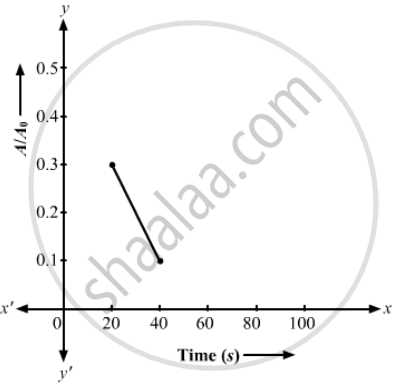
(e) The half-life period of `""^108"Ag"` that you can easily watch in your graph is 144 s .
