Advertisements
Advertisements
प्रश्न
A number of theories have been used to understand 'personality'. Discuss how efforts have been inade to categorise people into personality types since ancient times.
दीर्घउत्तर
Advertisements
उत्तर
Type theory presumes that people can be categorised into a series of categories or types based on no overlapping characteristics.
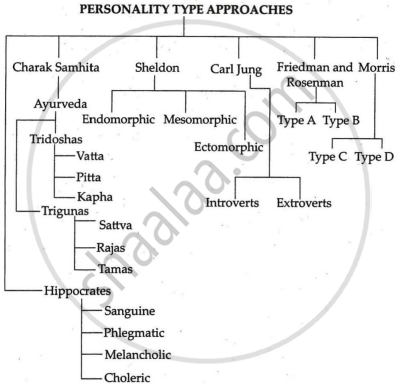
- Greek physician Hippocrates, regarded as the “father of modern medicine,” held that a person’s physical and mental health were interconnected. To extend his idea, he suggested four personality types based on the temperament’s major humour and fluids.
- Sanguine: cheerful, active and optimistic.
- Phlegmatic: touchy, sluggish, calm and apathetic.
- Melancholic: sad, broocling and morose.
- Choleric: irritable, hot-tempered and excitable.
- The three “Dashas”—Vata, Pitta, and Kapha—that make up the Indian discipline of medicine, known as Ayurveda, or Charak Samhita, are used to categorise persons.
- Based on qualities (gunas), there are three different types of personalities.
- Sattva: The qualities of sincerity, detachment, discipline, keen intelligence, self-control, and spirituality are included in the Sattva Guna.
- Rajas: Rajas Guna consists of some worldly characteristics, such as the need for instant gratification and a materialistic mindset. They are both inventive and envious.
- Tamas: The Tamas Guna is made up of all the vices in the world, including mental instability, rage, arrogance, laziness, etc.
Based on the physical constitution, Sheldon has categorised personalities.- Endomorphic: They are big, soft, and round, and they are relaxed and social, like eating and enjoying themselves.
- Mesomorphic: They have a rectangular, well-built body shape with a strong muscular structure. They are bold, energetic, assertive, and dominating.
- Ectomorphic: They have a body shape that is long, thin, and fragile. They are brainy, artistic, introvert and are fond of solitude and inward-looking.
- Carl Jung grouped all people into:
- Introverts: They are socially withdrawn, passive, quiet, cautious and reserved.
- Extroverts: Socially outgoing, talkative, impulsive and thrill-seeking.
- Meyer Friedman and Ray Rosenman (1974) identified psychological variables and suggested that individuals can be grouped into two personality types:
- Type-A: Type-A, coronary-prone behaviour pattern. They are never content, constantly pressed for time, overworked, and competitive.
- Type-B: The neutral behaviour pattern, often known as type B, is marked by an easygoing, relaxed way of life.
-
More recent research by Morris has suggested Type-C and Type-D personalities.
-
Type-C personalities are cancer-prone and are defined by their lack of aggressiveness, suppression of anger, and submission to external authorities to avoid disputes.
-
Type-D personalities are generally pessimistic and prone to depression.
-
shaalaa.com
क्या इस प्रश्न या उत्तर में कोई त्रुटि है?
