हिंदी
कर्नाटक बोर्ड पी.यू.सी.पीयूसी विज्ञान 2nd PUC Class 12

A metal plate is getting heated. It can be because ______. a direct current is passing through the plate. it is placed in a time varying magnetic field. it is placed in a space varying magnetic field - Physics

Advertisements
Advertisements

प्रश्न

A metal plate is getting heated. It can be because ______.

  1. a direct current is passing through the plate.
  2. it is placed in a time varying magnetic field.
  3. it is placed in a space varying magnetic field, but does not vary with time.
  4. a current (either direct or alternating) is passing through the plate.

विकल्प

  • a, b and d

  • a, c and d

  • b, c and d

  • a, b and c

MCQ
रिक्त स्थान भरें
Advertisements

उत्तर

a, b and d

Explanation:

When a changing magnetic flux is applied to a bulk piece of conducting material, then circulating currents called eddy currents are induced in the material. Because the resistance of the bulk conductor is usually low, eddy currents often have large magnitudes and heat up the conductor.

  1. These are circulating currents like eddies in water.
  2. The Experimental concept is given by Focault, hence also named as “Focault current”.
  3. The production of eddy currents in a metallic block leads to the loss of electric energy in the form of heat.
  4. By lamination and slotting processes, the resistance path for circulation of eddy current increases, resulting in weakening them and also reducing losses causes by them.
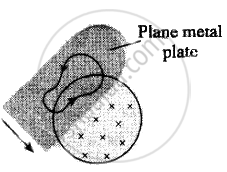
(A) Strong eddies produced cause excessive electro
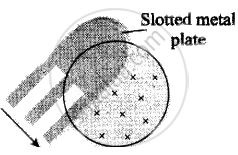
(B) Feeble eddies gradual damping

A metal plate is getting heated when a DC or AC current is passed through the plate, known as heating effect of current. This current (called eddy current) is induced in the plate when a metal plate is subjected to a time-varying magnetic field, i.e., the magnetic flux linked with the plate changes and eddy currents comes into existence which makes the plate hot.

shaalaa.com
  क्या इस प्रश्न या उत्तर में कोई त्रुटि है?
अध्याय 6: Electromagnetic Induction - MCQ I [पृष्ठ ३४]

APPEARS IN

एनसीईआरटी एक्झांप्लर Physics [English] Class 12
अध्याय 6 Electromagnetic Induction
MCQ I | Q 6.07 | पृष्ठ ३४

वीडियो ट्यूटोरियलVIEW ALL [1]

संबंधित प्रश्न

Describe briefly three main useful application of eddy currents ?


Metallic (nonferromagnetic) and nonmetallic particles in a solid waste may be separated as follows. The waste is allowed to slide down an incline over permanent magnets. The metallic particles slow down as compared to the nonmetallic ones and hence are separated. Discuss the role of eddy currents in the process.


A metallic bob A oscillates through the space between the poles of an electromagnet (See the figure). The oscillations are more quickly damped when the circuit is on, as compared to the case when the circuit is off. Explain.


State applications of eddy currents.


In which of the following devices, the eddy current is not used ______ 


Why and where are eddy currents are undesirable? How are they minimized? 


Give the uses of Foucault current.


Certain galvanometers have a fixed core made of nonmagnetic metallic material, when the coil oscillates, ...A... generated in the core ...B... the motion and bring the coil to rest ...C...
Here, A, B and C refer to ______.

Which of the following does not use the application of eddy current?

When strength of eddy currents is reduced, as dissipation of electrical energy into heat depends on the ...A... of the strength of electrical energy into heat depends on the ...A... of the strength of electric current heat loss is substantially ...B.... Here, A and B refer to ______.

Two simple pendula of length L and 4L are pulled aside to the right and are at rest so that they make an angle 30° with the vertical. They are then released simultaneously at time t = 0. The time after which they will be in phase is ______.


If the length of a simple pendulum increases by 5%, then its period shall increase by ______.


Which one is not an application of eddy current?


Eddy currents are also known as ______


Consider a metallic pipe with an inner radius of 1 cm. If a cylindrical bar magnet of radius 0.8 cm is dropped through the pipe, it takes more time to come down than it takes for a similar unmagnetised cylindrical iron bar dropped through the metallic pipe. Explain.


Share
Notifications

Englishहिंदीमराठी


      Forgot password?
Use app×