Advertisements
Advertisements
प्रश्न
A metal ball of mass 2 kg is allowed to fall freely from rest from a height of 5 m above the ground. Taking g = 10 m s−2, calculate:
- the potential energy possessed by the ball when it is initially at rest.
- the kinetic energy of the ball just before it hits the ground?
Advertisements
उत्तर
Mass of the ball m = 2 kg, g = 10 ms−2, h = 5 m
(i) Potential Energy possessed by the ball = mgh
= 2 × 10 × 5
= 100 J
(ii) K.E of ball = potential Energy = 100 J
or v2 = 2gh
v2 = 2 × 10 × 5
= 100 J
∴ K.E = `1/2 mv^2`
= `1/2 xx 2 xx 100`
= 100 J
APPEARS IN
संबंधित प्रश्न
A body falls freely under gravity from rest. Name the kind of energy it will possess while falling.
State whether the object possess kinetic energy, potential energy, or both :
A flying aeroplane _______________.
What type of energy is possessed : by the stretched rubber strings of a catapult?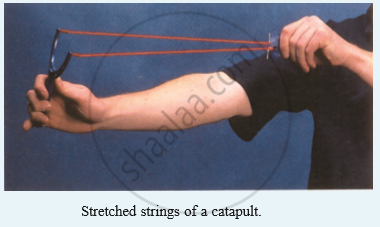
What is the difference between potential energy and kinetic energy?
Fill in the blank with suitable word:
The electricity meter installed in our homes measure electrical energy in the units of ___________.
Fill in the blanks with suitable words :
The principle of ___________ of energy says energy can be transformed from one form to another, but it cannot be ___________ or ___________.
What kind of energy transformations take place at a coal-based thermal power station?
A ball falls to the ground as shown below :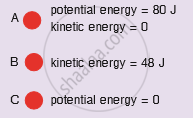
Which law you have made use of in answering this question?
When an object falls freely towards the earth, then its total energy :
A girl is carrying a school bag of 3 kg mass on her back and moves 200 m on a levelled road. The work done against the gravitational force will be (g = 10 m s–2)
