Advertisements
Advertisements
प्रश्न
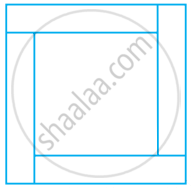
A large square is made by arranging a small square surrounded by four congruent rectangles as shown in the following figure. If the perimeter of each of the rectangle is 16 cm, find the area of the large square.
Advertisements
उत्तर
Let the length and breadth of rectangle be l and b, respectively.
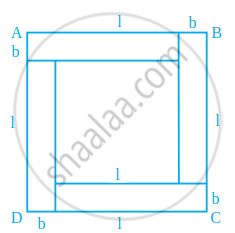
It is given that, perimeter of one rectangle = 16 cm2
⇒ 2(l + b) = 16 ...[∵ Perimeter of rectangle = 2(l + b)]
⇒ l + b = 8 cm
Since, the side of larger square is (l + b).
Hence, area = (side)2 = (l + b)2 = (8)2 = 64 cm2
APPEARS IN
संबंधित प्रश्न
The diagonal of a rectangle is 34 cm. If its breadth is 16 cm; find its :
(i) length
(ii) area
The area of a small rectangular plot is 84 m2. If the difference between its length and the breadth is 5 m; find its perimeter.
Find the perimeter of a regular hexagon of side 6.5 cm.
Each side of a square is 45 cm and a rectangle has length 50 cm. If the perimeters of both (square and rectangle) are same, find the breadth of the rectangle.
The cost of flooring a hall of ₹64 per square meter is ₹2,048. If the breadth of the hall is 5m, find:
(i) its length.
(ii) its perimeter.
(iii) cost of fixing a border of very small width along its boundary at the rate of ₹60 per square meter.
If the length of a rectangle is 20 m and its width is 12 m, what is its perimeter?
Length of a rectangle is three times its breadth. Perimeter of the rectangle is 40 cm. Find its length and width.
A rectangular path of 60 m length and 3 m width is covered by square tiles of side 25 cm. How many tiles will there be in one row along its width? How many such rows will be there? Find the number of tiles used to make this path?
In the following figure, perimeter of (ii) is greater than that of (i), but its area is smaller than that of (i).
 |
 |
| (i) | (ii) |
A rectangle has length 15 cm and breadth 9 cm. What is its perimeter?
