Advertisements
Advertisements
प्रश्न
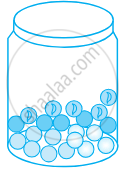
A glass jar contains 6 red, 5 green, 4 blue and 5 yellow marbles of same size. Hari takes out a marble from the jar at random. What is the probability that the chosen marble is of red colour?
विकल्प
`7/10`
`3/10`
`4/5`
`2/5`
Advertisements
उत्तर
`bb(3/10)`
Explanation:
As, jar contains 6 red, 5 green, 4 blue and 5 yellow marbles of same size.
Then, probability that the chosen marble is of red colour
= `"Number of red marbles"/"Total number of marbles"`
= `6/(6 + 5 + 4 + 5)`
= `6/20`
= `3/10`
APPEARS IN
संबंधित प्रश्न
Tell whether the given is certain to happen, impossible, can happen but not certain.
A die when tossed shall land up with 8 on top.
In a simultaneous throw of a pair of dice, find the probability of getting:
a sum greater than 9
In a simultaneou throw of a pair of dice, find the probability of getting:
an even number on first
In a simultaneous throw of a pair of dice, find the probability of getting:
an even number on one and a multiple of 3 on the other
Three coins are tossed together. Find the probability of getting:
at least two heads
A card is drawn at random from a pack of 52 cards. Find the probability that the card drawn is:
either a black card or a king
What is the probability that a number selected from the numbers 1, 2, 3, ..., 15 is a multiple of 4?
It is impossible to get a sum of 14 of the numbers on both dice when a pair of dice is thrown together.
A coin is tossed 15 times and the outcomes are recorded as follows:
H T T H T H H H T T H T H T T. The chance of occurrence of a head is 50 per cent.
The letters written on paper slips of the word MEDIAN are put in a bag. If one slip is drawn randomly, what is the probability that it bears the letter D?
