Advertisements
Advertisements
प्रश्न
A force of 1 kgf displaces a body by a distance of 10 cm
(i) in direction of force,
(ii) normal to the force
(iii) at an angle of 60° to the direction of the force.
Calculate the amount of work done in each case. (Take: g = 9.8 ms−2 )
Advertisements
उत्तर
Given : F = 1 kgf = 1 × g Newton
(i) When displacement is in direction of force.
θ = 0°, cos 0° = 1
W = F × d = 9.8 × 0.1 = 0.98 J.
(ii) When displacement is normal to the force
θ = 90°, cos 90° = 0, i.e.,W = 0.
(iii) When displacement is at an angle of 60° to the direction of force
θ = 60° or, cos 60° =`1/2`
W = F . d cos θ = `9.8xx0.1xx1/2` = 0.49 J.
संबंधित प्रश्न
When a body is placed on a table top, it exerts a force equal to its weight downwards on the table top but does not move or fall
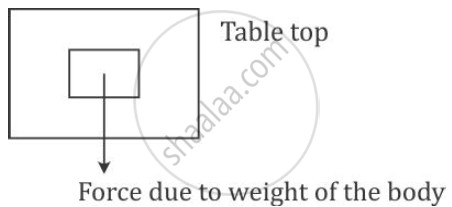
1) Name the force exerted by the table top
2) What is the direction of the force?
State the condition when the work done by a force is positive. Explain with the help of examples.
A satellite revolves around the earth in a circular orbit. What is the work done by the force of gravity? Give reason.
Work done by a force is equal to the product of ....... and ....
A boy takes 3 minutes to lift a 20 litre water bucket from a 20 m deep well, while his father does it in 2 minutes.
How much work each does? Take density of water = 103 kg m-3 and g = 9.8 N kg-1.
How is 1 kgf related to the SI unit of force?
Give the units of couple.
In the following case write yes, if the work is being done and no if no work is being done.
A man trying to push a wall.
A force F when acts on a body, displace it by a distance d in a direction at an angle θ with the direction of the force. Write down the expression for the work done by the force.
State the S.I. and C.G.S. units of energy. How are they related?
