Advertisements
Advertisements
प्रश्न
A force is applied on a body of mass 20 kg moving with a velocity of 40 ms−1. The body attains a velocity of 50 ms−1 in 2 seconds. Calculate the work done by the body.
Advertisements
उत्तर
Work done, W =`1/2` m (v22 − v12)
=`1/2xx20(50^2-40^2)`
= 9000 J
संबंधित प्रश्न
An object thrown at a certain angle to the ground moves in a curved path and falls back to the ground. The initial and the final points of the path of the object lie on the same horizontal line. What is the work done by the force of gravity on the object?
Can there be displacement of an object in the absence of any force acting on it? Think. Discuss this question with your friends and teacher.
Work done by a boy depends on the time in which he does work.
State two advantage of producing hydroelectricity.
Is the motion of moon around the earth in circular path an accelerated motion?
Calculate the amount of work done by a child carrying a bag of 20 kg when he moves a distance of 40 m in
(a) Vertical direction, and
(b) Horizontal direction
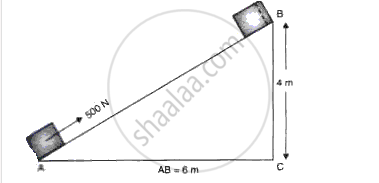
A block of mass 20 kg is pulled up a slope (fig.12) with a constant speed by applying a force of 500 N parallel to the slope. A and B are initial and final positions of the block.
(a) Calculate the work done by the force in moving the block from A and B.
(b) Calculate the potential energy gained by the block.