Advertisements
Advertisements
प्रश्न
A disc revolves with a speed of `33 1/3` rev/min, and has a radius of 15 cm. Two coins are placed at 4 cm and 14 cm away from the centre of the record. If the co-efficient of friction between the coins and the record is 0.15, which of the coins will revolve with the record?
Advertisements
उत्तर १
If the coin is to revolve with the record, then the force of friction must be enough to provide the necessary centripetal force
`:. mr omega^2 <= mu_s mg` or `r <= (mu_s mg)/(m omega^2)` or `r <= (mu_sg)/omega^2`
frequency = `33 1/2 "rpm"` = `100/3 "rpm" = 100/(3xx60) "rps"`
The Problems in which centripetal force is obtained fromforce of friction, start with the follwoing equation:
`m romega^2 <= mu_s mg`
`omega = 2pi xx 100/(3xx60)"rad s"^(-1) = 10/9 pi rad s^(-1)`
`(mu_sg)/omega^2 = (0.15xx10)/(10/9 pi)^2 m = 0.12 m = 12 cm`
The condition (r < = 12 cm) is satified by the coin placed at 4 cm from the centre of record. So the coin at 4 cm will revolve with the record.
उत्तर २
Coin placed at 4 cm from the centre
Mass of each coin = m
Radius of the disc, r = 15 cm = 0.15 m
Frequency of revolution, v = `33 1/3` rev/min = `100/ (3xx60) = 5/9 "rev/s"`
Coefficient of friction, μ = 0.15
In the given situation, the coin having a force of friction greater than or equal to the centripetal force provided by the rotation of the disc will revolve with the disc. If this is not the case, then the coin will slip from the disc.
Coin placed at 4 cm:
Radius of revolution, r' = 4 cm = 0.04 m
Angular frequency, ω = 2πν = `2 xx 22/7 xx 5/9 = 3.49 s^(-1)`
Frictional force, f = μmg = 0.15 × m × 10 = 1.5m N
Centripetal force on the coin:
`F_"cent" = mr^'omega^2`
`= m xx 0.04 xx (3.49)^2`
= 0.49 m N
Since f > Fcent, the coin will revolve along with the record.
Coin placed at 14 cm:
Radius, `r^n` = 14 cm = 0.14 m
Angular frequency, ω = 3.49 s–1
Frictional force, f' = 1.5m N
Centripetal force is given as:
`F_"cent" = mr^"` `omega^2`
= m × 0.14 × (3.49)2
= 1.7m N
Since f < Fcent., the coin will slip from the surface of the record.
संबंधित प्रश्न
A stone of mass 0.25 kg tied to the end of a string is whirled round in a circle of radius 1.5 m with a speed of 40 rev/min in a horizontal plane. What is the tension in the string? What is the maximum speed with which the stone can be whirled around if the string can withstand a maximum tension of 200 N?
You may have seen in a circus a motorcyclist driving in vertical loops inside a ‘death-well’ (a hollow spherical chamber with holes, so the spectators can watch from outside). Explain clearly why the motorcyclist does not drop down when he is at the uppermost point, with no support from below. What is the minimum speed required at the uppermost position to perform a vertical loop if the radius of the chamber is 25 m?
When a particle moves in a circle with a uniform speed
Tow cars having masses m1 and m2 moves in circles of radii r1 and r2 respectively. If they complete the circle in equal time, the ratio of their angular speed ω1/ω2 is
Three identical cars A, B and C are moving at the same speed on three bridges. The car A goes on a place bridge, B on a bridge convex upward and C goes on a bridge concave upward. Let FA, FB and FC be the normal forces exerted by the car on the bridges when they are at the middle of bridges.
A train A runs from east to west and another train B of the same mass runs from west to east at the same speed along the equator. A presses the track with a force F1 and B presses the track with a force F2.
If the earth stop rotating, the apparent value of g on its surface will
Let θ denote the angular displacement of a simple pendulum oscillating in a vertical plane. If the mass of the bob is m, the tension is the string is mg cos θ
Assume that the earth goes round the sun in a circular orbit with a constant speed of 30 kms
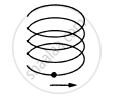
A particle is going in a spiral path as shown in figure with constant speed.
Suppose the bob of the previous problem has a speed of 1.4 m/s when the string makes an angle of 0.20 radian with the vertical. Find the tension at this instant. You can use cos θ ≈ 1 − θ2/2 and SINθ ≈ θ for small θ.
A person stands on a spring balance at the equator. By what fraction is the balance reading less than his true weight?
A turn of radius 20 m is banked for the vehicles going at a speed of 36 km/h. If the coefficient of static friction between the road and the tyre is 0.4, what are the possible speeds of a vehicle so that it neither slips down nor skids up?
Choose the correct option.
Select correct statement about the formula (expression) of moment of inertia (M.I.) in terms of mass M of the object and some of its distance parameter/s, such as R, L, etc.
In a certain unit, the radius of gyration of a uniform disc about its central and transverse axis is `sqrt2.5`. Its radius of gyration about a tangent in its plane (in the same unit) must be ______.
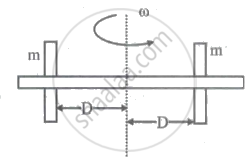
Two identical masses are connected to a horizontal thin (massless) rod as shown in the figure. When their distance from the pivot is D, a torque τ produces an angular acceleration of α1. The masses are now repositioned so that they are 2D from the pivot. The same torque produces an angular acceleration α2 which is given by ______
A rope is wound around a solid cylinder of mass 1 kg and radius 0.4 m. What is the angular acceleration of cylinder, if the rope is pulled with a force of 25 N? (Cylinder is rotating about its own axis.)
A particle performs uniform circular motion in a horizontal plane. The radius of the circle is 10 cm. If the centripetal force F is kept constant but the angular velocity is halved, the new radius of the path will be ______.
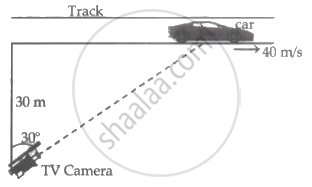
A racing car is travelling along a track at a constant speed of 40 m/s. A T.V. cameraman is recording the event from a distance of 30 m directly away from the track as shown in the figure. In order to keep the car under view in the position shown, the angular speed with which the camera should be rotated is ______.