Advertisements
Advertisements
प्रश्न
A dipole with its charges, −q and + q located at the points (0, −b, 0) and (0, +b, 0) is present in a uniform electric field E. The equipotential surfaces of this field are planes parallel to the yz plane.
- What is the direction of the electric field E?
- How much torque would the dipole experience in this field?
Advertisements
उत्तर
a. Given, the equipotentials of the external uniform electric field are planes parallel to the yz plane, the electric field `vec E = +- E hat i` that is, `vec E` is parallel to the x-axis.
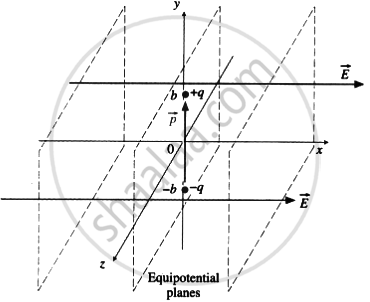
A dipole in an external electric field along x-axis
b. The above diagram, the dipole moment, `vec p = q (2 b) hat j`
The torque on this dipole,
`vec tau = vec p xx vec E = (2 qb hat j) xx (+- E hat i) = (2 qbE)(hat j xx hat i)`
Since `hat j xx hat i = - bar k`
`vec tau = (+- 2 qbE)(-hat k) = (2 qbE)(+- hat k)`
So that the magnitude of the torque is τ = 2qbE.
If `vec E` is in the direction of the + x-axis, the torque `vec tau` is in the direction of - z-axis, while if `vec E` s in the direction of the - x-axis, the torque `vec tau` is in the direction of + z-axis.
संबंधित प्रश्न
Answer in brief:
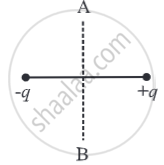
A charge q is moved from a point A above a dipole of dipole moment p to a point B below the dipole in an equatorial plane without acceleration. Find the work done in this process.
Three charges –q, +Q, and –q are placed at equal distances on a straight line. If the potential energy of the system of the three charges is zero, then what is the ratio of Q: q?
Derive an expression for the electric potential at a point due to a short electric dipole. Hence, write the expression for the electric potential at a point (i) dipole axis and (ii) on the dipole equator.
The work done in bringing a unit positive charge from infinity to a given point against the direction of electric field is known as ______.
Electric potential at a point ‘P’ due to a point charge of 5 × 10⁻⁹ C is 50 V. The distance of ‘P’ from the point charge is ______.
(Assume, `1/(4piε_0)` = 9 × 10+9 Nm2 C−2)
The electrostatic potential due to an electric dipole at a distance ‘r’ varies as ______.
The electric potential at a point in an electric field is defined as:
The electric potential at a distance \[r\] from a point charge \[q\] in air/vacuum is given by:
A point charge \[+q\] is at the origin \[O\], and a unit positive test charge is placed at a distance \[x\] from \[O\]. The electrostatic force on this test charge acts:
The total work done in bringing a unit positive test charge from infinity to a distance \[r\] from a point charge \[+q\] in vacuum is:
Regarding the distance dependence of quantities due to a point charge, which of the following is correct?
The equipotential surfaces around an isolated point charge are:
A charge of \[2 \times 10^{-9}\ \text{C}\] is brought from infinity to a point P where the potential is \[4 \times 10^4\ \text{V}\]. The work done in bringing this charge is:
A wire is bent into a circle of radius \[R = 10\ \text{cm}\] carrying a uniformly spread charge \[q = 250\ \mu\text{C}\]. The electric potential at the centre of the circle is:
The net potential due to several point charges at a point is found by simple algebraic addition of individual potentials because:
In the derivation of the potential in a medium of dielectric constant \[K\), the total work done in bringing a unit positive test charge from infinity to distance \[r\) is:
