Advertisements
Advertisements
प्रश्न
A device called oscillator is used to send waves along a stretched string. The string is 20 cm long, and four complete waves fit along its length when the oscillator vibrates 30 times per second. For the waves on the strings.
(a) what is their wavelength?
(b) what is their frequency
(c) what is their speed?
Advertisements
उत्तर
(a) Given that there are four complete waves. So,
Wavelength = `"Total length of string"/"Number of waves"`
Therefore ,
Wavelength = `20/4` cm
= 5 cm
= 0.05 m
(b) We have to calculate frequency. We know,
Frequency = (Vibration per second) × (Number of complete waves formed)
Therefore frequency,
Frequency = (30) × (4) Hz
= 120 Hz
(c) Now we have to calculate the velocity of the wave.
Given: Frequency f = 120 Hz
Wavelength λ = 0.05 m
We know the relation between velocity, frequency, and wavelength
ν = f × λ,
where ν is the velocity, f the frequency, and λ the wavelength.
Therefore,
ν = (120) × (0.05) m/s
= 6 m/s
Therefore, velocity of the wave is 6 m/s.
APPEARS IN
संबंधित प्रश्न
Explain how sound is produced by your school bell.
Name two sources of sound.
Can sound travel through (a) iron, and (b) water?
Name the device which is used to produce sound in laboratory experiments?
State whether the following statement is true or false :
Sound produced by a vibrating body travels to our ears by the actual movement of air.
What will be the change in the wavelength of a sound wave in air if its frequency is doubled?
Name four ways in which sound can be produced.
If a ringing bicycle bell is held tightly by hand, it stops producing sound. Why?
In the sound wave produced by a vibrating turning fork shown in the diagram, half the wavelength is represented by :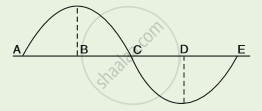
______ is produced when an object is set to vibrate.
