Advertisements
Advertisements
प्रश्न
A cycle followed by an engine (made of one mole of an ideal gas in a cylinder with a piston) is shown in figure. Find heat exchanged by the engine, with the surroundings for each section of the cycle. (Cv = (3/2)R)
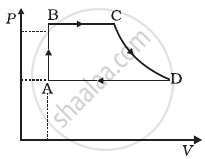
- AB : constant volume
- BC : constant pressure
- CD : adiabatic
- DA : constant pressure
Advertisements
उत्तर
a. By using the first law of thermodynamics, we can find the amount of heat associated with each process
For process AB
Volume is constant, hence work done dW = 0
According to first law of thermodynamics,
`ΔQ = ΔU + ΔW = ΔU + 0 = ΔU`
= `nCvΔT = nCv(T_B - T_A)`
= `3/2 R(T_B - T_A)` .....(∵ n = 1)
= `3/2 (RT_B - RT_A)`
= `3/2 (P_AV_B - P-AV_A)`
= `3/2 (P_B - P_A)V_A` .....[∵ VB = VA]
b. For process BC, P = constant
`ΔQ = ΔU + ΔW`
= `3/2 R(T_C - T_B) + P_B(V_C - V_B)`
= `3/2 (P_CV_C - P+BV_B) + P_B (V_C - V_B)`
= `5/2 P_B (V_C - V_B)`
Heat exchanged = `5/2 P_B (V_C - V_A)` .....(∵ PB = PC and PB = VA)
c. For process CD, QCD = 0 .....(As the change is adiabatic.)
d. In process DA involves compression of gas from VD to VA at constant pressure PA.
∴ Heat exchanged can be calculated in a similar way as process BC.
Hence, `ΔQ = 5/2 P_A(V_A - V_D)`.
