Advertisements
Advertisements
प्रश्न
A current of 1 ampere flows in a series circuit containing an electric lamp and a conductor of 5 Ω when connected to a 10 V battery. Calculate the resistance of the electric lamp.
Now if a resistance of 10 Ω is connected in parallel with this series combination, what change (if any) in current flowing through 5 Ω conductor and potential difference across the lamp will take place? Give reason.
Advertisements
उत्तर
Let the resistance of the electric lamp be Rlamp.
Current (I) = 1 A
Resistance of conductor (Rconductor) = 5Ω
Potential difference of battery (V) = 10 V
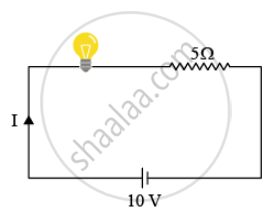
Since the lamp and the conductor is connected in series, thus same current 1 A will pass through both of them.
Using Ohm's law,
`"R"_"net" = "V"/"I"`
`"R"_"net" = 10/1`
`"R"_"net" = 10`Ω
`"R"_"net" = "R"_"lamp" + "R"_"conductor"`
⇒ 10 = Rlamp + 5
⇒ Rlamp = 5Ω
Potential difference across lamp,
Vlamp = I × Rlamp = 1 × 5 = 5V
When 10Ω resistor is connected parallel to the series combination of lamp and conductor (Rnet = 5 + 5 = 10Ω) then the equivalent resistance,
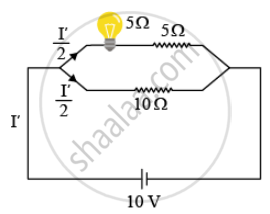
`1/("R"_"eq") = 1/10 + 1/10 = 2/10 =1/5`
⇒ Req = 5Ω
Using Ohm's law
`"I"^"'" = "V"/"R"_"eq"`
⇒ `"I"^"'" = 10/5`
⇒ `"I"^"'" = 2 "A"`
Current will distribute equally in two parallel parts.
Thus, `"I"^"'"/2 = 1"A"` current will pass through both the lamp and the resistor of 5Ω (because they are connected in series).
Potential difference across the lamp (Rlamp) = 5Ω
`"V"_"lamp"^"'" = 1 xx 5 = 5"V"`
Hence, there will be no change in current through the conductor of resistance 5Ω, and potential difference across the lamp.
