Advertisements
Advertisements
प्रश्न
A circular pond is surrounded by a 2 m wide circular path. If outer circumference of circular path is 44 m, find the inner circumference of the circular path. Also find area of the path.
Advertisements
उत्तर
Let R and r be the radius of outer circle and inner circle, respectively.
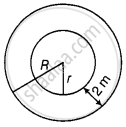
It is given that, circumference of outer circle is 44 m.
∴ 2πR = 44 ...[∵ Circumference of circle = 2πr]
⇒ `2 xx 22/7 xx R = 44`
⇒ `R = 44/(2 xx 22/7) = (7 xx 44)/(2 xx 22) = 7 m`
Since, r = (R – 2) m = (7 – 2) m = 5 m
∴ Inner circumference of the circular path = 2πr
= `2 xx 22/7 xx 5`
= 31.43 m (approx.)
∵ Area of path = Area of outer circle – Area of inner circle
= π(R2 – r2)
= `22/7 (7^2 - 5^2)`
= `22/7 xx 24`
= 75.43 m2 (approx.)
APPEARS IN
संबंधित प्रश्न
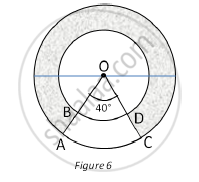
In Fig. 6, find the area of the shaded region, enclosed between two concentric circles of radii 7 cm and 14 cm where ∠AOC = 40°. (use `pi = 22/7`)
Choose the correct alternative answer for the following question.
A wire when bent in the form of an equilateral triangle encloses an area of `121sqrt(3)` cm2. The same wire is bent to form a circle. Find the area enclosed by the circle.
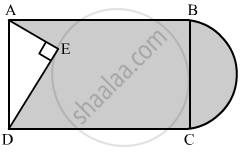
In the given figure, from a rectangular region ABCD with AB = 20 cm, a right triangle AED with AE = 9 cm and DE = 12 cm, is cut off. On the other end, taking BC as diameter, a semicircle is added on outside the region. Find the area of the shaded region. [Use π = 3.14.]
A canvas tent is in the shape of a cylinder surmounted by a conical roof. The common diameter of the cone and the cylinder is 14 m. The height of the cylindrical part is 8 m and the height of the conical roof is 4 m. Find the area of the canvas used to make the tent.
Find the circumference of the circle whose area is 81π cm 2.
The radius of two circles are 20 cm and 13 cm. Find the difference between their circumferences. (Take π =`22/7`)
Find the radius of the circle whose circumference is equal to the sum of the circumferences of the circles having radius 15 cm and 8 cm.
The circumference o a garden roller is 280cm. How many revolutions does it make in moving 490m?
A wire in the form of a circle of radius 42cm. It is bent into a square. Determine the side of the square and compare the area of the regions enclosed in the two cases.
