Advertisements
Advertisements
प्रश्न
A bulb is connected to a battery of e.m.f. 6V and internal resistance 2Ω A steady current of 0.5A flows through the bulb. Calculate the total energy supplied by the battery in 10 minutes.
Advertisements
उत्तर
Given: E = 6V, r = 2Ω, i = 0.5A, t = 10 minute = 10 × 60s = 600s.
The total energy supplied by the battery = Eit
= 6 × 0.5 × 600 = 1800 J
संबंधित प्रश्न
Which one has a higher electrical resistance : a 100 watt bulb or a 60 watt bulb?
Name the physical quality which is measured in
(i) Kw (ii) kWh
Water in an electric kettle connected to a 220 V supply took 5 minutes to reach its boiling point. How long would it have taken if the supply voltage had fallen to 200 V?
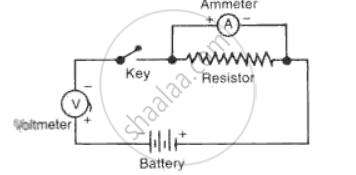
What is wrong with the circuit diagram (Fig. 34)? Carefully check the symbols and assign proper positive and negative signs to them.
‘The current rating of a fuse is 5A’. Comment on this statement.
Of the three connecting wires in a household circuit: Which two of the three wires are at the same potential? In which of the three wires should the switch be connected?
How does the heat produced by die passage of current in a metallic wire depend on the time of passage of current in the wire?
State other bigger units of electric power and express them in watt.
An Electric bulb is marked 100 W, 230 V. What how long would this lamp take to consume one unit of electricity?
Two bulbs are rated: bulb A 100W, 120 V bulb B 10 W, 120 V. If both are connected across a 120V supply, which bulb will consume more energy, When in parallel? Also calculate the current through each bulb in the above cases.
