Advertisements
Advertisements
प्रश्न
A block of mass M is kept on a rough horizontal surface. The coefficient of static friction between the block and the surface is μ. The block is to be pulled by applying a force to it. What minimum force is needed to slide the block? In which direction should this force act?
Advertisements
उत्तर
Let P be the force applied to slide the block at an angle θ.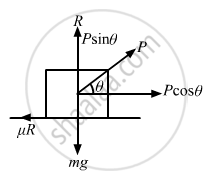
From the free body diagram,
R + P sin θ − mg = 0
⇒ R = −P sin θ + mg (1)
μR = P cos θ (2)
From Equation (1),
μ(mg − P sin θ)−P cos θ = 0
⇒ μmg = μP sin θ + P cos θ
`=> "p" = (mu "mg")/(musintheta+costheta)`
The applied force P should be minimum, when μ sin θ + cos θ is maximum.
Again, μ sin θ + cos θ is maximum when its derivative is zero:
`"d"/("d"theta)(mu sintheta+costheta)=0`
⇒ μ cos θ - sin θ = 0
θ = tan−1 μ
So, `"P"=(mu"mg")/(musintheta+costheta)`
Dividing numerator and denominator by cos θ, we get
`=(mu"mg"//costheta)/((musintheta)/costheta+costheta/costheta)`
`"P"=(mu "mg"sectheta)/(1+mu tantheta)`
`=(mu "mg"sectheta)/(1+tan^2theta)=(mu"mg")/(1+mu^2)`
(using the property 1 + tan2θ = sec2θ)
Therefore, the minimum force required is `(mu "mg")/sqrt(1+mu^2)` at an angle θ = tan−1 μ.
