Advertisements
Advertisements
प्रश्न
A baloon filled with helium rises against gravity increasing its potential energy. The speed of the baloon also increases as it rises. How do you reconcile this with the law of conservation of mechanical energy? You can neglect viscous drag of air and assume that density of air is constant.
Advertisements
उत्तर
Because the pulling viscous force of the air on the balloon is ignored, there is
Net Buoyant Force = `Vpg`
The volume of air displaced × net density upward × g
= `V(p_(ar) - p_(He)) g(upward)`
Let a be the upward acceleration on the balloon then
`ma = V(p_(ag) - p_(He)) g`
Where m = mass of the balloon
V = Volume of air displacement by balloon
= Volume of balloon
`p_(air)` = density of air
`p_(He)` = density of helium
`m (dv)/(dt) = V * (p_(ar) - p_(He)) g`
`mdv = V * (p_(air) - p_(He)) g * dt`
Integrating both sides `mv = V * (p_(ar) - p_(He)) g t`
`v = V/m (p_(air) - p_(He)) g t`
KE of balloon = `1/2 mv^2`
`1/2 mv^2 = 1/2 m v^2/m^2 (p_(air) - p_(He))^2g^2t^2`
= `V^2/(2m) (p_(air) - p_(He))^2g^2t^2` ......(ii)
If the balloon rises to a height h, from (i)
`a = V/m (p_(ai) - p_(he)) g`
`h = ut + 1/2 at^2 = 0.t + 1/2 [V/m (p_(ai) - p_(Bb))g]t^2`
∴ `h = V/(2m) (p_(ar) - p_(He)) g t^2`
Rearranging the words of (ii) according to h in (ii) and (iii) (iii)
`1/2 mv^2 = {V/(2m) (P_(air) - p_(He)) g t^2} * V(P_(air) - p_(He)) g`
`1/2 mv^2 = {h} * V (p_(air) - p_(He)) g`
`1/2 mv^2 = V * (p_(at) - p_(He)) gh`
`1/2 mv^2 = Vp_(air) gh - Vp_(He) = gh`
`1/2 mv^2 + p_(He)V gh = p_(av) V gh`
`KE_(balloon) + PE_(ballon)` = Change in PE of air.
As a result, as the balloon rises, an equivalent volume of air falls, increasing the balloon's PE and KE at the expense of the air's PE (which come down).
APPEARS IN
संबंधित प्रश्न
A body is initially at rest. It undergoes one-dimensional motion with constant acceleration. The power delivered to it at time t is proportional to ______.
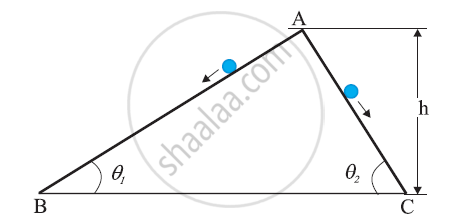
Two inclined frictionless tracks, one gradual and the other steep meet at A from where two stones are allowed to slide down from rest, one on each track . Will the stones reach the bottom at the same time? Will they reach there with the same speed? Explain. Given θ1 = 30°, θ2 = 60°, and h = 10 m, what are the speeds and times taken by the two stones?
A heavy stone is thrown from a cliff of height h with a speed v. The stoen will hit the ground with maximum speed if it is thrown
A heavy stone is thrown in from a cliff of height h in a given direction. The speed with which it hits the ground
(a) must depend on the speed of projection
(b) must be larger than the speed of projection
(c) must be independent of the speed of projection
(d) may be smaller than the speed of projection.
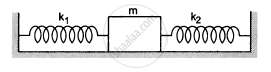
A block of mass m is attached to two unstretched springs of spring constants k1 and k2 as shown in the following figure. The block is displaced towards the right through a distance x and is released. Find the speed of the block as it passes through the mean position shown.
A small heavy block is attached to the lower end of a light rod of length l which can be rotated about its clamped upper end. What minimum horizontal velocity should the block be given so that it moves in a complete vertical circle?
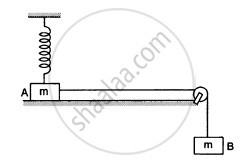
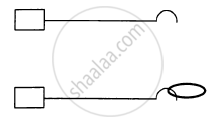
Figure following shows a light rod of length l rigidly attached to a small heavy block at one end and a hook at the other end. The system is released from rest with the rod in a horizontal position. There is a fixed smooth ring at a depth h below the initial position of the hook and the hook gets into the ring as it reaches there. What should be the minimum value of h so that the block moves in a complete circle about the ring?
A particle is released from height S from the surface of the Earth. At a certain height, its kinetic energy is three times its potential energy. The height from the surface of the earth and the speed of the particle at that instant are respectively ______.
A particle is released from height S from the surface of the Earth. At a certain height, its kinetic energy is three times its potential energy. The height from the surface of the earth and the speed of the particle at that instant are respectively ______
Two inclined frictionless tracks, one gradual and the other steep meet at A from where two stones are allowed to slide down from rest, one on each track as shown in figure.
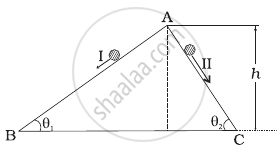
Which of the following statement is correct?
A mass of 5 kg is moving along a circular path of radius 1 m. If the mass moves with 300 revolutions per minute, its kinetic energy would be ______.
In a shotput event an athlete throws the shotput of mass 10 kg with an initial speed of 1 ms–1 at 45° from a height 1.5 m above ground. Assuming air resistance to be negligible and acceleration due to gravity to be 10 ms–2, the kinetic energy of the shotput when it just reaches the ground will be ______.
Why is electrical power required at all when the elevator is descending? Why should there be a limit on the number of passengers in this case?
A force shown in the F-x graph is applied to a 5 kg cart, which then coasts up a ramp as shown. The maximum height, ymax is ______ m, at which the cart can reach.
(g = 10 m/s2)


