Advertisements
Advertisements
प्रश्न
50 g of metal piece at 27°C requires 2400 J of heat energy so as to attain a temperature of 327°C . Calculate the specific heat capacity of the metal.
Advertisements
उत्तर
Given: Mass of metal, \(m=50\,\text{g}\)
Initial temperature, \(T_1=27^\circ\text{C}\)
Final temperature, \(T_2=327^\circ\text{C}\)
Heat energy supplied, \(Q=2400\,\text{J}\)
Using the formula,
\[ Q=mc\Delta T \]
\[ c=\frac{Q}{m(T_2-T_1)} \]
The rise in temperature.
\[ \Delta T=327-27=300^\circ\text{C} \]
The specific heat capacity.
\[ c=\frac{2400}{50\times300} \]
\[=\frac{2400}{15000} \]
\[{=0.16\,\text{J g}^{-1}\,^\circ\text{C}^{-1}} \]
संबंधित प्रश्न
A refrigerator converts 100 g of water at 20°C to ice at −10°C in 35 minutes. Calculate the average rate of heat extraction in terms of watts.
Given: Specific heat capacity of ice = 2.1 J g−1°C−1
Specific heat capacity of water = 4.2 J g−1°C−1
Specific latent heat of fusion of ice = 336 J g−1
Describe a method to determine the specific heat capacity of a solid, like a piece of copper ?
State, with reason, which of the two, boiling water or steam both at 100°C will produce more severe burns.
A piece of iron of mass 2.0 kg has a heat capacity of 966 J K-1. Find its specific heat capacity in S.I unit.
Some heat is provided to a body to raise its temperature by 25°C. What will be the corresponding rise in temperature of the body as shown on the Kelvin scale?
The cold object the hot object enclosed in one box of heat-resistant material.
- What changes will occur in the two objects when temperature flows from those objects?
- Which principle can show that the energy exchange takes place between two objects only when kept in isolated system?
Consider the statement given below and choose the correct option.
Assertion: Radiation is a form of heat transfer which takes place only in vacuum.
Reason: The thermal energy is transferred from one part of a substance to another part without the actual movement of the atoms or molecules.
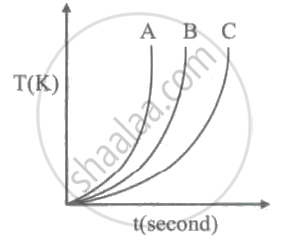
Which of the following substances (A, B and C) has the highest specific beat?
Thermal capacities of substances A and B are same. If mass of A is more than mass of B then:
Which substance will have more specific heat capacity?
