4 × 10²⁰ electrons flow through a circuit in 10 hours. Calculate magnitude of current. [1 e- = 1.6 × 10⁻¹⁹ C]
Advertisements
प्रश्न
4 × 10²⁰ electrons flow through a circuit in 10 hours. Calculate magnitude of current. [1 e- = 1.6 × 10⁻¹⁹ C]
Advertisements
उत्तर
Number of electrons = n = 4 × 10²⁰
Time = t = 10 hours
t = 10 × 60 × 60 s
t = 36000 s
Charge on one electron = e = 1.6 × 10⁻¹⁹ C
Electric current = I = ?
Charge = Q = ne
Q = 4 × 1020 × 1.6 × 10-19
Q = 6.4 × 101
Q = 64 C
Electric current = I = `"Q"/"t"`
I = `64/36000 = 64/36 xx 10^-3"A"`
`= 16/9 xx 10^-3`
I = 1.77 × 10⁻³A
I = 1.77 mA
APPEARS IN
संबंधित प्रश्न
The unit of potential difference is :
What do you understand by the term parallel circuit?
State the kind of charge on a negative ion.
The following figure shows a metal rod PQ mounted on an insulated stand. The cap of an uncharged electroscope touches one end Q of the metal rod. A negatively charged ebonite rod is brought near the other end P of the metal rod.
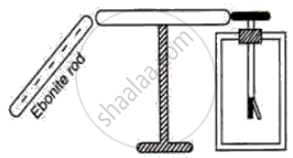
(a) What charge does the end P have?
(b) What charge does the end Q have?
(c) What charge does the cap of the electroscope have?
(d) What charge does the gold leaf have?
(e) Will the leaf diverge or collapse? Give reason.
(f) If the electroscope is now earthed, what charge does the metal rod have?
