Topics
Operating System
- Basics of Operating System (OS)
- Basics of Operating System (OS)
- Windows NT
- Introduction to GNU/Linux (GNU Not Unix)
- File Systems and Its Types
- File Operations
- Access Methods in Operating System
- Allocation Methods
- Concepts Related to Process Management
- Concepts Related to Memory Management
- Ubuntu is One of the Most Popular GNU/Linux Distributions
- Access and Security Aspects of O.S.
Data Structures
C++ Programming
- Introduction to C++ Programming
- Idea Behind Object-Oriented Programming
- Object-Oriented Programming Approach
- Object-Oriented Terms and Concepts
- Classes and Objects
- Constructors and Destructors
- Functions in C + +
- Arrays in Data Structure
- Pointers in C++
- References in C++
- Strings in C++
- Inheritance
- Virtual Functions and Polymorphism
- Friends in C++
- Operator Overloading and Type Conversions
- Files and Stream
HyperTex Markup Language (HTML)
- Introduction to HyperText Markup Language (HTML)
- HTML Documentation
- Basics of HTML Tags
- Font Tags in HTML
- Lists in HTML
- Tables in HTML
- Images in HTML
- Links in HTML
- HTML Scripts
- Introduction to Records
- Representation of Records in Memory
Maharashtra State Board: Class 12
Records
Records is a collection of fields. A record may contain non-homogeneous data i.e. data items in a record may have different data types. In records, the natural ordering of elements is not possible. The elements in records can be described by level numbers. For ex:
- Newborn
- Name
- Birthday.
- Month
- Day
- Year
Representation of records in memory
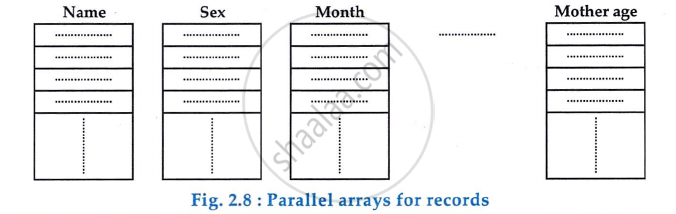
Records contain non-homogeneous data. To store records in memory we may use linear arrays. As data in a record are of non-homogenous type while data stored in array is of homogenous type, we use parallel arrays, each storing a different field.