Advertisements
Chapters
1: Introduction
UNIT 5: Consumer's Equilibrium and Demand
▶ 2: Consumer's Equilibrium
Chapter 3: Demand
Chapter 4: Elasticity of Demand
UNIT 6: Producer Behaviour and Supply
Chapter 5: Production Function
Chapter 6: Cost
Chapter 7: Revenue
Chapter 8: Producer's Equilibrium
Chapter 9: Supply
UNIT 7: Forms of Market and Price Determination Under Perfect Competition With Simple Applications
Chapter 10: Main Market Forms
Chapter 11: Price Determination and Simple Applications
Advertisements
Solutions for Chapter 2: Consumer's Equilibrium
Below listed, you can find solutions for Chapter 2 of CBSE Sandeep Garg for इंट्रोडक्टरी मायक्रोइकॉनॉमिक्स [इंग्रजी] इयत्ता ११.
Sandeep Garg solutions for इंट्रोडक्टरी मायक्रोइकॉनॉमिक्स [इंग्रजी] इयत्ता ११ 2 Consumer's Equilibrium OBJECTIVE QUESTIONS [Pages 2.42 - 2.56]
Fill in the Blanks.
At the point of satiety, marginal utility is __________.
The utility derived from the first unit of a commodity is known as __________.
As long as MU is positive, TU __________ with an increase in consumption of a commodity.
__________ means that a rational consumer always prefers more of a commodity as it offers him a higher level of satisfaction.
As Price Ratio is constant throughout, the __________ is a straight line.
MUx of X is 50 and MUy of Y is 40. If the price of Y is ₹ 8, then price of X at equilibrium will be __________.
Any consumption beyond the point of satiety leads to __________.
Total utility is __________ when marginal utility is zero.
Indifference curves are convex to the origin because of __________ marginal rate of substitution.
If consumption of an additional unit of a commodity causes no change in TU, then the resultant MU is __________.
The consumer will be in equilibrium where there is tangency between price line and indifference curve because at this point __________ is equal to Price Ratio.
Indifference Map refers to __________ of indifference curves.
Higher indifference curve represents larger bundle of goods, i.e. more utility because of __________.
In case of single commodity, consumer is in equilibrium when marginal utility from a commodity equals __________ of the commodity.
The consumer is in equilibrium at a point where the budget line is __________ to an indifference curve.
Total Utility is __________ at the point of satiety.
Slope of an Indifference Curve is measured by __________.
The total utility derived by Kartik by eating 12 oranges is 400 utils. Marginal Utility of the 13th orange is 20 utils. The total utility for 13 oranges will be __________ utils.
According to Indifference Curve Approach, utility can be measured in terms of __________.
State whether true or false:
Utility is directly linked with the usefulness of a commodity.
State whether true or false:
Any consumption beyond the point of satiety leads to disutility.
State whether true or false:
Different points on an indifference curve represent different satisfaction levels.
State whether true or false:
An indifference curve is convex to the origin because of the law of equi-marginal utility.
State whether true or false:
Marginal rate of substitution indicates the slope of budget line.
State whether true or false:
When we add up utility derived from each successive unit, we get total utility.
State whether true or false:
All points below the budget line show the various possible bundles which cost exactly equal to consumer’s money income.
State whether true or false:
Marginal rate of substitution remains same along the indifference curve.
State whether true or false:
The bundles of budget set lie either on or below the budget line.
State whether true or false:
Two indifference curves intersect each other when they represent same level of satisfaction.
State whether true or false:
The law of diminishing marginal utility states that a rise in price of a product results in decline in its marginal utility.
State whether true or false:
Total utility is minimum when marginal utility is zero.
State whether true or false:
The slope of indifference curve is different at different points of the curve.
State whether true or false:
Only one indifference curve will pass through a given point on an indifference map.
State whether true or false:
When the marginal utility starts falling, total utility also start decreasing.
State whether true or false:
A consumer buys a combination of two goods: X and Y with marginal utilities equal to 30 utils and 35 utils respectively. Price of X is ₹ 6 per unit. The consumer will be in equilibrium only when price of Y is ₹ 7 per unit.
State whether true or false:
If `(MU_x)/P_x > (MU_y)/P_y`, then the consumer should buy more of commodity Y and less of commodity X to reach the equilibrium position.
State whether true or false:
Marginal utility can never be negative.
State whether true or false:
A budget set is the collection of all bundles of goods that a consumer wants to buy.
State whether true or false:
A budget set is a collection of such bundles of goods that give same satisfaction.
State whether true or false:
In case of two commodities, MU of a commodity must fall to attain consumer’s equilibrium.
State whether true or false:
A consumer in consumption of single commodity equates price of the commodity with total utility.
State whether true or false:
When `P_x \cancel= P_y`, then consumer is at equilibrium when MUx = MUy.
Matching Type Questions.
From the set of statements given in Column I and Column II, choose the correct pair of statements:
Column I Column II (a) Point of satiety (i) TU = 0 Column I Column II (b) Slope of Indifference Curve (ii) Marginal Rate of Substitution Column I Column II (c) MUn (iii) TUn − TUn + 1 Column I Column II (d) Cardinal Utility Approach (iv) Hicksian Analysis
Match the statements given under A with the correct options given under B.
| (A) | (B) |
|---|---|
| (i) Law of Equi-marginal utility | a. Gossen's first law of consumption |
| b. Gossen's Second Law |
Match the statements given under A with the correct options given under B.
| (A) | (B) |
|---|---|
| (i) Slope of budget line | a. Marginal Rate of Substitution |
| (ii) Slope of Indifference Curve | b. Price Ratio |
Match the statements given under A with the correct options given under B.
| (A) | (B) |
|---|---|
| (i) Initial Utility | a. A rational consumer always prefers more of a commodity as it offers him a higher level of satisfaction |
| (ii) Indifference Curve Analysis | b. Additional utility derived from consumption of one more unit of given commodity |
| (iii) Slope of budget line | c. Hicksian Analysis |
| (iv) Marginal Utility | d. Utility derived from first unit of a commodity |
| (v) Monotonic Preferences | e. Price Ratio |
Match the statements given under A with the correct options given under B.
| (A) | (B) |
|---|---|
| (i) Law of diminishing marginal utility | a. Slope of indifference curve |
| (ii) MU | b. Fundamental Psychological Law |
| (iii) Marginal Rate of Substitution | c. Point of satiety |
| (iv) Indifference Map | d. `(ΔTU)/(ΔQ)` |
| (v) Zero Marginal Utility | e. Family of indifference curves |
Match the statements given under A with the correct options given under B.
| (A) | (B) |
|---|---|
| (i) `(MU_x)/P_x > (MU_y)/P_y` | a. Consumer should buy more of both commodities X and Y |
| (ii) `(MU_x)/P_x < (MU_y)/P_y` | b. Consumer should buy less of both commodities X and Y |
| c. Consumer should buy more of commodity X | |
| d. Consumer should buy more of commodity Y |
Match the statements given under A with the correct options given under B.
| (A) | (B) |
|---|---|
| (i) Budget Line is a straight line because | a. Price Ratio or MRE decreases |
| b. Price Ratio or MRE is constant | |
| c. Price Ratio or MRE increases |
Match the statements given under A with the correct options given under B.
| (A) | (B) |
|---|---|
| (i) Equation of Budget Line | a. PxQx − PyQy = M |
| b. PxQx + PyQy ≤ M | |
| c. PxQx + PyQy = M |
Multiple Choice Questions (MCQs)
Which of these is not a property of indifference curve?
Indifference curve slopes downwards
Indifference curve is concave to the origin
Two indifference curves cannot intersect each other
Higher indifference curve represents higher level of satisfaction
Indifference curves are convex to the origin because of ______.
Increasing MRS
Diminishing MRS
Law of Diminishing Marginal Utility
Law of Equi-Marginal Utility
The necessary condition under utility approach to attain consumer’s equilibrium in case of 2 commodities is ______.
`(MU_X)/P_X = (MU_Y)/P_Y`
`MRS_X = P_X/P_Y`
MUX = PX
None of these
When we add up utility derived from consumption of all the units of the commodities, we get ______.
Total Utility
Initial utility
Marginal Utility
None of these
Marginal Utility (MU) in terms of money is equal to ______.
`"Marginal Utility in utils"/"Marginal Utility of one rupee"`
`"Marginal Utility of one rupee"/"Marginal Utility in utils"`
`"Marginal Utility in utils"/"Price of the Commodity"`
None of these
According to the Law of diminishing marginal utility, satisfaction obtained from consumption of each successive unit ______.
Increases
Decreases
Remains same
Either increases or decreases
Indifference Map refers to ______.
Highest Indifference curve
Lowest Indifference curve
Family of indifference curves
None of these
Budget set includes ______.
All those combinations of two goods which a consumer already possesses
All those combinations of two goods which a consumer cannot afford
All those combinations of two goods which a consumer is willing to buy
All those combinations of two goods which a consumer can afford
Indifference curves are ______.
Concave to the origin
Convex to the origin
Upward sloping straight line passing from the origin
None of these
Which of these is a condition for consumer’s equilibrium by indifference curve analysis?
MUX = PX
`(MU_X)/P_X = (MU_Y)/P_Y`
`MRS_X = P_X/P_Y`
MUX = MUY
If `(MU_X)/P_X> (MU_Y)/P_Y`, then to reach the equilibrium position, consumer should ______.
Stop buying any commodity
Buy both the commodities in equal quantity
Buy more of X and less of Y
Buy more of (Y) and less of (X)
If the consumption of an additional unit of a commodity causes no change in TU, then the resultant MU is ______.
Zero
Positive
Negative
Constant
An indifference curve is best described as a series of points which show ______.
Combinations of two commodities which give the consumer same satisfaction
Combinations of two goods, such that cost of each combination is equal to money income of the consumer
Combinations of the two goods which a consumer can afford, given his income & prices in the market
None of these
Total Utility is ______ at the point of satiety.
Minimum
Maximum
Zero
None of these
Marginal Utility (MU) of nth unit is calculated as ______.
`(M U_{n}=T U_{n}-T U_{n+1})`
`(M U_{n}=T U_{n}+T U_{n+1})`
`(M U_{n}=T U_{n}+T U_{n-1})`
`(M U_{n}=T U_{n}-T U_{n-1})`
In case of single commodity, consumer’s equilibrium is achieved when ______.
MUx > Px
MUx < Px
MUx ≠ Px
MUx = Рx
______ measures the slope of indifference curve.
Budget Line
Marginal Rate of Substitution
Marginal Rate of Transformation
None of these
In the following diagram of budget line, point “D” represents:
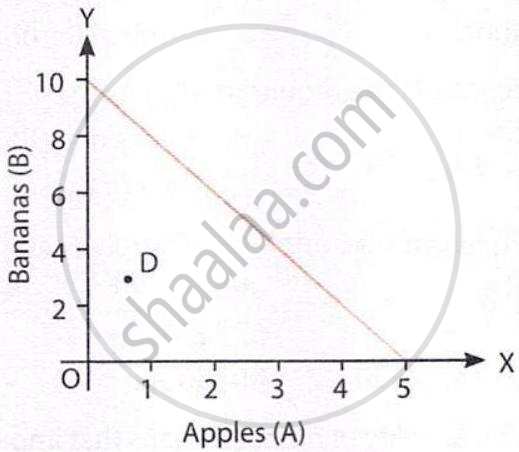
Bundle which cost equal to money income of consumer
Bundle which cost less than money income of consumer
Bundle which cost greater than money income of consumer
None of these
How is TU derived from MU?
TU = ΣΜU
TU = U1 + U2 + U3 ---------- + UN
Both (a) and (b)
None of these
What happens to MU when TU is maximum?
MU is negative
MU is Zero
MU is decreasing
MU is increasing
An indifference curve always ______.
Slopes downwards from left to right
Slopes upwards from left to right
Is parallel to the Y-axis
Is parallel to the X-axis
In case of cardinal utility approach, utility is measured in ______.
Rupees
Ranks
Utils
None of these
The consumer will be in equilibrium where there is tangency between price line and indifference curve because at this point ______.
MRS < Price Ratio
MRS > Price Ratio
MRS = Price Ratio
None of these
“Cardinality” means utility can be ______.
Measured
Ranked
Not measured
None of these
The slope of price line (in case of commodities X and Y) is given by ______.
Taste and preferences of consumer
Prices of both the commodities
Price of commodity X alone
Price of commodity Y alone
Which Law states that: “When a consumer consumes more and more units of a product, the utility derived from each additional unit decreases”?
Law of Equi-Marginal Utility
Law of Ordinal Utility
Law of Cardinal Utility
Law of Diminishing Marginal Utility
In the context of Indifference Curve Analysis, MRS stands for ______.
Marginal Rate of Substitution
Marginal Rate of Satisfaction
Marginal Return of Substitution
Marginal Return of Satisfaction
For consumer’s equilibrium to be stable, the requirement is ______.
Constant MRS
Increasing MRS
Diminishing MRS
None of these
The total utility derived by Shyam by eating 6 apples is 300 utils. Marginal Utility of the 7th apple is 30 utils. The total utility for 7 apples will be ______ utils.
330
270
300
30
The assumption of “Constant marginal utility of money” means that importance of money to consumer is ______.
Increasing
Decreasing
Same
None of these
When Economists speak of the utility of a certain product, they are referring to ______.
Demand for the product
Usefulness of the product in consumption
Satisfaction gained from consuming such product
Rate at which consumers are willing to exchange one good for another
Utility ______.
Differs from person to person
Differs from time to time
Differs from product to product
All of these
A consumer in consumption of two commodities A and B is at equilibrium. The prices of A and B are ₹ 10 & ₹ 20 respectively & the marginal utility of product B is 50. What will be the marginal utility of product A?
100
25
250
4
The Law of Diminishing Marginal Utility will not hold good if income of the consumer:
Increases
Decreases
Remains constant
Either (a) or (b)
As per Ordinal Approach ______.
Measurement of Utility is not possible through money
Measurement of Utility is possible but it can not be ranked
Measurement of Utility is not possible in cardinal numbers but it can be ranked
None of these
Marginal Utility ______.
Is always positive
Is always negative
Can be positive or negative but not zero
Can be positive or negative or zero
Mollie derives total utility of 10 utils after having 4 mangoes and total utility on consuming 5 mangoes is 9. What is her marginal utility for the 5th mango?
+1 util
0 util
−1 util
9 utils
After reaching the point of satiety, consumption of additional units of the commodity cause ______.
TU falls and MU increases
Both TU and MU increase
TU falls and MU falls and becomes negative
TU becomes negative and MU falls
According to one of the assumption of Law of Diminishing Marginal Utility, there should be ______ between the consumption of one unit and another unit.
Equal time gap
No time gap
Long time gap
Any of these
Budget line shows ______.
Possible combination of two goods that a consumer can buy by spending his entire income at the given prices
Possible combination of two goods which cost less than or equal to consumer’s money income
Possible combination of two goods among which the consumer is indifferent
All the these
MUX of X is 40 and MUY, of Y is 30. It the price of Y is ₹ 9, then price of X at equilibrium will be ______.
₹ 9
₹ 30
₹ 15
₹ 12
The farther the Indifference Curve is from the origin, then ______.
Higher is the satisfaction level
Lower is the satisfaction level
Same satisfaction level will be obtained
Nothing can be said about satisfaction
The consumer is in equilibrium when Marginal Utility from a Commodity equals ______.
Demand for that Commodity
Supply of that Commodity
Price of the Commodity
All of these
An Indifference Curve represents all those combinations of two goods which give ______.
No satisfaction to the Consumer
Lower satisfaction to the Consumer
Higher satisfaction to the Consumer
Equal satisfaction to the Consumer
The consumer is in equilibrium at a point where the budget line ______.
Is above an indifference curve
Is below an indifference curve
Is tangent to an indifference curve
Cuts an indifference curve
Which of the shaded area in the diagrams below represent total utility?
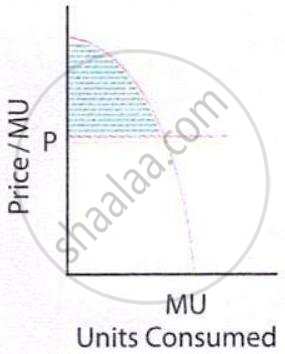
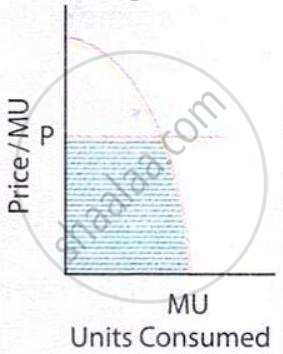
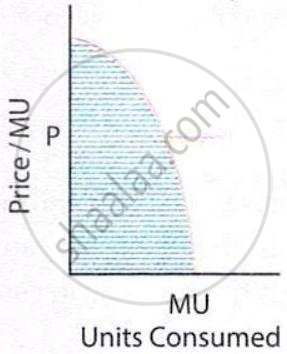
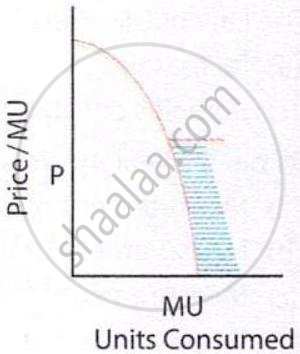
If Marginal Rate of Substitution is constant throughout, the Indifference curve will be ______.
(choose the correct alternative)
Parallel to the (x)-axis
Downward sloping concave
Downward sloping convex
Downward sloping straight line
If Marginal Rate of Substitution is increasing throughout, the Indifference Curve will be ______.
(Choose the correct alternative)
Downward sloping convex
Downward sloping concave
Downward sloping straight line
Upward sloping convex
A consumer consumes only two goods. If price of one of the goods falls, the indifference curve ______.
(Choose the correct alternative)
Shifts upwards
Shifts downwards
Can shift both upwards or downwards
Does not shift
A consumer consumes only two goods X and Y both priced at ₹ 4 per unit. If the consumer chooses a combination of these two goods with Marginal Rate of Substitution equal to 4, then the consumer will ______.
Buy more units of X
Buy more units of Y
Buy more units of both, X and Y
Buy less units of both, X and Y
A consumer consumes only two goods X and Y whose prices are ₹ 3 and ₹ 4 per unit respectively. If the consumer chooses a combination of the two goods with marginal utility of X equal to 4 and that of Y equal to 3, is the consumer in equilibrium, then the consumer will ______.
Buy more units of both, (X) and (Y)
Buy more units of (Y) and less of (X)
Buy more units of (X) and less of (Y)
Buy less units of both, (X) and (Y)
In the given diagram, the situation of Consumer’s Equilibrium and Point of Satiety are represented by the points:
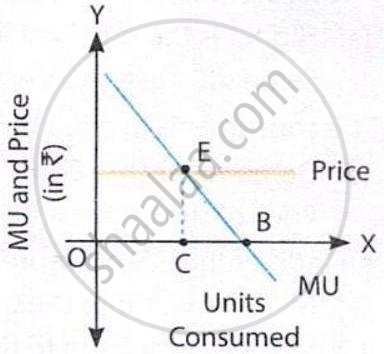
Point C and Point E
Point E and Point B
Point B and Point E
Point B and Point C
Which Indifference Curve represents the highest level of satisfaction?
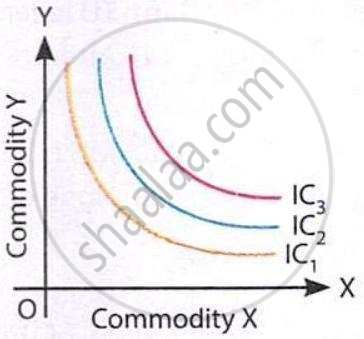
IC1
IC2
IC3
None of these
An increase in income will lead to the following change in Budget Line:
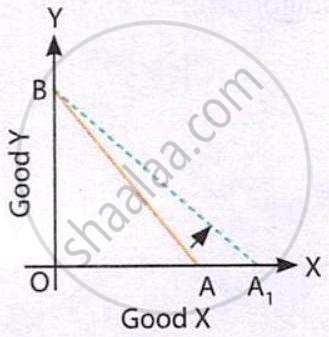
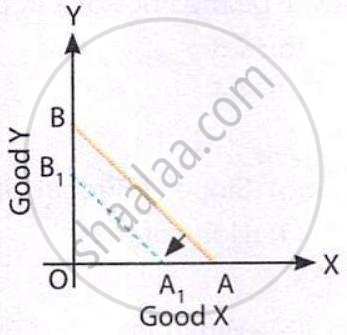
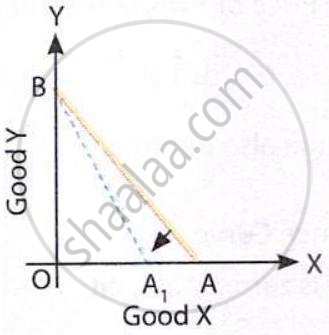
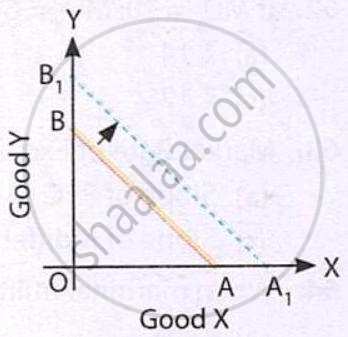
The rotation of budget line in the following diagram is due to:
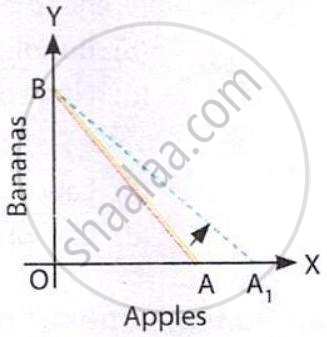
Decrease in price of Apples
Increase in price of Apples
Increase in price of Bananas
Decrease in price of Bananas
Marginal utility is ______.
The utility from first unit of a commodity consumed
The utility from the last unit consumed
Total utility divided by number of units consumed
Always positive
Total utility is ______.
The sum of marginal utilities
Utility from first unit × Number of units consumed
Always increasing
Utility from last unit × Number of units consumed
Which of the following statement is not true?
As long as MU is positive, TU increases
TU is zero when MU is zero
TU starts decreasing when MU is negative
After the point of satiety, MU becomes negative
At the Point of Satiety ______.
MU is Negative
MU is Zero
MU is Rising
None of these
Which of the following is a characteristic of utility?
Utility is Subjective
Utility is a relative concept
Utility is a Psychological phenomenon
All of these
Slope of an Indifference Curve is measured by ______.
Marginal Rate of Substitution
Marginal Rate of Transformation
Marginal Opportunity Cost
None of these
If MUY = 20; MUX = 60; Price of Y = ₹ 4, then what will be the Price of X at Equilibrium ______.
₹ 14
₹ 3
₹ 12
₹ 4
Market Rate of Exchange also denotes ______.
Slope of PPC
Slope of Budget Line
Slope of Indifference Curve
None of these
When marginal utility is zero, total utility is ______.
Zero
Minimum
Maximum
Negative
Suppose, Mayank consumes Burger and Garlic Bread. Which of the following bundle of Burger and Garlic Bread will Mayank choose if he has monotonic preference?
Bundle A (5,7)
Bundle B (4,7)
Bundle C (5,6)
None of these
Which is the First Law of Gossen?
Law of Equi-marginal Utility
Law of Diminishing Marginal Utility
Law of Supply
Law of Demand
Assertion Reason Questions (ARQs)
In the following Question, read the following statement: Assertion (A) and Reason (R). Choose the correct alternative among those given below:
Assertion (A): An Indifference curve is always convex to the origin.
Reason (R): MRS is always diminishing because of the law of diminishing marginal utility.
Both Assertion (A) and Reason (R) are True and Reason (R) is the correct explanation of Assertion (A).
Both Assertion (A) and Reason (R) are True and Reason (R) is not the correct explanation of Assertion (A).
Assertion (A) is True but Reason (R) is False.
Assertion (A) is False but Reason (R) is True.
In the following Question, read the following statement: Assertion (A) and Reason (R). Choose the correct alternative among those given below:
Assertion (A): Slope of Budget Line is represented by Price Ratio.
Reason (R): Budget line slopes downwards as more of one good can be bought by decreasing some units of the other good.
Both Assertion (A) and Reason (R) are True and Reason (R) is the correct explanation of Assertion (A).
Both Assertion (A) and Reason (R) are True and Reason (R) is not the correct explanation of Assertion (A).
Assertion (A) is True but Reason (R) is False.
Assertion (A) is False but Reason (R) is True.
In the following Question, read the following statement: Assertion (A) and Reason (R). Choose the correct alternative among those given below:
Assertion (A): Budget Line is a narrower concept as compared to Budget Set.
Reason (R): The bundles of budget set lie only on the budget line.
Both Assertion (A) and Reason (R) are True and Reason (R) is the correct explanation of Assertion (A).
Both Assertion (A) and Reason (R) are True and Reason (R) is not the correct explanation of Assertion (A).
Assertion (A) is True but Reason (R) is False.
Assertion (A) is False but Reason (R) is True.
In the following Question, read the following statement: Assertion (A) and Reason (R). Choose the correct alternative among those given below:
Assertion (A): Only one Indifference Curve passes through a particular point on an indifference map.
Reason (R): Indifference Curves can never intersect each other.
Both Assertion (A) and Reason (R) are True and Reason (R) is the correct explanation of Assertion (A).
Both Assertion (A) and Reason (R) are True and Reason (R) is not the correct explanation of Assertion (A).
Assertion (A) is True but Reason (R) is False.
Assertion (A) is False but Reason (R) is True.
In the following Question, read the following statement: Assertion (A) and Reason (R). Choose the correct alternative among those given below:
Assertion (A): Marginal Utility can never be negative.
Reason (R): Total Utility is maximum when Marginal Utility is zero.
Both Assertion (A) and Reason (R) are True and Reason (R) is the correct explanation of Assertion (A).
Both Assertion (A) and Reason (R) are True and Reason (R) is not the correct explanation of Assertion (A).
Assertion (A) is True but Reason (R) is False.
Assertion (A) is False but Reason (R) is True.
Statement Based Questions (SBQs)
In the following Question, read the following statement and choose the correct alternative among those given below:
Statement 1: According to Ordinal Utility Approach, utility can be numerically estimated, which a person derives from consumption of goods and services.
Statement 2: Utility is subjective and it varies from person to person.
Both the Statements are true.
Both the Statements are false.
Statement 1 is true and Statement 2 is false.
Statement 2 is true and Statement 1 is false.
In the following Question, read the following statement and choose the correct alternative among those given below:
Statement 1: Law of Diminishing Marginal Utility (Law of DMU) has universal applicability and applies to all goods and services.
Statement 2: Law of DMU is also known as 'Gossen’s First Law of Consumption.
Both the Statements are true.
Both the Statements are false.
Statement 1 is true and Statement 2 is false.
Statement 2 is true and Statement 1 is false.
In the following Question, read the following statement and choose the correct alternative among those given below:
Statement 1: When consumption is increased beyond the point of satiety, total utility starts rising.
Statement 2: MU is maximum at the point of satiety.
Both the Statements are true.
Both the Statements are false.
Statement 1 is true and Statement 2 is false.
Statement 2 is true and Statement 1 is false.
In the following Question, read the following statement and choose the correct alternative among those given below:
Statement 1: An indifference curve is concave to the origin because of increasing MRS.
Statement 2: Every point on indifference curve represents an equal amount of satisfaction to the consumer.
Both the Statements are true.
Both the Statements are false.
Statement 1 is true and Statement 2 is false.
Statement 2 is true and Statement 1 is false.
In the following Question, read the following statement and choose the correct alternative among those given below:
Statement 1: Higher indifference curve represents larger bundle of goods, which means more utility because of monotonic preference.
Statement 2: Indifference curve analysis assumes diminishing marginal rate of substitution.
Both the Statements are true.
Both the Statements are false.
Statement 1 is true and Statement 2 is false.
Statement 2 is true and Statement 1 is false.
In the following Question, read the following statement and choose the correct alternative among those given below:
Statement 1: Bundles which cost more than consumer’s money income lie outside the budget line.
Statement 2: Budget Line remains the same even with change in income.
Both the Statements are true.
Both the Statements are false.
Statement 1 is true and Statement 2 is false.
Statement 2 is true and Statement 1 is false.
Very Short Answer Type Questions (VSAQs)
Define Utility.
Define the following concept:
Total utility
How much is total utility at zero level of consumption?
How is total utility derived from marginal utility?
Define marginal utility.
If one burger gives you satisfaction of 15 utils and 2 burgers generate total satisfaction of 25 utils, then calculate the marginal utility of second burger.
What happens to marginal utility, when the total utility is maximum?
Why does TU increase at a diminishing rate due to continuous increase in consumption?
What is law of diminishing marginal utility?
What is meant by consumer’s equilibrium?
What is the general condition of consumer’s equilibrium with respect to any particular product?
What is meant by MU of one rupee?
State the conditions of consumer’s equilibrium in case of two commodities.
Define an indifference curve.
Define Marginal rate of substitution.
Is consumer willing to move away from consumer’s equilibrium point?
Define indifference map.
At which point, slope of indifference curve is equal to slope of budget line?
Why does Total Utility (TU) increases at diminishing rate due to continuous increase in consumption?
Why are indifference curves always convex to the origin?
Why does an indifference curve slope downwards?
State the conditions of consumer’s equilibrium in case of indifference curve approach?
Explain why the budget line is downward sloping.
What is the impact of diminishing marginal rate of substitution on the slope of indifference curve?
What does an indifference curve show?
Why is the study of consumer’s equilibrium a subject matter of microeconomics?
Why budget line is a straight line? Explain.
What is meant by monotonic preferences?
Give the equation of Budget Line.
Give equation of Budget Set.
What is 'ordinal' utility?
Higher indifference curve represents higher level of satisfaction to the consumer. State the underlying assumption related to this property of indifference curve.
When is a consumer said to be rational?
At which rate TU increases when MU is decreasing?
What is any combination of the amount of two goods consumed by a consumer called?
What is the slope of an Indifference curve?
What are the main determinants of budget line?
Sandeep Garg solutions for इंट्रोडक्टरी मायक्रोइकॉनॉमिक्स [इंग्रजी] इयत्ता ११ 2 Consumer's Equilibrium REVISION EXERCISE [Pages 2.56 - 2.58]
Short Answer Type Questions
Define the following concept:
Total utility
Define Initial Utility.
Define marginal utility.
Explain the law of diminishing marginal utility.
Explain the various points of relationship between marginal utility and total utility with the help of schedule and diagram.
How does a consumer reach equilibrium position when he is buying only one commodity? Explain with the help of utility schedule.
A consumer consumes only two goods X and Y. State and explain the conditions of consumer’s equilibrium with the help of utility analysis.
Define an indifference curve.
Define indifference map.
Define Marginal rate of substitution.
Explain the law of diminishing marginal utility with the help of a utility schedule.
Discuss the meaning of budget line, with a hypothetical schedule and diagram.
Explain the relation between total utility and marginal utility.
Define an indifference curve.
Explain why an indifference curve is downward sloping from left to right.
What do you mean by monotonic preferences?
Define an indifference map. Why does indifference curve to the right show more utility? Explain.
Define indifference map.
Define an indifference map. Why does indifference curve to the right show more utility? Explain.
A consumer consumes only two goods X and Y and is in equilibrium. Show that when the price of good X rises, the consumer buys less of good X. Use utility analysis.
Explain the distinction between budget set and budget line.
Define Marginal rate of substitution.
Explain why is an indifference curve is Convex.
What is the difference between cardinal and ordinal measurement of utility?
What is a budget line?
Explain why the budget line is downward sloping.
Explain the meaning of diminishing marginal rate of substitution with the help of an example.
Explain the concept of marginal utility with the help of an example.
Explain why the indifference curve is convex to the origin.
A consumer consumers only two goods A and B and is in equilibrium. Show that when price of good B falls, demand for B rises. Answer this question with the help of utility analysis.
A consumer consumes two goods X and Y. What will happen if `(MU_X)/P_X` is greater than `(MU_Y)/P_Y`?
A Consumer consumes only two goods X and Y. Marginal utilities of X and Y is 4 and 5 respectively. The prices of X and Y are Rs 4 per unit and Rs 5 per unit respectively. Is the consumer in equilibrium? What will be the further reaction of the consumer? Explain.
A consumer consumes only two goods X and Y. The Marginal Rate of Substitution is 1. Prices of X and Y are ₹ 3 and ₹ 4 per unit respectively. Is the consumer in equilibrium? What will be further reaction of the consumer? Give reason.
Higher indifference curve represents higher level of satisfaction to the consumer. State the underlying assumption related to this property of indifference curve.
Explain the reaction of the consumer when Price Ratio (or Market Rate of Exchange) is higher than Marginal Rate of Substitution.
Explain the conditions of consumer’s equilibrium using indifference curve analysis.
Explain the meaning of ‘Budget set’.
Explain the meaning of Budget line.
Explain the meaning of the marginal rate of substitution. Why does it diminish as one good is substituted for the other? Explain.
Explain the meaning of Budget line.
What can cause a change in the budget line? Explain.
Why budget line is a straight line? Explain.
Explain the law of Equi-marginal utility.
A rational consumer is consuming only two goods, Good X and Good Y with ₹ 4 and ₹ 5 as their respective prices. Her total money income is ₹ 40. Answer the following question, based on the given information:
- State the consumer’s budget line equation.
- What would be the slope of the budget line?
Long Answer Type Questions
Explain consumer’s equilibrium, in case of a single commodity, with the help of a utility schedule.
A consumer consumes only two goods. Explain consumer's equilibrium with the help of utility analysis.
Explain consumer’s equilibrium, in case of a single commodity, with the help of a utility schedule.
Explain the condition of consumer’s equilibrium in case of two commodities. Use utility approach.
A consumer consumes only two goods X and Y, both priced at Rs 2 per unit. If the consumer chooses a combination of the two goods with Marginal Rate of Substitution equal to 2, is the consumer in equilibrium? Why or why not? What will a rational consumer do in this situation? Explain.
Explain consumer’s equilibrium using indifference curve analysis.
A consumer consumes only two goods X and Y whose prices are Rs 2 and Rs 1 per unit respectively. It the consumer chooses a combination of the two goods with marginal utility of X being 4 and that of Y also being 4, is the consumer in equilibrium? Give reasons. Explain what will a rational consumer do in this situation. Use Marginal Utility Analysis.
What is a budget line?
What does the point on the budget line indicate in terms of prices?
A consumer consumes only two goods X and Y. Her money income is ₹ 24 and the prices of Goods X and Y are ₹ 4 and ₹ 2 respectively. Answer the following questions:
- Can the consumer afford a bundle 4X and 5Y? Explain.
- What will be the MRSXY when consumer is in equilibrium? Explain.
Explain why the indifference curve is convex to the origin.
Explain the following:
Why does a higher indifference curve represent a higher level of satisfaction?
State and explain the characteristics of indifference curve.
What do you mean by monotonic preferences?
Explain why an indifference curve is downward sloping from left to right.
Explain why is an indifference curve is Convex.
Explain the concepts of marginal rate of substitution and with the help of numerical examples.
Explain the concepts of budget line equation with the help of numerical examples.
Explain the concept of Marginal Rate of Substitution and its behaviour along the typical indifference curve. Give a numerical example. Also give reason for its behaviour.
Solutions for 2: Consumer's Equilibrium
Sandeep Garg solutions for इंट्रोडक्टरी मायक्रोइकॉनॉमिक्स [इंग्रजी] इयत्ता ११ chapter 2 - Consumer's Equilibrium
Shaalaa.com has the CBSE Mathematics इंट्रोडक्टरी मायक्रोइकॉनॉमिक्स [इंग्रजी] इयत्ता ११ CBSE solutions in a manner that help students grasp basic concepts better and faster. The detailed, step-by-step solutions will help you understand the concepts better and clarify any confusion. Sandeep Garg solutions for Mathematics इंट्रोडक्टरी मायक्रोइकॉनॉमिक्स [इंग्रजी] इयत्ता ११ CBSE 2 (Consumer's Equilibrium) include all questions with answers and detailed explanations. This will clear students' doubts about questions and improve their application skills while preparing for board exams.
Further, we at Shaalaa.com provide such solutions so students can prepare for written exams. Sandeep Garg textbook solutions can be a core help for self-study and provide excellent self-help guidance for students.
Concepts covered in इंट्रोडक्टरी मायक्रोइकॉनॉमिक्स [इंग्रजी] इयत्ता ११ chapter 2 Consumer's Equilibrium are .
Using Sandeep Garg इंट्रोडक्टरी मायक्रोइकॉनॉमिक्स [इंग्रजी] इयत्ता ११ solutions Consumer's Equilibrium exercise by students is an easy way to prepare for the exams, as they involve solutions arranged chapter-wise and also page-wise. The questions involved in Sandeep Garg Solutions are essential questions that can be asked in the final exam. Maximum CBSE इंट्रोडक्टरी मायक्रोइकॉनॉमिक्स [इंग्रजी] इयत्ता ११ students prefer Sandeep Garg Textbook Solutions to score more in exams.
Get the free view of Chapter 2, Consumer's Equilibrium इंट्रोडक्टरी मायक्रोइकॉनॉमिक्स [इंग्रजी] इयत्ता ११ additional questions for Mathematics इंट्रोडक्टरी मायक्रोइकॉनॉमिक्स [इंग्रजी] इयत्ता ११ CBSE, and you can use Shaalaa.com to keep it handy for your exam preparation.
