Advertisements
Online Mock Tests
Chapters
![NCERT solutions for सोशल सायन्स अंडरस्टॅंडिंग इकॉनॉमिक्स डेवलपमेंट [इंग्रजी] इयत्ता १० chapter 1 - Development - Shaalaa.com](/images/social-science-understanding-economic-development-english-class-10_6:85bdf698b6c240edbabfd600621e35fb.jpg "NCERT solutions for सोशल सायन्स अंडरस्टॅंडिंग इकॉनॉमिक्स डेवलपमेंट [इंग्रजी] इयत्ता १० chapter 1 - Development")
Advertisements
Solutions for Chapter 1: Development
Below listed, you can find solutions for Chapter 1 of CBSE NCERT for सोशल सायन्स अंडरस्टॅंडिंग इकॉनॉमिक्स डेवलपमेंट [इंग्रजी] इयत्ता १०.
NCERT solutions for सोशल सायन्स अंडरस्टॅंडिंग इकॉनॉमिक्स डेवलपमेंट [इंग्रजी] इयत्ता १० 1 Development Intext Questions [Pages 4 - 15]
Let us try to imagine what development or progress is likely to mean to different persons listed in the table. What are their aspirations? You will find that some columns are partially filled. Try to complete the table. You can also add any other category of persons.
| DEVELOPMENTAL GOALS OF DIFFERENT CATEGORIES OF PERSONS | |
| Category of Person | Developmental Goals/Aspirations |
| Landless rural labourers | More days of work and better wages; local school is able to provide quality education for their children; there is no social discrimination and they too can become leaders in the village. |
| Prosperous farmers from Punjab | Assured a high family income through higher support prices for their crops and through hardworking and cheap labourers; they should be able to settle their children abroad. |
| Farmers who depend only on rain for growing crops | |
| A rural woman from a land owning family | |
| Urban unemployed youth | |
| A boy from a rich urban family | |
| A girl from a rich urban family | She gets as much freedom as her brother and is able to decide what she wants to do in life. She is able to pursue her studies abroad. |
| An adivasi from Narmada valley | |
LET’S WORK THESE OUT
Why do different persons have different notions of development? Which of the following explanations is more important and why?
- Because people are different.
- Because life situations of persons are different.
Do the following two statements mean the same? Justify your answer.
- People have different developmental goals.
- People have conflicting developmental goals.
Give some examples where factors other than income are important aspects of our lives.
Explain some of the important ideas of the Income and other goals in your own words.
LET’S WORK THESE OUT Discuss the following situations:
Look at the picture. What should be the developmental goals for such an area?
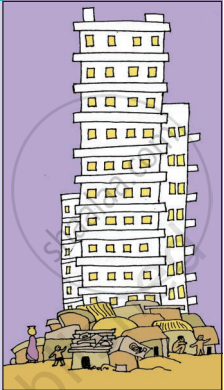
Read this newspaper report and answer the questions that follow:
|
A vessel dumped 500 tonnes of liquid toxic wastes into open-air dumps in a city and in the surrounding sea. This happened in a city called Abidjan in Ivory Coast, a country in Africa. The fumes from the highly toxic waste caused nausea, skin rashes, fainting, diarrhoea etc. After a month seven persons were dead, twenty in hospital and twenty six thousand treated for symptoms of poisoning. A multinational company dealing in petroleum and metals had contracted a local company of the Ivory Coast to dispose the toxic waste from its ship. |
- Who are the people who benefited and who did not?
- What should be the developmental goal for this country?
What can be some of the developmental goals for your village, town or locality?
ACTIVITY 1
If even the idea of what constitutes development can be varied and conflicting, then certainly there can be differences about ways of developing. If you know of any such controversy, try to find out arguments advanced by different people. You may do so by talking to different persons or you may find it from newspapers and television.
Based on data given in Table, calculate the average income for both the countries.
Comparison of Two Countries
| Country | Monthly incomes of citizens (in Rupees) |
|||||
| I | II | III | IV | V | Average | |
| Country A | 9500 | 10500 | 9800 | 10000 | 10200 | |
| Country B | 500 | 500 | 500 | 500 | 500 | |
Will you be equally happy to live in both these countries? Are both equally developed?
LET’S WORK THESE OUT
Give three examples where an average is used for comparing situations.
Why do you think average income is an important criterion for development? Explain.
Besides size of per capita income, what other property of income is important in comparing two or more societies?
Suppose records show that the average income in a country has been increasing over a period of time. From this, can we conclude that all sections of the economy have become better? Illustrate your answer with an example.
Find out the per capita income level of about 10-15 low-income countries as per the World Development Reports.
Write a paragraph on your notion of what should India do, or achieve, to become a developed country.
LET’S WORK THESE OUT
Look at the data in tables. Is Haryana ahead of Kerala in literacy rate etc., as it is in terms of per capita income?
Per Capita Income of Selected States
| State | Per Capita Income for 2023-24 (in Rs) |
| Haryana | 3,25,759 |
| Kerala | 2,81,001 |
| Bihar | 60,337 |
Some comparative data on Haryana, Kerala and Bihar
| State | Infant Mortality Rate per 1,000 live births (2020) |
Literacy Rate % | Net Attendance Ratio (per 100 persons) secondary stage (aged 15–17 years) 2017–18 |
| 2017–18 | |||
| Haryana | 28 | 82 | 73 |
| Kerala | 6 | 94 | 94 |
| Bihar | 27 | 62 | 69 |
Think of other examples where collective provision of goods and services is cheaper than individual provision.
Does availability of good health and educational facilities depend only on amount of money spent by the government on these facilities? What other factors could be relevant?
In a study, it was found that in Tamil Nadu, 90 per cent of the people living in rural areas used a ration shop, whereas in West Bengal only 35 per cent of rural people did so. Where would people did better off and why?
ACTIVITY 2
Study the table carefully and fill in the blanks in the following paragraphs. For this, you may need to make calculations based on the table.
Educational Achievement of Rural Population of Uttar Pradesh
| Category | Male | Female |
| Literacy rate for rural population | 76% | 54% |
| Literacy rate for rural children in age group 10-14 years | 90% | 87% |
| Percentage of rural children aged 10-14 attending school | 85% | 82% |
- The literacy rate for all age groups, including young and old, is ______ for rural males and ______ for rural females. However, it is not just that these many adults could not attend school but that there are ______ who are currently not in school.
- It is clear from the table that ______% of rural girls and ______% of rural boys are not attending school. Therefore, illiteracy among children in the age group 10- 14 is as high as ______% for rural females and ______% for rural males.
- This high level of illiteracy among ______ age group, even after more than 75 years of our independence, is most disturbing. In many other states also we are nowhere near realisation of the constitutional goal of free and compulsory education for all children up to the age of 14, which was expected to be achieved by 1960.
LET’S UNDERSTAND WHY THIS IS SO THROUGH THE FOLLOWING EXAMPLE: Example 1: Groundwater in India
| “Recent evidence suggests that the groundwater is under serious threat of overuse in many parts of the country. About 300 districts have reported a water level decline of over 4 metres during the past 20 years. Nearly one-third of the country is overusing their groundwater reserves. In another 25 years, 60 per cent of the country would be doing the same if the present way of using this resource continues. Groundwater overuse is particularly found in the agriculturally prosperous regions of Punjab and Western U.P., hard rock plateau areas of central and south India, some coastal areas and the rapidly growing urban settlements.” |
- Why groundwater is overused?
- Can there be development without overuse?
Example 2: Exhaustion of Natural Resources
Look at the following data for crude oil.
Crude Oil Reserves
| Region/Country | Reserves (2017) (Thousand Million Barrels) |
Number of Years Reserves will last |
| Middle East | 836 | 70 |
| United States of America | 69 | 10.5 |
| World | 1732 | 47 |
The table gives an estimate of reserves of crude oil (column 1). More important, it also tells us for how many years the stock of crude oil will last if people continue to extract it at the present rate. The reserves would last only 50 years more. This is for the world as a whole. However, different countries face different situations. Countries like India depend on importing oil from abroad because they do not have enough stocks of their own. If prices of oil increase this becomes a burden for everyone. There are countries like USA which have low reserves and hence want to secure oil through military or economic power.
The question of sustainability of development raises many fundamentally new issues about the nature and process of development.
- Is crude oil essential for the development process in a country? Discuss.
- India has to import crude oil. What problems do you anticipate for the country looking at the above situation?
NCERT solutions for सोशल सायन्स अंडरस्टॅंडिंग इकॉनॉमिक्स डेवलपमेंट [इंग्रजी] इयत्ता १० 1 Development Exercises [Pages 16 - 17]
Development of a country can generally be determined by ______.
its per capita income
its average literacy level
health status of its people
all the above
Which of the following neighbouring countries has better performance in terms of human development than India?
Bangladesh
Sri Lanka
Nepal
Pakistan
Assume there are four families in a country. The average per capita income of these families is Rs 5000. If the income of three families is Rs 4000, Rs 7000 and Rs 3000 respectively, what is the income of the fourth family?
Rs 7500
Rs 3000
Rs 2000
Rs 6000
What is the main criterion used by the World Bank in classifying different countries? What are the limitations of this criterion, if any?
In what respects is the criterion used by the UNDP for measuring development different from the one used by the World Bank?
Why do we use averages? Are there any limitations to their use? Illustrate with your own examples related to development.
Kerala, with lower per capita income has a better human development ranking than Haryana. Hence, per capita income is not a useful criterion at all and should not be used to compare states. Do you agree? Discuss.
Find out the present sources of energy that are used by the people in India. What could be the other possibilities fifty years from now?
Why is the issue of sustainability important for development?
“The Earth has enough resources to meet the needs of all but not enough to satisfy the greed of even one person”. How is this statement relevant to the discussion of development? Discuss.
List a few examples of environmental degradation that you may have observed around you.
For each of the items given in the table, find out which country is at the top and which is at the bottom.
| SOME DATA REGARDING INDIA AND ITS NEIGHBOURS FOR 2023 | ||||
| Country | Gross National Income (GNI) Per Capita (2021 PPP $) |
Life Expectancy at birth |
Mean Years of Schooling of People aged 25 and above |
HDI Rank in the world (2021-22) |
| Sri Lanka | 12,616 | 77.5 | 10.8 | 89 |
| India | 9,047 | 72 | 6.9 | 130 |
| Myanmar | 4,919 | 66.9 | 6.4 | 150 |
| Pakistan | 5,501 | 67.6 | 4.3 | 168 |
| Nepal | 4,726 | 70.4 | 4.5 | 145 |
| Bangladesh | 8,498 | 74.7 | 6.8 | 130 |
The following table shows the proportion of adults (aged 15-49 years) whose BMI is below normal (BMI < 18.5 kg/m2 ) in India. It is based on a survey of various states for the year 2019-21. Look at the table and answer the following questions.
| State | Male (%) |
Female (%) |
| Kerala | 8.5 | 10 |
| Karnataka | 17 | 21 |
| Madhya Pradesh | 28 | 28 |
| All States | 20 | 23 |
- Compare the nutritional level of people in Kerala and Madhya Pradesh
- Can you guess why around one-fifth of people in the country are undernourished, even though it is argued that there is enough food in the country? Describe in your own words.
ADDITIONAL PROJECT/ACTIVITY
Invite three different speakers to talk to you about the development of your region. Ask them all the questions that come to your mind. Discuss these ideas in groups. Each group should prepare a wall chart, giving reasons about ideas that you agree or do not agree with.
Solutions for 1: Development
NCERT solutions for सोशल सायन्स अंडरस्टॅंडिंग इकॉनॉमिक्स डेवलपमेंट [इंग्रजी] इयत्ता १० chapter 1 - Development
Shaalaa.com has the CBSE Mathematics सोशल सायन्स अंडरस्टॅंडिंग इकॉनॉमिक्स डेवलपमेंट [इंग्रजी] इयत्ता १० CBSE solutions in a manner that help students grasp basic concepts better and faster. The detailed, step-by-step solutions will help you understand the concepts better and clarify any confusion. NCERT solutions for Mathematics सोशल सायन्स अंडरस्टॅंडिंग इकॉनॉमिक्स डेवलपमेंट [इंग्रजी] इयत्ता १० CBSE 1 (Development) include all questions with answers and detailed explanations. This will clear students' doubts about questions and improve their application skills while preparing for board exams.
Further, we at Shaalaa.com provide such solutions so students can prepare for written exams. NCERT textbook solutions can be a core help for self-study and provide excellent self-help guidance for students.
Concepts covered in सोशल सायन्स अंडरस्टॅंडिंग इकॉनॉमिक्स डेवलपमेंट [इंग्रजी] इयत्ता १० chapter 1 Development are Concept for Traditional Notion of Development, Concept for National Income and Percapita Income, Concept of Growth of National Income, Critical Appraisal of Existing Development Indicators (PCI, IMR, SR and Other Income and Health Indicators), Need for Health and Educational Development, Human Development Indicators (Holistic Measure of Development), Overview of Development, What Development Promises - Different People, Different Goals, Income and Other Goals, National Development, Comparison Between Different Countries Or States, Income and Other Criteria, Public Facilities, Sustainability of Development, Concept of Development.
Using NCERT सोशल सायन्स अंडरस्टॅंडिंग इकॉनॉमिक्स डेवलपमेंट [इंग्रजी] इयत्ता १० solutions Development exercise by students is an easy way to prepare for the exams, as they involve solutions arranged chapter-wise and also page-wise. The questions involved in NCERT Solutions are essential questions that can be asked in the final exam. Maximum CBSE सोशल सायन्स अंडरस्टॅंडिंग इकॉनॉमिक्स डेवलपमेंट [इंग्रजी] इयत्ता १० students prefer NCERT Textbook Solutions to score more in exams.
Get the free view of Chapter 1, Development सोशल सायन्स अंडरस्टॅंडिंग इकॉनॉमिक्स डेवलपमेंट [इंग्रजी] इयत्ता १० additional questions for Mathematics सोशल सायन्स अंडरस्टॅंडिंग इकॉनॉमिक्स डेवलपमेंट [इंग्रजी] इयत्ता १० CBSE, and you can use Shaalaa.com to keep it handy for your exam preparation.
