Advertisements
Advertisements
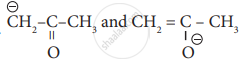 are
areNitrogen detection in an organic compound is carried out by Lassaigne’s test. The blue colour formed is due to the formation of
Concept: undefined >> undefined
Advertisements
An organic Compound weighing 0.15g gave on carius estimation, 0.12g of silver bromide. The percentage of bromine in the Compound will be close to ______.
Concept: undefined >> undefined
Identify the functional group in the following compound.
Acetaldehyde
Concept: undefined >> undefined
Identify the functional group in the following compound.
Oxalic acid
Concept: undefined >> undefined
Identify the functional group in the following compound.
Di methyl ether
Concept: undefined >> undefined
Identify the functional group in the following compound.
Methylamine
Concept: undefined >> undefined
Give the general formula for the following class of organic compound.
Aliphatic monohydric alcohol
Concept: undefined >> undefined
Give the general formula for the following class of organic compound.
Aliphatic ketones
Concept: undefined >> undefined
Give the general formula for the following class of organic compound.
Aliphatic amines
Concept: undefined >> undefined
Explain various types of constitutional isomerism (structural isomerism) in organic compounds.
Concept: undefined >> undefined
Describe optical isomerism with a suitable example.
Concept: undefined >> undefined
Describe optical isomerism with a suitable example.
Concept: undefined >> undefined
Briefly explain geametrical isomerism in alkene by considering 2-butene as an example.
Concept: undefined >> undefined
Major product of the below mentioned reaction is, \[\ce{(CH3 )2 C = CH2 ->[ICI]}\]
Concept: undefined >> undefined
Identify the compound (A) in the following reaction
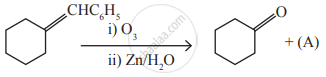
Concept: undefined >> undefined
Consider the nitration of benzene using mixed con H2SO4 and HNO3 if a large quantity of KHSO4 is added to the mixture, the rate of nitration will be ______.
Concept: undefined >> undefined
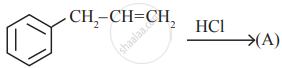 is
isWhich one of the following is non aromatic?
Concept: undefined >> undefined
Which of the following compounds will not undergo Friedal – crafts reaction easily ? (NEET)
Concept: undefined >> undefined
