Please select a subject first
Advertisements
Advertisements
Magnetic moment of revolving electron of charge 'e' and mass 'm' in terms of angular momentum 'L' of electron is ____________.
Concept: undefined >> undefined
An electron in the ground state of hydrogen atom is revolving in a circular orbit of radius R. The orbital magnetic moment of the electron is ____________. (m = mass of electron, h = Planck's constant, e = electronic charge)
Concept: undefined >> undefined
Advertisements
The pressure at the bottom of a tank containing liquid does not depend upon the ______.
Concept: undefined >> undefined
A parallel beam of fast-moving electrons is incident perpendicular on a narrow slit. The distance between slit and screen is large. If the speed of the incident electrons is increased then which one of the following statements is correct?
Concept: undefined >> undefined
In the biprism experiment, fringes are obtained using monochromatic light. The distance between the 5th bright band and 9th dark band on the same side of the central bright band, in terms of the fringe width 'X' is ______
Concept: undefined >> undefined
The radiations of energies 1 eV and 2.5 eV are incident on a metal surface having work function 0.5 eV. The ratio of the maximum velocities of the emitted photo-electrons is ____________.
Concept: undefined >> undefined
A light of wavelength '`lambda`' and intensity 'I' falls on photosensitive material. If 'N' photoelectrons are emitted, each with kinetic energy E, then ____________.
Concept: undefined >> undefined
When a certain metallic surface is illuminated with monochromatic light of wavelength '`lambda`', the stopping potential for photoelectric effect is '3V0'. If the same surface is illuminated with a light of wavelength '`2 lambda`', the stopping potential is found as 'V0'. The threshold wavelength for this surface is ____________.
Concept: undefined >> undefined
When light enters glass from vacuum then the wavelength of light ______
Concept: undefined >> undefined
When a metal with work function 0.6 eV is illuminated with light of energy 2 eV, the stopping potential will be ____________.
Concept: undefined >> undefined
When a photosensitive surface is irradiated by lights of wavelengths `lambda_1` and `lambda_2`, kinetic energies of emitted photoelectrons are E1 and E2 respectively. The work function of the photosensitive surface is ____________.
Concept: undefined >> undefined
Two incident radiations having energies two times and ten times of the work function of a metal surface, produce photoelectric effect. The ratio of maximum velocities of emitted photo electrons respectively is ____________.
Concept: undefined >> undefined
Two parallel plates separated by a distance 'd' are kept at potential difference 'V' volt. A charge 'q' of mass 'm' enters in parallel plates with some velocity. The acceleration of the charged particle will be ______
Concept: undefined >> undefined
An electromagnetic wave of wavelength '`lambda`' is incident on a photosensitive surface of negligible work function. If the photoelectrons emitted from this surface have the de-Broglie wavelength '`lambda_1`' then ____________.
Concept: undefined >> undefined
When light of wavelength '`lambda`' is incident on photosensitive surface, photons of power 'P' are emitted. The number of photons (n) emitted in 't' second is (h = Planck's constant, c = velocity of light in vacuum) ____________.
Concept: undefined >> undefined
A metal surface having work function 'w0' emits photoelectrons when photons of energy 'E' are incident on it. The electron enters the uniform magnetic field (B) in perpendicular direction and moves in circular path of radius 'r'. Then 'r' is equal to (m and e be the mass and charge of electron respectively) ____________.
Concept: undefined >> undefined
The potential differences that must be applied across the parallel and series combination of 3 identical capacitors are such that the energy stored in them becomes the same. The ratio of potential difference in parallel to series combination is ______
Concept: undefined >> undefined
The electron in hydrogen atom is moving in an orbit of radius 0.53 Å. It takes 1.571 x 10⁻¹⁶ s to complete one revolution. The velocity of electron will be `pi` = 3.142.
Concept: undefined >> undefined
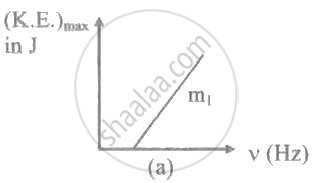
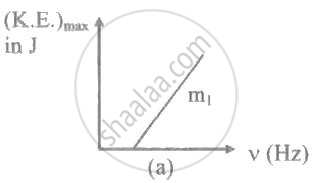
The ratio of slopes m1: ro2 of the lines given in the following graphs is, ______.
Concept: undefined >> undefined
In an atom, electron of charge (-e) perform U.C.M. around a stationary positively charged nucleus, with period of revolution 'T'. If 'r' is the radius of the orbit of the electron and 'v' is the orbital velocity, then the circulating current (I) is proportional to ____________.
Concept: undefined >> undefined
