Advertisements
Advertisements
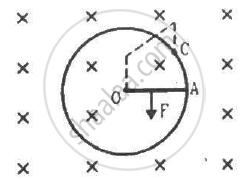
Consider the situation shown in the figure. Suppose the circular loop lies in a vertical plane. The rod has a mass m. The rod and the loop have negligible resistances but the wire connecting O and C has a resistance R. The rod is made to rotate with a uniform angular velocity ω in the clockwise direction by applying a force at the midpoint of OA in a direction perpendicular to it. Find the magnitude of this force when the rod makes an angle θ with the vertical.
Concept: undefined >> undefined
Write the expression, in a vector form, for the Lorentz magnetic force \[\vec{F}\] due to a charge moving with velocity \[\vec{V}\] in a magnetic field \[\vec{B}\]. What is the direction of the magnetic force?
Concept: undefined >> undefined
Advertisements
Write the principle of working of a metre bridge
Concept: undefined >> undefined
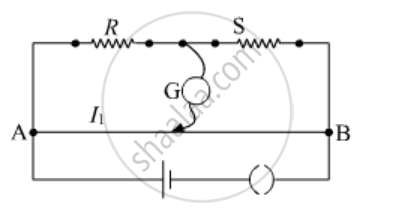
In a metre bridge, the balance point is found at a distance l1 with resistances R and S as shown in the figure.An unknown resistance X is now connected in parallel to the resistance S and the balance point is found at a distance l2. Obtain a formula for X in terms of l1, l2 and S.
Concept: undefined >> undefined
State its any ‘two’ uses of photodiode.
Concept: undefined >> undefined
Write the expression for the force `vecF` acting on a particle of mass m and charge q moving with velocity `vecV` in a magnetic field `vecB` , Under what conditions will it move in (i) a circular path and (ii) a helical path?
Concept: undefined >> undefined
Show that the kinetic energy of the particle moving in a magnetic field remains constant.
Concept: undefined >> undefined
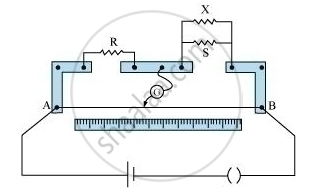
In a meter bridge, the null point is found at a distance of l1 cm from A. If now a resistance of X is connected in parallel with S, the null point occurs at l2 cm. Obtain a formula for X in terms of l1, l2 and S.
Concept: undefined >> undefined
Explain the formation of depletion layer and potential barrier in a p−n junction.
Concept: undefined >> undefined
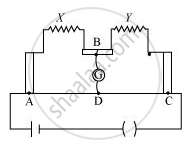
The figure shows experimental set up of a meter bridge. When the two unknown resistances X and Y are inserted, the null point D is obtained 40 cm from the end A. When a resistance of 10 Ω is connected in series with X, the null point shifts by 10 cm. Find the position of the null point when the 10 Ω resistance is instead connected in series with resistance ‘Y’. Determine the values of the resistances X and Y.
Concept: undefined >> undefined
Light of wavelength 560 nm goes through a pinhole of diameter 0.20 mm and falls on a wall at a distance of 2.00 m. What will be the radius of the central bright spot formed on the wall?
Concept: undefined >> undefined
A convex lens of diameter 8.0 cm is used to focus a parallel beam of light of wavelength 620 nm. If the light is focused at a distance of 20 cm from the lens, what would be the radius of the central bright spot formed?
Concept: undefined >> undefined
The dielectric constant decreases if the temperature is increased. Explain this in terms of polarization of the material.
Concept: undefined >> undefined
When a dielectric slab is gradually inserted between the plates of an isolated parallel-plate capacitor, the energy of the system decreases. What can you conclude about the force on the slab exerted by the electric field?
Concept: undefined >> undefined
A dielectric slab is inserted between the plates of an isolated capacitor. The force between the plates will
Concept: undefined >> undefined
Assume that the magnetic field is uniform in a cubical region and zero outside. Can you project a charged particle from outside into the field, so that the particle describes a complete circle in the field?
Concept: undefined >> undefined
A positively-charged particle projected towards east is deflected towards north by a magnetic field. The field may be
Concept: undefined >> undefined
A charged particle is whirled in a horizontal circle on a frictionless table by attaching it to a string fixed at one point. If a magnetic field is switched on in the vertical direction, the tension in the string
Concept: undefined >> undefined
A beam consisting of protons and electrons moving at the same speed goes through a thin region in which there is a magnetic field perpendicular to the beam. The protons and the electrons
Concept: undefined >> undefined
A charged particle moves in a uniform magnetic field. The velocity of the particle at some instant makes an acute angle with the magnetic field. The path of the particle will be
Concept: undefined >> undefined
