Advertisements
Advertisements
In a Young's double slit experiment, a laser light of 560 nm produces an interference pattern with consecutive bright fringes separation of 7.2 mm. Now another light is used to produce an interference pattern with consecutive bright fringes separation of 8.1 mm. The wavelength of second light is ______ nm.
Concept: undefined >> undefined
In a Young's double slit experiment, the slits are separated by 0.3 mm and the screen is 1.5 m away from the plane of slits. Distance between fourth bright fringes on both sides of central bright is 2.4 cm. The frequency of light used is ______ × 1014 Hz.
Concept: undefined >> undefined
Advertisements
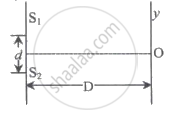
Consider a usual set-up of Young's double slit experiment with slits of equal intensity as shown in the figure. Take 'O' as the origin and the Y axis as indicated. If the average intensity between y1 = `(lambdaD)/(4d)` and y2 = `(lambdaD)/(4d)` equals n times the intensity of maximum, then n equal is (take average over phase difference) ______.
Concept: undefined >> undefined
In the following nuclear reaction, \[\ce{D->[α]D_1->[β^-]D_2->[α]D_3->[γ]D_4}\]. The mass number of D is 182 and its atomic number is 74. The mass number and atomic number of D4 respectively will be ______.
Concept: undefined >> undefined
A resonance circuit having inductance and resistance 2 x 10⁻⁴ H and 6.28 Ω respectively oscillates at 10 MHz frequency. The value of quality factor of this resonator is ______. [π = 3.14]
Concept: undefined >> undefined
In an interference experiment, the ratio of amplitudes of coherent waves is `a_1/a_2 = 1/3.` The ratio of maximum and minimum intensities of fringes will be ______.
Concept: undefined >> undefined
The power factor of an AC circuit having resistance (R ) and inductance (L) connected in series and an angular ω is ______.
Concept: undefined >> undefined
Two lighter nuclei combine to form a comparatively heavier nucleus by the relation given below:
\[\ce{^2_1X + ^2_1X = ^4_2Y}\]
The binding energies per nucleon \[\ce{^2_1X}\] and \[\ce{^4_2Y}\] are 1.1 MeV and 7.6 MeV respectively. The energy released in this process is ______ MeV.
Concept: undefined >> undefined
Find the Binding energy per neucleon for \[\ce{^120_50Sn}\]. Mass of proton mp = 1.00783 U, mass of neutron mn = 1.00867 U and mass of tin nucleus mSn = 119.902199 U. (take 1 U = 931 MeV)
Concept: undefined >> undefined
When 3Li7 nuclei are bombarded by protons, and the resultant nuclei are 4Be8, the emitted particles will be ______.
Concept: undefined >> undefined
In the nuclear fusion reaction
\[\ce{^2_1H + ^3_1H-> ^4_2He + n}\]
given that the repulsive potential energy between the two nuclei is ∼ 7.7 × 10⁻¹⁴J, the temperature at which the gases must be heated to initiate the reaction is nearly
[Boltzmann's Constant k = 1.38 × 10⁻²³ J/K]
Concept: undefined >> undefined
Two identical beakers A and B contain equal volumes of two different liquids at 60°C each and is left to cool down. Liquid in A has a density of 8 × 10² kg/m3 and specific heat of 2000 J kg-1 K-1 while the liquid in B has a density of 103 kg m-3 and specific heat of 4000 J kg-1 K-1. Which of the following best describes their temperature versus time graph schematically? (assume the emissivity of both the beakers to be the same.)
Concept: undefined >> undefined
Consider a finite insulated, uncharged conductor placed near a finite positively charged conductor. The uncharged body must have a potential:
Concept: undefined >> undefined
An earthen pitcher loses 1 gm of water per minute due to evaporation. If the water equivalent of the pitcher is 0.5 kg and the pitcher contains 9.5 kg of water, calculate the time required for the water in a pitcher to cool to 28°C from the original temperature of 30°C. Neglect radiation effects. The latent heat of vaporization in this range of temperature is 580 Cal/gm and the specific heat of water is 1 Cal/gm°C.
Concept: undefined >> undefined
Heat given to a body that raises its temperature by 1°C is ______.
Concept: undefined >> undefined
The displacement current of 4.425 µA is developed in the space between the plates of the parallel plate capacitor when voltage is changing at a rate of 106 Vs-1. The area of each plate of the capacitor is 40 cm2. The distance between each plate of the capacitor is x × 10-3 m. The value of x is ______.
(Permittivity of free space, ε0 = 8.85 × 10⁻¹²C2N-1m-2).
Concept: undefined >> undefined
For changing the capacitance of a given parallel plate capacitor, a dielectric material of dielectric constant K is used, which has the same area as the plates of the capacitor.
The thickness of the dielectric slab is `3/4`d, where 'd' is the separation between the plate of the parallel plate capacitor.
The new capacitance (C') in terms of the original capacitance (C0) is given by the following relation:
Concept: undefined >> undefined
The material filled between the plates of a parallel plate capacitor has a resistivity of 200Ωm. The value of the capacitance of the capacitor is 2 pF. If a potential difference of 40V is applied across the plates of the capacitor, then the value of leakage current flowing out of the capacitor is ______.
(given the value of relative permittivity of a material is 50.)
Concept: undefined >> undefined
A 5µF capacitor is charged fully by a 220 V supply. It is then disconnected from the supply and is connected in series to another uncharged 2.5 µF capacitor If the energy change during the charge redistribution is `"X"/100`J then value of X to the 100 nearest integer is ______.
Concept: undefined >> undefined
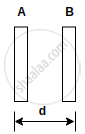
Two plates A and B of a parallel plate capacitor are arranged in such a way, that the area of each plate is S = 5 × 10⁻³ m 2 and distance between them is d = 8.85 mm. Plate A has a positive charge q1 = 10-10 C and Plate B has charge q2 = + 2 × 10⁻¹⁰ C. Then the charge induced on the plate B due to the plate A be - (....... × 10-11 )C
Concept: undefined >> undefined
