Advertisements
Advertisements
| Mihir and Mahadev lived in the same village. While Mahadev owned the largest shop in the village, Mihir was a poor farmer. Both had large families, with many sons, daughters-in-law and grandchildren. One day, Mihir, tired of not being able to make ends meet, decided to leave the village and move to the city where they were sure to make enough to feed everyone. They said their goodbyes, packed their few belongings and set off. When night fell, they stopped under a large tree. There was a stream running nearby, where they could refresh themselves. Mihir told his sons to clear the area below the tree. He told his wife to fetch water. He instructed his daughters-in-law to make up the fire and started cutting wood from the tree himself. Now, in that branches of the tree sat a thief. He watched as Mihir's family worked together. He also noticed they had nothing to cook. Mihir's wife too thought the same, for she said to her husband, "Everything is ready. But what shall we eat?" Mihir raised his hands to heaven and said, "Don't worry. He is watching all this from above. He will help us." The thief was worried. He had seen that the family was large and worked well together. Surely they did not know he was hiding in the branches. He decided to make a quick getaway. He climbed down swiftly when they were not looking and ran for his life. But, he left behind his bundle of stolen jewels and money, which dropped down into Mihir's lap. He opened it and jumped with joy when he saw the contents. The family promptly gathered its belongings and returned to the village. There was great excitement when they told everyone how they got rich. Mahadev thought this was a nice quick way to earn some money! He commanded his family to pack some clothes and they set off as if on a journey. They stopped under the same tree and Mahadev started commanding everyone as Mihir had done. But no one in his family was willing to obey orders. They were used to having servants wait on them – so the one who went to the river to fetch water had a nice bath. The one who went to gather wood for the fire went off to sleep beneath the tree. And Mahadev only ordered everyone about, not conversation that they had rehearsed carefully. Mahadev's wife said, "Everything is ready. But what shall we eat?" Mahadev raised his hands upwards and said, "Don't worry. He is watching all this from above. He will help us". At this, the thief jumped down from the tree, knife in hand. Seeing him, everyone started running helter-skelter to save themselves. The thief stole everything. Mahadev and his family had to return to the village empty-handed, having lost all the jewellery and gold they had taken with them. |
Why was the thief not afraid of Mahadev's family?
Concept: undefined >> undefined
| Antarctica, because of her simple ecosystem and lack of biodiversity, is the perfect place to study how little changes in the environment can have big repercussions. Take the microscopic phytoplankton — those grasses of the sea that nourish and sustain the entire Southern Ocean's food chain. These single-celled plants use the sun's energy to assimilate carbon and synthesise organic compounds in that wondrous and most important of processes called photosynthesis. Scientists warn that a further depletion in the ozone layer will affect the activities of phytoplankton, which in turn will affect the lives of all the marine animals and birds of the region, and the global carbon cycle. In the parable of the phytoplankton, there is a great metaphor for existence: take care of the small things and the big things will fall into place. |
Photosynthesis is a process in which:
Concept: undefined >> undefined
Advertisements
| (1) | Most of us know that smoking causes cancer, lung disease, heart disease, can shorten life by 10 years or more and can cost a smoker thousands of rupees a year. So, why are people still smoking? The answer, in a word, is addiction. |
| (2) | Smoking is a hard habit to break because tobacco contains the very addictive chemical nicotine. The body and mind quickly get used to the nicotine in cigarettes. Soon, a person needs to have it just to feel normal. |
| (3) | People start smoking for different reasons. Some think it looks cool. Others start because their family members or friends smoke. Almost all adult tobacco users started before they were 18 years old. Most, never expected to become addicted. |
| (4) | Many of the chemicals in cigarettes, like nicotine and cyanide, are poisons that can kill in high doses. The body is smart. It goes on the defence when it's being poisoned. First time, smokers often feel pain or burning in their throat and lungs, and some even cough vigorously the first few times they try tobacco. Over time, smoking leads to health problems such as heart disease, stroke, lung damage and many types of cancer - including lung, throat, stomach, and bladder cancer. |
| (5) | A survey was conducted to collect views of the people whether smoking should be allowed or not in public places. The results of the responses received have been depicted in the form of a pie chart here.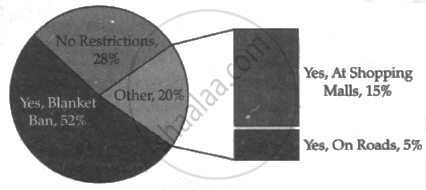 |
From the given pictorial representation, choose the option that correctly states the percentage of persons who say that smoking should have a blanket ban as compared to those supporting no restrictions on smoking.
Concept: undefined >> undefined
| (1) | Most of us know that smoking causes cancer, lung disease, heart disease, can shorten life by 10 years or more and can cost a smoker thousands of rupees a year. So, why are people still smoking? The answer, in a word, is addiction. |
| (2) | Smoking is a hard habit to break because tobacco contains the very addictive chemical nicotine. The body and mind quickly get used to the nicotine in cigarettes. Soon, a person needs to have it just to feel normal. |
| (3) | People start smoking for different reasons. Some think it looks cool. Others start because their family members or friends smoke. Almost all adult tobacco users started before they were 18 years old. Most, never expected to become addicted. |
| (4) | Many of the chemicals in cigarettes, like nicotine and cyanide, are poisons that can kill in high doses. The body is smart. It goes on the defence when it's being poisoned. First time, smokers often feel pain or burning in their throat and lungs, and some even cough vigorously the first few times they try tobacco. Over time, smoking leads to health problems such as heart disease, stroke, lung damage and many types of cancer - including lung, throat, stomach, and bladder cancer. |
| (5) | A survey was conducted to collect views of the people whether smoking should be allowed or not in public places. The results of the responses received have been depicted in the form of a pie chart here. |
What is the meaning in which 'cool' has been used in Para 3 of the passage?
Concept: undefined >> undefined
| The lawyer was also officially known as the legal adviser, but everybody referred to him as the opposite. An extremely talented actress, who was also extremely temperamental, once blew over on the sets. While everyone stood stunned, the lawyer quietly switched on the recording equipment. When the actress paused for breath, the lawyer said to her, ''one minute, please", and played back the recording. There was nothing incriminating or unmentionably foul about the actress's tirade against the producer. But when she heard her voice again through the sound equipment, she was struck dumb. A girl from the countryside, she hadn't gone through all the stages of worldly experience that generally precede a position of importance and sophistication that she had found herself catapulted into. She never quite recovered from the terror she felt that day. That was the end of a brief and brilliant acting career — the legal adviser, who was also a member of the Story Department, had unwittingly brought about that sad end. |
In the line: 'While everyone stood stunned, the lawyer quietly .....' what is the meaning of 'stunned'?
Concept: undefined >> undefined
| (1) | Every morning Ravi gives his brain an extra boost. We're not talking about drinking strong cups of coffee or playing one of those mind-training video games advertised all over Facebook. "I jump onto my stationary bike and cycle for 45 minutes to work," says Ravi. "When I go to my desk, my brain is at peak activity for a few hours." After his mental focus comes to a halt later in the day, he starts it with another short spell of cycling to be able to run errands. |
| (2) | Ride, work, ride, repeat. It's a scientifically proven system that describes some unexpected benefits of cycling. In a recent study in the Journal of Clinical and Diagnostic Research, scientists found that people scored higher on tests of memory, reasoning, and planning after 30 minutes of spinning on a stationary bike than they did before they rode the bike. They also completed the tests faster after pedalling. |
| (3) | Exercise is like fertilizer for your brain. All those hours, spent on exercising your muscles, create rich capillary beds not only in leg and hip muscles, but also in your brain. More blood vessels in your brain and muscles mean more oxygen and nutrients to help them work. When you pedal, you also force more nerve cells to fire. The result : you double or triple the production of these cells - literally building your brain. You also release neurotransmitters (the messengers between your brain cells) so all those cells, new and old, can communicate with each other for better, faster functioning. That's a pretty profound benefit to cyclists. |
| (4) | This kind of growth is especially important with each passing birthday, because as we age, our brains shrink and those connections weaken. Exercise restores and protects the brain cells. Neuroscientists say, 'Adults who exercise display sharper memory skills, higher concentration levels, more fluid thinking, and greater problem-solving ability than those who are sedentary." |
| (5) | Cycling also elevates your mood, relieves anxiety, increases stress resistance, and even banishes the blues. "Exercise works in the same way as psychotherapy and antidepressants in the treatment of depression, maybe better," says Dr. Manjari. A recent study analyzing 26 years of research finds that even some exercise - as little as 20 to 30 minutes a day - can prevent depression over the long term. |
| (6) | Remember : although it's healthy, exercise itself is a stress, especially when you're just getting started or getting back into riding. When you first begin to exert yourself, your body releases a particular hormone to raise your heart rate, blood pressure, and blood glucose levels, says Meher Ahluwalia, PhD, a professor of integrative physiology. As you get fitter, it takes a longer, harder ride to trigger that same response. |
What are the unexpected benefits of cycling?
Concept: undefined >> undefined
| In a village in the East, there lived an old couple. They did not have any children and never spent an extra paisa on themselves. They never repaired their house or cooked good food. One day, a family moved into the village. It was their son's second birthday and they sent two delicious laddoos to the old couple. The couple ate the laddoos with great relish. For days after they could talk of nothing else. Finally, the old man could take it no more. He said to his wife, “Let's buy the ingredients to make just two laddoos”. His wife agreed but said, “If I make the laddoos at home, the neighbours will know and will want a share. Let's cook in the woods behind our hut. That way no one will ever know”. The next day the old man purchased the ingredients from the market and they set off to the woods. Having never prepared food like this before, they ended up with three laddoos instead of two. The old couple returned home with the sweets, dying to eat them. But there was a problem. “It was my idea and I went to the market, so I ought to get two,” said the old man. But his wife refused to give in so easily and said, “Since I prepared the sweets, I ought to have two,” The day wore on and the argument continued. At last, the old man suggested, “Let us not talk to each other. Whoever breaks the silence first will get one laddoo and the other person two”. His wife agreed. Hours passed, but neither of them spoke and finally, they fell asleep with the bowl of sweets between them. That evening one of the neighbours knocked on the door but the couple did not answer for fear of losing the bet. Peering through the window, the man saw the couple lying on the floor with an untouched bowl of food. “They are dead!” He shouted and alerted the other villagers. Soon the door was broken down and the house was swarming with villagers. They discussed everything from the funeral to where the couple had hidden their wealth. But the couple lay still. Finally, the villagers carried them to the cremation ground. As the flames licked his feet, the old man jumped up screaming "You win!" His wife jumped up too, happy that she had won. The two then rushed home leaving the bewildered villagers present there behind. But when they got home... Alas, the door had been left open and they found a stray dog licking the last crumbs of the sweets from the bowl. |
Why did the old couple cook in the woods?
Concept: undefined >> undefined
| The lawyer was also officially known as the legal adviser, but everybody referred to him as the opposite. An extremely talented actress, who was also extremely temperamental, once blew over on the sets. While everyone stood stunned, the lawyer quietly switched on the recording equipment. When the actress paused for breath, the lawyer said to her, ''one minute, please", and played back the recording. There was nothing incriminating or unmentionably foul about the actress's tirade against the producer. But when she heard her voice again through the sound equipment, she was struck dumb. A girl from the countryside, she hadn't gone through all the stages of worldly experience that generally precede a position of importance and sophistication that she had found herself catapulted into. She never quite recovered from the terror she felt that day. That was the end of a brief and brilliant acting career — the legal adviser, who was also a member of the Story Department, had unwittingly brought about that sad end. |
What was the reaction of the girl when she heard her voice again through the sound equipment?
Concept: undefined >> undefined
| (1) | Every morning Ravi gives his brain an extra boost. We're not talking about drinking strong cups of coffee or playing one of those mind-training video games advertised all over Facebook. "I jump onto my stationary bike and cycle for 45 minutes to work," says Ravi. "When I go to my desk, my brain is at peak activity for a few hours." After his mental focus comes to a halt later in the day, he starts it with another short spell of cycling to be able to run errands. |
| (2) | Ride, work, ride, repeat. It's a scientifically proven system that describes some unexpected benefits of cycling. In a recent study in the Journal of Clinical and Diagnostic Research, scientists found that people scored higher on tests of memory, reasoning, and planning after 30 minutes of spinning on a stationary bike than they did before they rode the bike. They also completed the tests faster after pedalling. |
| (3) | Exercise is like fertilizer for your brain. All those hours, spent on exercising your muscles, create rich capillary beds not only in leg and hip muscles, but also in your brain. More blood vessels in your brain and muscles mean more oxygen and nutrients to help them work. When you pedal, you also force more nerve cells to fire. The result : you double or triple the production of these cells - literally building your brain. You also release neurotransmitters (the messengers between your brain cells) so all those cells, new and old, can communicate with each other for better, faster functioning. That's a pretty profound benefit to cyclists. |
| (4) | This kind of growth is especially important with each passing birthday, because as we age, our brains shrink and those connections weaken. Exercise restores and protects the brain cells. Neuroscientists say, 'Adults who exercise display sharper memory skills, higher concentration levels, more fluid thinking, and greater problem-solving ability than those who are sedentary." |
| (5) | Cycling also elevates your mood, relieves anxiety, increases stress resistance, and even banishes the blues. "Exercise works in the same way as psychotherapy and antidepressants in the treatment of depression, maybe better," says Dr. Manjari. A recent study analyzing 26 years of research finds that even some exercise - as little as 20 to 30 minutes a day - can prevent depression over the long term. |
| (6) | Remember : although it's healthy, exercise itself is a stress, especially when you're just getting started or getting back into riding. When you first begin to exert yourself, your body releases a particular hormone to raise your heart rate, blood pressure, and blood glucose levels, says Meher Ahluwalia, PhD, a professor of integrative physiology. As you get fitter, it takes a longer, harder ride to trigger that same response. |
Why is exercise so important for adults?

Concept: undefined >> undefined
| In a village in the East, there lived an old couple. They did not have any children and never spent an extra paisa on themselves. They never repaired their house or cooked good food. One day, a family moved into the village. It was their son's second birthday and they sent two delicious laddoos to the old couple. The couple ate the laddoos with great relish. For days after they could talk of nothing else. Finally, the old man could take it no more. He said to his wife, “Let's buy the ingredients to make just two laddoos”. His wife agreed but said, “If I make the laddoos at home, the neighbours will know and will want a share. Let's cook in the woods behind our hut. That way no one will ever know”. The next day the old man purchased the ingredients from the market and they set off to the woods. Having never prepared food like this before, they ended up with three laddoos instead of two. The old couple returned home with the sweets, dying to eat them. But there was a problem. “It was my idea and I went to the market, so I ought to get two,” said the old man. But his wife refused to give in so easily and said, “Since I prepared the sweets, I ought to have two,” The day wore on and the argument continued. At last, the old man suggested, “Let us not talk to each other. Whoever breaks the silence first will get one laddoo and the other person two”. His wife agreed. Hours passed, but neither of them spoke and finally, they fell asleep with the bowl of sweets between them. That evening one of the neighbours knocked on the door but the couple did not answer for fear of losing the bet. Peering through the window, the man saw the couple lying on the floor with an untouched bowl of food. “They are dead!” He shouted and alerted the other villagers. Soon the door was broken down and the house was swarming with villagers. They discussed everything from the funeral to where the couple had hidden their wealth. But the couple lay still. Finally, the villagers carried them to the cremation ground. As the flames licked his feet, the old man jumped up screaming "You win!" His wife jumped up too, happy that she had won. The two then rushed home leaving the bewildered villagers present there behind. But when they got home... Alas, the door had been left open and they found a stray dog licking the last crumbs of the sweets from the bowl. |
Which of the following is/are TRUE in the context of the passage?
- The old woman had prepared more laddoos than she had intended.
- The family who had recently moved into the village were fond of the old couple.
- The villagers were saddened by the death of the old couple and gave them a grand funeral.
Concept: undefined >> undefined
| The lawyer was also officially known as the legal adviser, but everybody referred to him as the opposite. An extremely talented actress, who was also extremely temperamental, once blew over on the sets. While everyone stood stunned, the lawyer quietly switched on the recording equipment. When the actress paused for breath, the lawyer said to her, ''one minute, please", and played back the recording. There was nothing incriminating or unmentionably foul about the actress's tirade against the producer. But when she heard her voice again through the sound equipment, she was struck dumb. A girl from the countryside, she hadn't gone through all the stages of worldly experience that generally precede a position of importance and sophistication that she had found herself catapulted into. She never quite recovered from the terror she felt that day. That was the end of a brief and brilliant acting career — the legal adviser, who was also a member of the Story Department, had unwittingly brought about that sad end. |
The legal advisor was also a ______.
Concept: undefined >> undefined
| In a village in the East, there lived an old couple. They did not have any children and never spent an extra paisa on themselves. They never repaired their house or cooked good food. One day, a family moved into the village. It was their son's second birthday and they sent two delicious laddoos to the old couple. The couple ate the laddoos with great relish. For days after they could talk of nothing else. Finally, the old man could take it no more. He said to his wife, “Let's buy the ingredients to make just two laddoos”. His wife agreed but said, “If I make the laddoos at home, the neighbours will know and will want a share. Let's cook in the woods behind our hut. That way no one will ever know”. The next day the old man purchased the ingredients from the market and they set off to the woods. Having never prepared food like this before, they ended up with three laddoos instead of two. The old couple returned home with the sweets, dying to eat them. But there was a problem. “It was my idea and I went to the market, so I ought to get two,” said the old man. But his wife refused to give in so easily and said, “Since I prepared the sweets, I ought to have two,” The day wore on and the argument continued. At last, the old man suggested, “Let us not talk to each other. Whoever breaks the silence first will get one laddoo and the other person two”. His wife agreed. Hours passed, but neither of them spoke and finally, they fell asleep with the bowl of sweets between them. That evening one of the neighbours knocked on the door but the couple did not answer for fear of losing the bet. Peering through the window, the man saw the couple lying on the floor with an untouched bowl of food. “They are dead!” He shouted and alerted the other villagers. Soon the door was broken down and the house was swarming with villagers. They discussed everything from the funeral to where the couple had hidden their wealth. But the couple lay still. Finally, the villagers carried them to the cremation ground. As the flames licked his feet, the old man jumped up screaming "You win!" His wife jumped up too, happy that she had won. The two then rushed home leaving the bewildered villagers present there behind. But when they got home... Alas, the door had been left open and they found a stray dog licking the last crumbs of the sweets from the bowl. |
Why did the neighbour peep into the old couple's house?
Concept: undefined >> undefined
| (1) | Every morning Ravi gives his brain an extra boost. We're not talking about drinking strong cups of coffee or playing one of those mind-training video games advertised all over Facebook. "I jump onto my stationary bike and cycle for 45 minutes to work," says Ravi. "When I go to my desk, my brain is at peak activity for a few hours." After his mental focus comes to a halt later in the day, he starts it with another short spell of cycling to be able to run errands. |
| (2) | Ride, work, ride, repeat. It's a scientifically proven system that describes some unexpected benefits of cycling. In a recent study in the Journal of Clinical and Diagnostic Research, scientists found that people scored higher on tests of memory, reasoning, and planning after 30 minutes of spinning on a stationary bike than they did before they rode the bike. They also completed the tests faster after pedalling. |
| (3) | Exercise is like fertilizer for your brain. All those hours, spent on exercising your muscles, create rich capillary beds not only in leg and hip muscles, but also in your brain. More blood vessels in your brain and muscles mean more oxygen and nutrients to help them work. When you pedal, you also force more nerve cells to fire. The result : you double or triple the production of these cells - literally building your brain. You also release neurotransmitters (the messengers between your brain cells) so all those cells, new and old, can communicate with each other for better, faster functioning. That's a pretty profound benefit to cyclists. |
| (4) | This kind of growth is especially important with each passing birthday, because as we age, our brains shrink and those connections weaken. Exercise restores and protects the brain cells. Neuroscientists say, 'Adults who exercise display sharper memory skills, higher concentration levels, more fluid thinking, and greater problem-solving ability than those who are sedentary." |
| (5) | Cycling also elevates your mood, relieves anxiety, increases stress resistance, and even banishes the blues. "Exercise works in the same way as psychotherapy and antidepressants in the treatment of depression, maybe better," says Dr. Manjari. A recent study analyzing 26 years of research finds that even some exercise - as little as 20 to 30 minutes a day - can prevent depression over the long term. |
| (6) | Remember : although it's healthy, exercise itself is a stress, especially when you're just getting started or getting back into riding. When you first begin to exert yourself, your body releases a particular hormone to raise your heart rate, blood pressure, and blood glucose levels, says Meher Ahluwalia, PhD, a professor of integrative physiology. As you get fitter, it takes a longer, harder ride to trigger that same response. |
Based on the understanding of the passage, choose the option that lists the correct sequence of 'How is the exercise itself a stress?'
- The body released a particular hormone.
- As one gets fitter, it takes a longer and more rigorous exercising to trigger the same response.
- As soon as one states exercising, the body reacts immediately.
- That hormone raises one's heart rate, blood pressure and blood glucose levels.
Concept: undefined >> undefined
| In a village in the East, there lived an old couple. They did not have any children and never spent an extra paisa on themselves. They never repaired their house or cooked good food. One day, a family moved into the village. It was their son's second birthday and they sent two delicious laddoos to the old couple. The couple ate the laddoos with great relish. For days after they could talk of nothing else. Finally, the old man could take it no more. He said to his wife, “Let's buy the ingredients to make just two laddoos”. His wife agreed but said, “If I make the laddoos at home, the neighbours will know and will want a share. Let's cook in the woods behind our hut. That way no one will ever know”. The next day the old man purchased the ingredients from the market and they set off to the woods. Having never prepared food like this before, they ended up with three laddoos instead of two. The old couple returned home with the sweets, dying to eat them. But there was a problem. “It was my idea and I went to the market, so I ought to get two,” said the old man. But his wife refused to give in so easily and said, “Since I prepared the sweets, I ought to have two,” The day wore on and the argument continued. At last, the old man suggested, “Let us not talk to each other. Whoever breaks the silence first will get one laddoo and the other person two”. His wife agreed. Hours passed, but neither of them spoke and finally, they fell asleep with the bowl of sweets between them. That evening one of the neighbours knocked on the door but the couple did not answer for fear of losing the bet. Peering through the window, the man saw the couple lying on the floor with an untouched bowl of food. “They are dead!” He shouted and alerted the other villagers. Soon the door was broken down and the house was swarming with villagers. They discussed everything from the funeral to where the couple had hidden their wealth. But the couple lay still. Finally, the villagers carried them to the cremation ground. As the flames licked his feet, the old man jumped up screaming "You win!" His wife jumped up too, happy that she had won. The two then rushed home leaving the bewildered villagers present there behind. But when they got home... Alas, the door had been left open and they found a stray dog licking the last crumbs of the sweets from the bowl. |
What puzzled the villagers?
Concept: undefined >> undefined
| The lawyer was also officially known as the legal adviser, but everybody referred to him as the opposite. An extremely talented actress, who was also extremely temperamental, once blew over on the sets. While everyone stood stunned, the lawyer quietly switched on the recording equipment. When the actress paused for breath, the lawyer said to her, ''one minute, please", and played back the recording. There was nothing incriminating or unmentionably foul about the actress's tirade against the producer. But when she heard her voice again through the sound equipment, she was struck dumb. A girl from the countryside, she hadn't gone through all the stages of worldly experience that generally precede a position of importance and sophistication that she had found herself catapulted into. She never quite recovered from the terror she felt that day. That was the end of a brief and brilliant acting career — the legal adviser, who was also a member of the Story Department, had unwittingly brought about that sad end. |
A lawyer is officially called a ______.
Concept: undefined >> undefined
| In a village in the East, there lived an old couple. They did not have any children and never spent an extra paisa on themselves. They never repaired their house or cooked good food. One day, a family moved into the village. It was their son's second birthday and they sent two delicious laddoos to the old couple. The couple ate the laddoos with great relish. For days after they could talk of nothing else. Finally, the old man could take it no more. He said to his wife, “Let's buy the ingredients to make just two laddoos”. His wife agreed but said, “If I make the laddoos at home, the neighbours will know and will want a share. Let's cook in the woods behind our hut. That way no one will ever know”. The next day the old man purchased the ingredients from the market and they set off to the woods. Having never prepared food like this before, they ended up with three laddoos instead of two. The old couple returned home with the sweets, dying to eat them. But there was a problem. “It was my idea and I went to the market, so I ought to get two,” said the old man. But his wife refused to give in so easily and said, “Since I prepared the sweets, I ought to have two,” The day wore on and the argument continued. At last, the old man suggested, “Let us not talk to each other. Whoever breaks the silence first will get one laddoo and the other person two”. His wife agreed. Hours passed, but neither of them spoke and finally, they fell asleep with the bowl of sweets between them. That evening one of the neighbours knocked on the door but the couple did not answer for fear of losing the bet. Peering through the window, the man saw the couple lying on the floor with an untouched bowl of food. “They are dead!” He shouted and alerted the other villagers. Soon the door was broken down and the house was swarming with villagers. They discussed everything from the funeral to where the couple had hidden their wealth. But the couple lay still. Finally, the villagers carried them to the cremation ground. As the flames licked his feet, the old man jumped up screaming "You win!" His wife jumped up too, happy that she had won. The two then rushed home leaving the bewildered villagers present there behind. But when they got home... Alas, the door had been left open and they found a stray dog licking the last crumbs of the sweets from the bowl. |
Why did the old couple initially not reveal that they were alive to the villagers?
Concept: undefined >> undefined
| (1) | Every morning Ravi gives his brain an extra boost. We're not talking about drinking strong cups of coffee or playing one of those mind-training video games advertised all over Facebook. "I jump onto my stationary bike and cycle for 45 minutes to work," says Ravi. "When I go to my desk, my brain is at peak activity for a few hours." After his mental focus comes to a halt later in the day, he starts it with another short spell of cycling to be able to run errands. |
| (2) | Ride, work, ride, repeat. It's a scientifically proven system that describes some unexpected benefits of cycling. In a recent study in the Journal of Clinical and Diagnostic Research, scientists found that people scored higher on tests of memory, reasoning, and planning after 30 minutes of spinning on a stationary bike than they did before they rode the bike. They also completed the tests faster after pedalling. |
| (3) | Exercise is like fertilizer for your brain. All those hours, spent on exercising your muscles, create rich capillary beds not only in leg and hip muscles, but also in your brain. More blood vessels in your brain and muscles mean more oxygen and nutrients to help them work. When you pedal, you also force more nerve cells to fire. The result : you double or triple the production of these cells - literally building your brain. You also release neurotransmitters (the messengers between your brain cells) so all those cells, new and old, can communicate with each other for better, faster functioning. That's a pretty profound benefit to cyclists. |
| (4) | This kind of growth is especially important with each passing birthday, because as we age, our brains shrink and those connections weaken. Exercise restores and protects the brain cells. Neuroscientists say, 'Adults who exercise display sharper memory skills, higher concentration levels, more fluid thinking, and greater problem-solving ability than those who are sedentary." |
| (5) | Cycling also elevates your mood, relieves anxiety, increases stress resistance, and even banishes the blues. "Exercise works in the same way as psychotherapy and antidepressants in the treatment of depression, maybe better," says Dr. Manjari. A recent study analyzing 26 years of research finds that even some exercise - as little as 20 to 30 minutes a day - can prevent depression over the long term. |
| (6) | Remember : although it's healthy, exercise itself is a stress, especially when you're just getting started or getting back into riding. When you first begin to exert yourself, your body releases a particular hormone to raise your heart rate, blood pressure, and blood glucose levels, says Meher Ahluwalia, PhD, a professor of integrative physiology. As you get fitter, it takes a longer, harder ride to trigger that same response. |
Find word/phrase from the passage which means the opposite of 'abstain' from functioning: (Para 6)
Concept: undefined >> undefined
| The lawyer was also officially known as the legal adviser, but everybody referred to him as the opposite. An extremely talented actress, who was also extremely temperamental, once blew over on the sets. While everyone stood stunned, the lawyer quietly switched on the recording equipment. When the actress paused for breath, the lawyer said to her, ''one minute, please", and played back the recording. There was nothing incriminating or unmentionably foul about the actress's tirade against the producer. But when she heard her voice again through the sound equipment, she was struck dumb. A girl from the countryside, she hadn't gone through all the stages of worldly experience that generally precede a position of importance and sophistication that she had found herself catapulted into. She never quite recovered from the terror she felt that day. That was the end of a brief and brilliant acting career — the legal adviser, who was also a member of the Story Department, had unwittingly brought about that sad end. |
Which of the following is not related to the girl (described in the passage)?
Concept: undefined >> undefined
| (1) | Every morning Ravi gives his brain an extra boost. We're not talking about drinking strong cups of coffee or playing one of those mind-training video games advertised all over Facebook. "I jump onto my stationary bike and cycle for 45 minutes to work," says Ravi. "When I go to my desk, my brain is at peak activity for a few hours." After his mental focus comes to a halt later in the day, he starts it with another short spell of cycling to be able to run errands. |
| (2) | Ride, work, ride, repeat. It's a scientifically proven system that describes some unexpected benefits of cycling. In a recent study in the Journal of Clinical and Diagnostic Research, scientists found that people scored higher on tests of memory, reasoning, and planning after 30 minutes of spinning on a stationary bike than they did before they rode the bike. They also completed the tests faster after pedalling. |
| (3) | Exercise is like fertilizer for your brain. All those hours, spent on exercising your muscles, create rich capillary beds not only in leg and hip muscles, but also in your brain. More blood vessels in your brain and muscles mean more oxygen and nutrients to help them work. When you pedal, you also force more nerve cells to fire. The result : you double or triple the production of these cells - literally building your brain. You also release neurotransmitters (the messengers between your brain cells) so all those cells, new and old, can communicate with each other for better, faster functioning. That's a pretty profound benefit to cyclists. |
| (4) | This kind of growth is especially important with each passing birthday, because as we age, our brains shrink and those connections weaken. Exercise restores and protects the brain cells. Neuroscientists say, 'Adults who exercise display sharper memory skills, higher concentration levels, more fluid thinking, and greater problem-solving ability than those who are sedentary." |
| (5) | Cycling also elevates your mood, relieves anxiety, increases stress resistance, and even banishes the blues. "Exercise works in the same way as psychotherapy and antidepressants in the treatment of depression, maybe better," says Dr. Manjari. A recent study analyzing 26 years of research finds that even some exercise - as little as 20 to 30 minutes a day - can prevent depression over the long term. |
| (6) | Remember : although it's healthy, exercise itself is a stress, especially when you're just getting started or getting back into riding. When you first begin to exert yourself, your body releases a particular hormone to raise your heart rate, blood pressure, and blood glucose levels, says Meher Ahluwalia, PhD, a professor of integrative physiology. As you get fitter, it takes a longer, harder ride to trigger that same response. |
'Banishing the blues' is an idiom. Pick up the blue colour idiom which is NOT CORRECT.
Concept: undefined >> undefined
| Sadao had taken this into his mind as he did everything his father said, his father who never joked or played with him but who spent infinite pains upon him who was his only son. Sadao knew that his education was his father's chief concern. For this reason, he had been sent at twenty-two to America to learn all that could be learned of surgery and medicine. He had come back at thirty, and before his father died he had seen Sadao become famous not only as a surgeon but as a scientist. Because he was perfecting a discovery which would render wounds entirely clean, he had not been sent abroad with the troops. Also, he knew, there was some slight danger that the old General might need an operation for a condition for which he was now being treated medically, and for this possibility, Sadao was being kept in Japan. |
Why was Sadao sent to America by his father?
Concept: undefined >> undefined
