Please select a subject first
Advertisements
Advertisements
Describe an experiment to demonstrate that air exerts pressure.
Concept: undefined >> undefined
What is an aneroid barometer?
Draw a neat and labeled diagram to explain its construction and working.
Concept: undefined >> undefined
Advertisements
When a shot is fired from a gun, the gun is recoiled. Explain.
Concept: undefined >> undefined
A boy pushes a wall with a force of 10 N towards east. What force is exerted by the wall on the boy?
Concept: undefined >> undefined
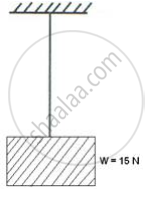
In the Figure a block of weight 15 N is hanging from a rigid support by a string. What force is exerted by (a) a block on the string and (b) a string on the block? Name and show them in the diagram.
Concept: undefined >> undefined
What do you understand by the term force due to gravity ?
Concept: undefined >> undefined
Explain the meaning of the following statement '1 kgf = 9.8 N'.
Concept: undefined >> undefined
The weight of a body is 2.0 N. What is the mass of the body? (g = 10 m s-2)
Concept: undefined >> undefined
The weight of a body on Earth is 98 N, where acceleration due to gravity is 9.8 m s-2. What will be its (a) mass and (b) weight on the Moon, where acceleration due to gravity is 1.6 m s-2?
Concept: undefined >> undefined
What is the (a) force of gravity and (b) weight of a block of mass 10.5 kg ? Take g = 10 ms-2 .
Concept: undefined >> undefined
Assuming the density of air to be 1.295 kg m-3, find the fall in barometric height in mm of Hg at a height of 107 m above the sea level. Take density of mercury = 13.6 × 10³ kg m-3.
Concept: undefined >> undefined
A body dipped into a liquid experiences an upthrust. State two factors on which upthrust on the body depends.
Concept: undefined >> undefined
A body of density ρ is immersed in a liquid of density ρL. State the condition when the body will (i) float and (ii) sink in the liquid.
Concept: undefined >> undefined
A body held completely immersed inside a liquid experiences two forces:
(i) F1, the force due to gravity and
(ii) F2, the buoyant force.
Draw a diagram showing the direction of these forces acting on the body and state the condition when the body will float or sink.
Concept: undefined >> undefined
Complete the following sentence :
An empty tin container with its mouth closed has an average density equal to that of a liquid. The container is taken 2 m below the surface of that liquid and is left there. Then the container will ____________ .
Concept: undefined >> undefined
A bunch of feathers and a stone of the same mass are released simultaneously in air. Which will fall faster and why? How will your observation be different if they are released simultaneously in vacuum?
Concept: undefined >> undefined
A body of density ρ sinks in a liquid of density ρL. The densities ρ and ρL are related as :
Concept: undefined >> undefined
A body of volume 100 cm3 weighs 5 kgf in air. It is completely immersed in a liquid of density 1.8 × 10³ kg m-3. Find:
- The upthrust due to liquid and
- The weight of the body in liquid.
Concept: undefined >> undefined
A piece of brass weighs 175 gf in air and 150 gf when fully submerged in water. The density of water is 1.0 g cm-3.
(i) What is the volume of the brass piece? (ii) Why does the brass piece weigh less in water?
Concept: undefined >> undefined
Define the term density.
Concept: undefined >> undefined
