Please select a subject first
Advertisements
Advertisements
The vertical angle of an isosceles triangle is three times the sum of its base angles. Find each angle.
Concept: undefined >> undefined
Express: 729 as a power of 3.
Concept: undefined >> undefined
Advertisements
Express: 343 as a power of 7.
Concept: undefined >> undefined
The ratio between a base angle and the vertical angle of an isosceles triangle is 1: 4. Find each angle of the triangle.
Concept: undefined >> undefined
If 27 × 32 = 3x × 2y; find the values of x and y.
27 × 32 = 3x × 2y
27 = 3x
| 3 | 27 |
| 3 | 9 |
| 3 | 3 |
| 1 |
Concept: undefined >> undefined
If 64 x 625 = 2a x 5b ; find: the values of a and b.
Concept: undefined >> undefined
If 64 x 625 = 2a x 5b ; find: 2b x 5a
Concept: undefined >> undefined
Fill in the blanks:
In 52 = 25, base = _______ and index = _________.
Concept: undefined >> undefined
Fill in the blank:
If index = 3x and base = 2y, the number = ______.
Concept: undefined >> undefined
In the given figure, BI is the bisector of ∠ABC and Cl is the bisector of ∠ACB. Find ∠BIC.
Concept: undefined >> undefined
Evaluate: 28 ÷ 23
Concept: undefined >> undefined
In ∆ ABC, BA and BC are produced. Find the angles a and h. if AB = BC.
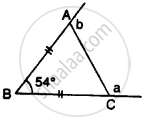
Concept: undefined >> undefined
The diagonal of a square is `12sqrt2` cm. Find its perimeter.
Concept: undefined >> undefined
In Figure, BP bisects ∠ABC and AB = AC. Find x.
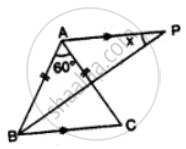
Concept: undefined >> undefined
Find x in Figure Given: DA = DB = DC, BD bisects ∠ABC and∠ADB = 70°.
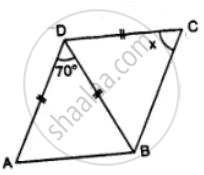
Concept: undefined >> undefined
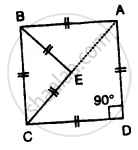
In the figure, given below, ABCD is a square, and ∆ BEC is an equilateral triangle. Find, the case:∠ABE
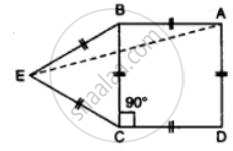
Concept: undefined >> undefined
In the figure, given below, ABCD is a square, and ∆ BEC is an equilateral triangle. Find, the case:∠BAE
Concept: undefined >> undefined
Complete the following table:
| Point | Reflection in | ||
| x-axis | y-axis | origin | |
| (i) (8, 2) | |||
| (ii) (5, 6) | |||
| (iii) (4, −5) | |||
| (iv) (6, −2) | |||
| (v) (−3, 7) | |||
| (vi) (−4, 5) | |||
| (vii) (−2, −7) | |||
| (viii) (−6, −3) | |||
| (ix) (4, 0) | |||
| (x) (−7, 0) | |||
| (xi) (0, −6) | |||
| (xii) (0, 7) | |||
| (xiii) (0, 0) | |||
Concept: undefined >> undefined
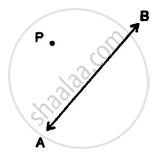
In the given figure, find the image of the point P in the line AB:
Concept: undefined >> undefined
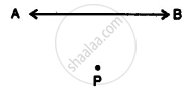
In the given figure, find the image of the point P in the line AB:
Concept: undefined >> undefined
