Please select a subject first
Advertisements
Advertisements
Name and define the characteristic which enables one to distinguish two sounds of same loudness, but of different frequencies, given by the same instrument.
Concept: undefined >> undefined
How is it possible to detect the filling of a bottle under a water tap by hearing the sound at a distance?
Concept: undefined >> undefined
Advertisements
The pitch of sound increases if its frequency ______.
Concept: undefined >> undefined
If the amplitude of a sound is halved, its loudness becomes ______.
Concept: undefined >> undefined
Name the characteristic which enables one to distinguish the sound of two musical instruments even if they are of the same pitch and same loudness.
Concept: undefined >> undefined
State the factor that determine the pitch of a note.
Concept: undefined >> undefined
Name the characteristic of the sound affected due to a change in its frequency.
Concept: undefined >> undefined
Two sounds A and B are of same amplitude, same wave forms but of frequencies f and 2f respectively. Then ______.
Concept: undefined >> undefined
A bulb is connected to a battery of p.d 4 V and internal resistance 2.5 Ω. A steady current of 0.5 A flows through the circuit. Calculate:
- the total energy supplied by the battery in 10 minutes
- the resistance of the bulb and
- the energy dissipated in the bulb in 10 minutes.
Concept: undefined >> undefined
A bulb is connected to a battery of p.d 4 V and internal resistance 2.5 Ω. A steady current of 0.5 A flows through the circuit. Calculate:
- the total energy supplied by the battery in 10 minutes
- the resistance of the bulb and
- the energy dissipated in the bulb in 10 minutes.
Concept: undefined >> undefined
What is a total reflecting prism?
Concept: undefined >> undefined
Show with the help of a diagram how a total reflecting prism can be used to turn a ray of light through 90°. Name one instrument in which such a prism is used.
Concept: undefined >> undefined
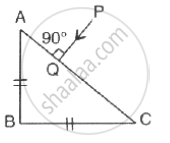
In the following figure, a ray of light PQ is incident normally on the hypotenuse of an isosceles right angle prism ABC.
- Complete the path of the ray PQ till it emerges from the prism. Mark in the diagram the angle wherever necessary.
- What is the angle of deviation of the ray PQ?
- Name a device in which this action is used.
Concept: undefined >> undefined
What device other than a plane mirror can be used to turn a ray of light through 180°? Draw a diagram in support of your answer. Name an instrument in which this device is used.
Concept: undefined >> undefined
Mention one difference between reflection of light from a plane mirror and total internal reflection of light from a prism.
Concept: undefined >> undefined
In the given figure, a ray of light PQ is incident normally on the face AB of an equilateral glass prism. Complete the ray diagram showing its emergence into air after passing through the prism. Take critical angle for glass = 42°.
- Write the angles of incidence at the faces AB and AC of the prism.
- Name the phenomenon which the ray of light suffers at the face AB, AC and BC of the prism.

Concept: undefined >> undefined
Draw a neat labelled ray diagram to show the total internal reflection of a ray of light normally incident on one face of a 30°, 90°, 60° prism.
Concept: undefined >> undefined
A total reflecting equilateral prism can be used to deviate a ray of light through ______.
Concept: undefined >> undefined
Concept: undefined >> undefined
A total reflecting right angled isosceles prism can be used to deviate a ray of light through ______.
Concept: undefined >> undefined
