Advertisements
Advertisements
How does the speed of light change when it passes from glass to water?
Concept: undefined >> undefined
A ray of light is passing from a transparent medium 1 to another transparent medium 2 (i) Speed up (ii) slows down. In each case, state whether the refractive index of medium 2 is equal to, less than or greater than the refractive index of medium 1.
Concept: undefined >> undefined
Advertisements
What do you understand by the statement the refractive index of glass is 1.5 for white light?
Concept: undefined >> undefined
The diagram alongside shows the refraction of a ray of light from air to a liquid.
- Write the values of (i) angle of incidence, (ii) angle of refraction.
- Use Snell’s law to find the refractive index of liquid with respect to air.

Concept: undefined >> undefined
In fig 4.18, name the ray which represents the correct path of light while emerging out through a glass block.
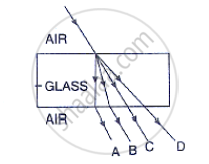
Concept: undefined >> undefined
Fill in the blanks to complete the following sentence
When light travels from a denser to a rarer medium, its speed ……………….
Concept: undefined >> undefined
Fill in the blanks to complete the following sentence
The refractive index of glass with respect to air is 3/2. The refractive index of air with respect to glass will be ……………….
Concept: undefined >> undefined
How is the angle of emergence related to the angle of incidence when prism is in the position of minimum deviation? Illustrate your answer with help of a labelled diagram using an equilateral prism?
Concept: undefined >> undefined
Name the colour of white light which is deviated the most on passing through a prism.
Concept: undefined >> undefined
An object is viewed through a glass prism with its vertex pointing upwards. It appears to be displaced upward. Explain the reason.
Concept: undefined >> undefined
Fig 4.31 below shows a light ray of single colour incident normally on two prisms A and B. In each case draw the path of the ray of light as it enters and emerges out of the prism. Mark the angle wherever necessary.
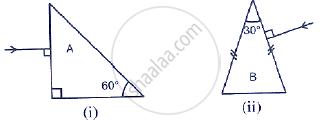
Concept: undefined >> undefined
Complete Fig. 4.32 to show the path of the ray of single colour as it enters the prism and emerges out of it. Mark the angles wherever necessary.
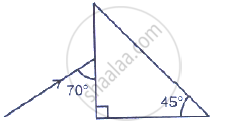
Concept: undefined >> undefined
A pond appears to be 2.7 m deep. If the refractive index of water is `4/3`, find the actual depth of the pond.
Concept: undefined >> undefined
A coin is places at the bottom of a beaker containing water (refractive index = 4/3) to a depth of 12 cm. By what height the coin appears to be raised when seen from vertically above?
Concept: undefined >> undefined
A postage stamp kept below a rectangular glass block of refractive index 1.5 when viewed from vertically above it, appears to be raised by 7.0 mm. Calculate the thickness of the glass slab.
Concept: undefined >> undefined
What is meant by the statement the critical angle for diamond is 24°?
Concept: undefined >> undefined
The critical angle for glass-air is 45° for the light of yellow colour. State whether it will be less than, equal to, or more than 45° for (i) ref light, (ii) blue light?
Concept: undefined >> undefined
The refractive index of air with respect to glass is expressed as `""_g μ_a=sin i /sin r`.
- Write down a similar expression for aμg in terms of the angles i and r.
- If angle r = 90°, what is the corresponding angle i called?
- What is the physical significance of the angle i in part (b)?
Concept: undefined >> undefined
The refractive index of glass is 1.5. From a point P inside a glass block, draw rays PA, PB and PC incident on the glass air surface at an angle of incidence 30°, 42° and 60° respectively.
- In the diagram show the approximate direction of these rays as they emerge out of the block.
- What is the angle of refraction for the ray PB?
`("Take" sin 42° =2/3)`
Concept: undefined >> undefined
A ray of light enters a glass slab ABDC as shown in figure and strikes at the centre O of the circular part AC of the slab. The critical angle of glass is 42°. Complete the path of the ray till it emerges out from the slab. Mark the angles in the diagram wherever necessary.
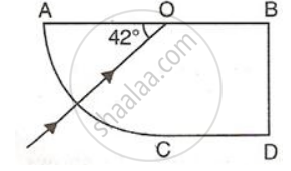
Concept: undefined >> undefined
