Advertisements
Advertisements
Calculate:
Write the empirical formula of C8H18.
Concept: undefined >> undefined
Explain the following:
\[\ce{H3PO3}\] is not a tribasic acid.
Concept: undefined >> undefined
Advertisements
State which of the two - a solution of HCl in water or in toluene is an electrolyte. Explain.
Concept: undefined >> undefined
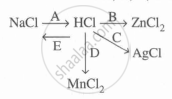
Study the flow chart and give balanced equations with conditions for the conversions A, B, C, D, and E.
Concept: undefined >> undefined
State which of the two - a solution of HCl in water or in toluene is an electrolyte. Explain.
Concept: undefined >> undefined
State which of the two - a solution of HCl in water or in toluene is an electrolyte. Explain.
Concept: undefined >> undefined
State which of the two - a solution of HCl in water or in toluene is an electrolyte. Explain.
Concept: undefined >> undefined
Give the IUPAC name of the organic compound represented by the structural formula given below:
\[\begin{array}{cc}
\ce{H}\phantom{...}\ce{Cl}\phantom{..}\ce{H}\phantom{...}\ce{H}\phantom{...}\ce{H}\\
|\phantom{....}|\phantom{....}|\phantom{....}|\phantom{....}|\\
\ce{H - C - C - C - C - C - H}\\
|\phantom{....}|\phantom{....}|\phantom{....}|\phantom{....}|\\
\ce{H}\phantom{...}\ce{H}\phantom{...}\ce{Cl}\phantom{..}\ce{H}\phantom{...}\ce{H}\end{array}\]
Concept: undefined >> undefined
Give the IUPAC name of the organic compound represented by the structural formula given below:
\[\begin{array}{cc}
\phantom{.}\ce{H\phantom{...}H\phantom{...}O}\phantom{..}\\
\phantom{.}|\phantom{....}|\phantom{....}||\phantom{..}\\
\ce{H - C - C - C - OH}\\
\phantom{}|\phantom{....}|\phantom{......}\\
\phantom{}\ce{H\phantom{...}H}\phantom{......}
\end{array}\]
Concept: undefined >> undefined
The compound which does not have a double bond in its structure.
Concept: undefined >> undefined
The compound in its pure form turns into an ice like solid on cooling.
Concept: undefined >> undefined
The compound which is used for artificial ripening of fruits.
Concept: undefined >> undefined
Give a balanced equation for the following reaction:
Copper reacts with concentrated nitric acid.
Concept: undefined >> undefined
The ratio between the volumes occupied by 4.4 grams of carbon dioxide and 2 grams of hydrogen gas is ______.
Concept: undefined >> undefined
Aqueous lead (II) nitrate can be distinguished from aqueous zinc nitrate by adding any of the following solutions in excess, except:
Concept: undefined >> undefined
Identify the following:
A salt formed by the complete neutralization of an acid by a base.
Concept: undefined >> undefined
Draw the structural diagram for the following compound.
2,2 dibromo butane
Concept: undefined >> undefined
Pratik heated 11.2 grams of element ‘M’ (atomic weight 56) with 4.8 grams of element 'N' (atomic weight 16) to form a compound. Find the empirical formula of the compound obtained by Pratik.
Concept: undefined >> undefined
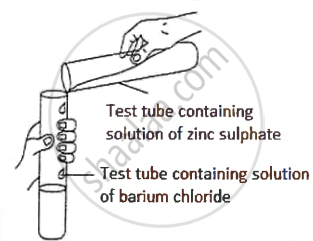
A student was asked to perform an experiment in the laboratory based on the instructions given:
Observe the picture given below and state one observation for the experiment you would notice on mixing the given solution.
Concept: undefined >> undefined
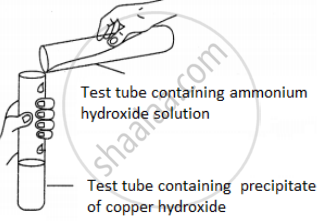
A student was asked to perform an experiment in the laboratory based on the instructions given:
Observe the picture given below and state one observation for the experiment you would notice on mixing the given solution.
Concept: undefined >> undefined
