Advertisements
Advertisements
Define the following term:
Exudation
Concept: undefined >> undefined
Define the following term:
Hydathodes
Concept: undefined >> undefined
Advertisements
Give a reason/suitable explanation.
Guttation normally occurs during early mornings or late nights.
Concept: undefined >> undefined
The figure given below is a diagrammatic representation of a part of the cross-section of the root in the root hair zone. Study the same and then answer the questions that follow:

- The parts labelled as 1, 2, 3 and 4 are:
- Root hair, Xylem vessel, Soil particles, Cortex respectively.
- Xylem vessel, Soil particles, Root hair, Cortex respectively.
- Root hair, Xylem vessel, Cortex, Soil particles respectively.
- Cortex, Soil particles, Xylem vessel, Root hair respectively.
- The process that enables the passage of water from soil into the root hair is:
- Diffusion
- Active transport
- Osmosis
- Passive absorption
- The kind of force which exists between a liquid and any surface is called as:
- Cohesive force
- Adhesive force
- Capillarity
- Suction force
- The kind of force between the same kind of liquid molecules is:
- Capillary force
- Transpirational pull
- Adhesive force
- Cohesive force
- Sometimes exudation of water occurs from the margin of the leaves in the early morning or night. It is termed as:
- Transpiration
- Guttation
- Bleeding
- Osmosis
Concept: undefined >> undefined
Given below is the figure of a plant cell showing different kinds of pressure acting upon it. Study the figure and answer the questions that follow:

- In the figure, 1, 2 and 3 represent:
- Cytoplasm, Nucleus, Vacuole respectively
- Vacuole, Cytoplasm, Cell wall respectively.
- Cytoplasm, Cell membrane and vacuole respectively.
- Cytoplasm, Cell wall and Vacuole respectively.
- B in the figure represents:
- Osmotic pressure
- Turgor pressure
- Wall pressure
- Diffusion pressure
- A in the figure represents:
- irnbibition pressure
- Wall pressure
- Turgor pressure
- Osmotic pressure
- C in the figure represents:
- Turgor pressure
- Osmotic pressure
- Wall pressure
- Imbibition pressure
- Draw a neat and labelled diagram of a plasmolyzed plant cell.
Concept: undefined >> undefined
Differentiate between members of the following pair with reference to what is asked in the bracket.
Myopia and Hyperopia (type of lens used for correction).
Concept: undefined >> undefined
Aqueous humour, Vitreous humour, lris, Central canal
Concept: undefined >> undefined
Give biological reasons for the following statements:
The left ventricle of the heart has a thicker wall than the right ventricle.
Concept: undefined >> undefined
The diagram given below represents a section of the human heart. Answer the questions that follow :
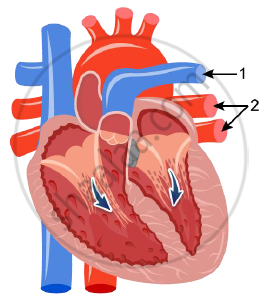
(i) Which parts of heart are in the diastolic phase? Give a reason to support your answer.
(ii) Label the parts numbered 1 and 2 in the diagram. What type of blood flows through them?
(iii) What causes the heart sounds ‘LUBB’ and ‘DUP’?
(iv) Name the blood vessels that supply oxygenated blood to the heart muscles.
(v) Draw neat labelled diagrams of a cross section of an artery and a vein.
Concept: undefined >> undefined
State the exact location of the Chordae tendinae
Concept: undefined >> undefined
Differentiate between LUBB and DUP (names of the valves whose closure produce the sound)
Concept: undefined >> undefined
the Biological/technical term for The vein which drains the blood from the intestine to the liver.
Concept: undefined >> undefined
the Biological/technical term for Blood vessels carrying blood to the left atrium.
Concept: undefined >> undefined
The vein that carries oxygenated blood.
Concept: undefined >> undefined
fill in the blanks with suitable functions: Eustachian Tube and ______
Concept: undefined >> undefined
The diagram below represents the human heart in one phase of its function. Study the diagram carefully and answer the questions that follow:
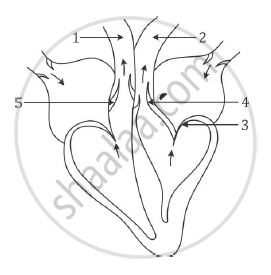
(i) Name the phase.
(ii) Which part of the heart is contracting in this phase? Give a reason to support your answer.
(iii) Name the parts labelled 1 to 4.
(iv) What type of blood flows through ‘2’?
(v) State the function of the part numbered ‘5’.
(vi) Name the membrane that covers the heart.
Concept: undefined >> undefined
The exact location of the tricuspid valve
Concept: undefined >> undefined
The diagram below represents the simplified pathway of the circulation of blood. Study the same and answer the questions which follow:

(i) Name the blood vessels labelled 1 and 2.
(ii) State the function of blood vessels labelled 5 and 8.
(iii) What is the importance of the blood vessel labelled 6?
(iv) Which blood vessel will contain a high amount of glucose and amino acids after a meal?
(v) Draw a diagram of the different blood cells as seen in a smear of human blood.
Concept: undefined >> undefined
Explain Diapedesis.
Concept: undefined >> undefined
