Please select a subject first
Advertisements
Advertisements
The number of red blood cells per cubic millimetre of blood is approximately 5.5 million. If the average body contains 5 litres of blood, what is the total number of red cells in the body? Write the standard form. (1 litre = 1,00,000 mm3)
Concept: undefined >> undefined
Express the following in standard form:
The mass of a proton in gram is `1673/1000000000000000000000000000`
Concept: undefined >> undefined
Advertisements
Express the following in standard form:
A Helium atom has a diameter of 0.000000022 cm.
Concept: undefined >> undefined
Express the following in standard form:
Mass of a molecule of hydrogen gas is about 0.00000000000000000000334 tons.
Concept: undefined >> undefined
Express the following in standard form:
Human body has 1 trillon of cells which vary in shapes and sizes.
Concept: undefined >> undefined
Express the following in standard form:
Express 56 km in m.
Concept: undefined >> undefined
Express the following in standard form:
Express 5 tons in g.
Concept: undefined >> undefined
Express the following in standard form:
Express 2 years in seconds.
Concept: undefined >> undefined
Express the following in standard form:
Express 5 hectares in cm2 (1 hectare = 10000 m2)
Concept: undefined >> undefined
The planet Uranus is approximately 2,896,819,200,000 metres away from the Sun. What is this distance in standard form?
Concept: undefined >> undefined
An inch is approximately equal to 0.02543 metres. Write this distance in standard form.
Concept: undefined >> undefined
The volume of the Earth is approximately 7.67 × 10⁻⁷ times the volume of the Sun. Express this figure in usual form.
Concept: undefined >> undefined
At the end of the 20th century, the world population was approximately 6.1 × 10⁹ people. Express this population in usual form. How would you say this number in words?
Concept: undefined >> undefined
While studying her family’s history. Shikha discovers records of ancestors 12 generations back. She wonders how many ancestors she has had in the past 12 generations. She starts to make a diagram to help her figure this out. The diagram soon becomes very complex.
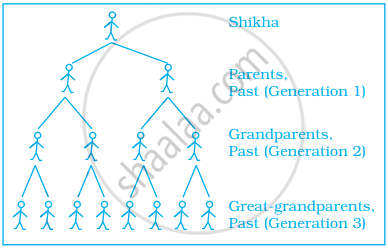
- Make a table and a graph showing the number of ancestors in each of the 12 generations.
- Write an equation for the number of ancestors in a given generation n.
Concept: undefined >> undefined
About 230 billion litres of water flows through a river each day. How many litres of water flows through that river in a week? How many litres of water flows through the river in an year? Write your answer in standard notation.
Concept: undefined >> undefined
A half-life is the amount of time that it takes for a radioactive substance to decay to one half of its original quantity.
Suppose radioactive decay causes 300 grams of a substance to decrease to 300 × 2–3 grams after 3 half-lives. Evaluate 300 × 2–3 to determine how many grams of the substance are left.
Explain why the expression 300 × 2–n can be used to find the amount of the substance that remains after n half-lives.
Concept: undefined >> undefined
Consider a quantity of a radioactive substance. The fraction of this quantity that remains after t half-lives can be found by using the expression 3–t. After how many half-lives will the fraction be `1/243` of the original?
Concept: undefined >> undefined
One Fermi is equal to 10–15 metre. The radius of a proton is 1.3 Fermis. Write the radius of a proton in metres in standard form.
Concept: undefined >> undefined
The paper clip below has the indicated length. What is the length in standard form.

Concept: undefined >> undefined
There are 864,00 seconds in a day. How many days long is a second? Express your answer in scientific notation.
Concept: undefined >> undefined
