Advertisements
Advertisements
Correct substitution for the solution of the differential equation of the type `("d"x)/("d"y) = "g"(x, y)` where g(x, y) is a homogeneous function of the degree zero is x = vy.
Concept: undefined >> undefined
Let f : R → R be given by f(x) = tan x. Then f-1(1) is ____________.
Concept: undefined >> undefined
Advertisements
If f : `(1, infty) → (2, infty) "is given by f"("x") = "x" + 1/"x"`, then f-1 equals to ____________.
Concept: undefined >> undefined
Let f(x) = x2 – x + 1, x ≥ `1/2`, then the solution of the equation f(x) = f-1(x) is ____________.
Concept: undefined >> undefined
If `vec"a", vec"b", vec"c"` are three vectors such that `vec"a" + vec"b" + vec"a" = vec0` and `|vec"a"|` = 2, `|vec"b"|` = 3, `|vec"c"|` = 5, then value of `vec"a"*vec"b" + vec"b"*vec"c" + vec"c"*vec"a"` is ______.
Concept: undefined >> undefined
If `|vec"a"| = |vec"b"|`, then necessarily it implies `vec"a" = +- vec"b"`.
Concept: undefined >> undefined
Find the shortest distance between the lines given by `vec"r" = (8 + 3lambdahat"i" - (9 + 16lambda)hat"j" + (10 + 7lambda)hat"k"` and `vec"r" = 15hat"i" + 29hat"j" + 5hat"k" + mu(3hat"i" + 8hat"j" - 5hat"k")`
Concept: undefined >> undefined
`"d"/"dx" {"cosec"^-1 ((1 + "x"^2)/(2"x"))}` is equal to ____________.
Concept: undefined >> undefined
If `"y = sin"^-1 ((sqrt"x" - 1)/(sqrt"x" + 1)) + "sec"^-1 ((sqrt"x" + 1)/(sqrt"x" - 1)), "x" > 0, "then" "dy"/"dx"` is ____________.
Concept: undefined >> undefined
If y `= "cos"^2 ((3"x")/2) - "sin"^2 ((3"x")/2), "then" ("d"^2"y")/("dx"^2)` is ____________.
Concept: undefined >> undefined
If ex + ey = ex+y, then `"dy"/"dx"` is:
Concept: undefined >> undefined
|
The fuel cost per hour for running a train is proportional to the square of the speed it generates in km per hour. If the fuel costs ₹ 48 per hour at a speed of 16 km per hour and the fixed charges to run the train amount to ₹ 1200 per hour. Assume the speed of the train as v km/h. |
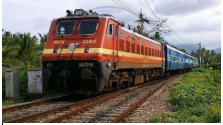
Given that the fuel cost per hour is k times the square of the speed the train generates in km/h, the value of k is:
Concept: undefined >> undefined
|
The fuel cost per hour for running a train is proportional to the square of the speed it generates in km per hour. If the fuel costs ₹ 48 per hour at a speed of 16 km per hour and the fixed charges to run the train amount to ₹ 1200 per hour. Assume the speed of the train as v km/h. |
If the train has travelled a distance of 500 km, then the total cost of running the train is given by the function:
Concept: undefined >> undefined
|
The fuel cost per hour for running a train is proportional to the square of the speed it generates in km per hour. If the fuel costs ₹ 48 per hour at a speed of 16 km per hour and the fixed charges to run the train amount to ₹ 1200 per hour. Assume the speed of the train as v km/h. |
The most economical speed to run the train is:
Concept: undefined >> undefined
|
The fuel cost per hour for running a train is proportional to the square of the speed it generates in km per hour. If the fuel costs ₹ 48 per hour at a speed of 16 km per hour and the fixed charges to run the train amount to ₹ 1200 per hour. Assume the speed of the train as v km/h. |
The fuel cost for the train to travel 500 km at the most economical speed is:
Concept: undefined >> undefined
|
The fuel cost per hour for running a train is proportional to the square of the speed it generates in km per hour. If the fuel costs ₹ 48 per hour at a speed of 16 km per hour and the fixed charges to run the train amount to ₹ 1200 per hour. Assume the speed of the train as v km/h. |
The total cost of the train to travel 500 km at the most economical speed is:
Concept: undefined >> undefined
The derivative of sin x with respect to log x is ____________.
Concept: undefined >> undefined
f(x) = 3x2 + 6x + 8, x ∈ R
Concept: undefined >> undefined
Find the height of a cylinder, which is open at the top, having a given surface area, greatest volume, and radius r.
Concept: undefined >> undefined
Polio drops are delivered to 50 K children in a district. The rate at which polio drops are given is directly proportional to the number of children who have not been administered the drops. By the end of 2nd week half the children have been given the polio drops. How many will have been given the drops by the end of 3rd week can be estimated using the solution to the differential equation `"dy"/"dx" = "k"(50 - "y")` where x denotes the number of weeks and y the number of children who have been given the drops.
The solution of the differential equation `"dy"/"dx" = "k"(50 - "y")` is given by ______.
Concept: undefined >> undefined
