Advertisements
Advertisements
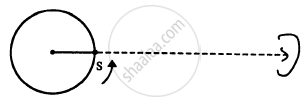
A small source of sound S of frequency 500 Hz is attached to the end of a light string and is whirled in a vertical circle of radius 1.6 m. The string just remains tight when the source is at the highest point. (a) An observer is located in the same vertical plane at a large distance and at the same height as the centre of the circle. The speed of sound in air = 330 m s−1 and g = 10 m s−2. Find the maximum frequency heard by the observer. (b) An observer is situated at a large distance vertically above the centre of the circle. Find the frequency heard by the observer corresponding to the sound emitted by the source when it is at the same height as the centre.
Concept: undefined >> undefined
A person stands on a spring balance at the equator. If the speed of earth's rotation is increased by such an amount that the balance reading is half the true weight, what will be the length of the day in this case?
Concept: undefined >> undefined
Advertisements
One end of a metal rod is dipped in boiling water and the other is dipped in melting ice.
Concept: undefined >> undefined
In summer, a mild wind is often found on the shore of a clam river. This is caused due to
Concept: undefined >> undefined
Answer the following question.
Show that its time period is given by, 2π`sqrt((l cos theta)/("g"))` where l is the length of the string, θ is the angle that the string makes with the vertical, and g is the acceleration due to gravity.
Concept: undefined >> undefined
Answer the following question.
Define the binding energy of a satellite.
Concept: undefined >> undefined
On the basis of dimensions, decide which of the following relations for the displacement of a particle undergoing simple harmonic motion is not correct ______.
- y = `a sin (2πt)/T`
- y = `a sin vt`
- y = `a/T sin (t/a)`
- y = `asqrt(2) (sin (2pit)/T - cos (2pit)/T)`
Concept: undefined >> undefined
If P, Q, R are physical quantities, having different dimensions, which of the following combinations can never be a meaningful quantity?
- (P – Q)/R
- PQ – R
- PQ/R
- (PR – Q2)/R
- (R + Q)/P
Concept: undefined >> undefined
A function f(θ) is defined as: `f(θ) = 1 - θ + θ^2/(2!) - θ^3/(3!) + θ^4/(4!)` Why is it necessary for q to be a dimensionless quantity?
Concept: undefined >> undefined
Why length, mass and time are chosen as base quantities in mechanics?
Concept: undefined >> undefined
Give an example of a physical quantity which has a unit but no dimensions.
Concept: undefined >> undefined
Give an example of a physical quantity which has neither unit nor dimensions.
Concept: undefined >> undefined
The volume of a liquid flowing out per second of a pipe of length l and radius r is written by a student as `v = π/8 (pr^4)/(ηl)` where P is the pressure difference between the two ends of the pipe and η is coefficient of viscosity of the liquid having dimensional formula ML–1 T–1. Check whether the equation is dimensionally correct.
Concept: undefined >> undefined
In the expression P = E l2 m–5 G–2, E, m, l and G denote energy, mass, angular momentum and gravitational constant, respectively. Show that P is a dimensionless quantity.
Concept: undefined >> undefined
If velocity of light c, Planck’s constant h and gravitational contant G are taken as fundamental quantities then express mass, length and time in terms of dimensions of these quantities.
Concept: undefined >> undefined
An artificial satellite is revolving around a planet of mass M and radius R, in a circular orbit of radius r. From Kepler’s Third law about the period of a satellite around a common central body, square of the period of revolution T is proportional to the cube of the radius of the orbit r. Show using dimensional analysis, that `T = k/R sqrt(r^3/g)`. where k is a dimensionless constant and g is acceleration due to gravity.
Concept: undefined >> undefined
Einstein’s mass-energy relation emerging out of his famous theory of relativity relates mass (m ) to energy (E ) as E = mc2, where c is speed of light in vacuum. At the nuclear level, the magnitudes of energy are very small. The energy at nuclear level is usually measured in MeV, where 1 MeV= 1.6 × 10⁻¹³ J; the masses are measured in unified atomic mass unit (u) where 1u = 1.67 × 10⁻²⁷ kg.
- Show that the energy equivalent of 1 u is 931.5 MeV.
- A student writes the relation as 1 u = 931.5 MeV. The teacher points out that the relation is dimensionally incorrect. Write the correct relation.
Concept: undefined >> undefined
A uniformly moving cricket ball is turned back by hitting it with a bat for a very short time interval. Show the variation of its acceleration with time. (Take acceleration in the backward direction as positive).
Concept: undefined >> undefined
For a particle performing uniform circular motion, choose the correct statement(s) from the following:
- Magnitude of particle velocity (speed) remains constant.
- Particle velocity remains directed perpendicular to radius vector.
- Direction of acceleration keeps changing as particle moves.
- Angular momentum is constant in magnitude but direction keeps changing.
Concept: undefined >> undefined
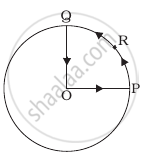
A cyclist starts from centre O of a circular park of radius 1 km and moves along the path OPRQO as shown figure. If he maintains constant speed of 10 ms–1, what is his acceleration at point R in magnitude and direction?
Concept: undefined >> undefined
