Advertisements
Advertisements
One end of a string of length l is connected to a particle of mass m and the other to a small peg on a smooth horizontal table. If the particle moves in a circle with speed the net force on the particle (directed towards the centre) is:
T is the tension in the string.
Concept: undefined >> undefined
A body of mass 5 kg is acted upon by two perpendicular forces 8 N and 6 N. Give the magnitude and direction of the acceleration of the body.
Concept: undefined >> undefined
Advertisements
A truck starts from rest and accelerates uniformly at 2.0 m s–2. At t = 10 s, a stone is dropped by a person standing on the top of the truck (6 m high from the ground).
- What are the velocity, and
- acceleration of the stone at t = 11?(Neglect air resistance.)
Concept: undefined >> undefined
Explain why a horse cannot pull a cart and run in empty space.
Concept: undefined >> undefined
A car weighs 1800 kg. The distance between its front and back axles is 1.8 m. Its centre of gravity is 1.05 m behind the front axle. Determine the force exerted by the level ground on each front wheel and each back wheel.
Concept: undefined >> undefined
From a uniform disk of radius R, a circular hole of radius R/2 is cut out. The centre of the hole is at R/2 from the centre of the original disc. Locate the centre of gravity of the resulting flat body.
Concept: undefined >> undefined
A metre stick is balanced on a knife edge at its centre. When two coins, each of mass 5 g are put one on top of the other at the 12.0 cm mark, the stick is found to be balanced at 45.0 cm. What is the mass of the metre stick?
Concept: undefined >> undefined
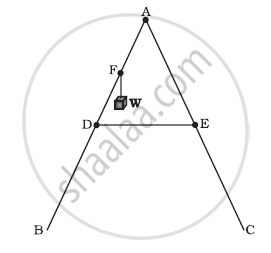
As shown in Fig.7.40, the two sides of a step ladder BA and CA are 1.6 m long and hinged at A. A rope DE, 0.5 m is tied half way up. A weight 40 kg is suspended from a point F, 1.2 m from B along the ladder BA. Assuming the floor to be frictionless and neglecting the weight of the ladder, find the tension in the rope and forces exerted by the floor on the ladder. (Take g = 9.8 m/s2)
(Hint: Consider the equilibrium of each side of the ladder separately.)
Concept: undefined >> undefined
Compute the bulk modulus of water from the following data: Initial volume = 100.0 litre, Pressure increase = 100.0 atm (1 atm = 1.013 × 10⁵ Pa), Final volume = 100.5 litre. Compare the bulk modulus of water with that of air (at constant temperature). Explain in simple terms why the ratio is so large.
Concept: undefined >> undefined
What is the density of water at a depth where the pressure is 80.0 atm, given that its density at the surface is 1.03 × 10³ kg m–3?
Concept: undefined >> undefined
Compute the fractional change in volume of a glass slab, when subjected to a hydraulic pressure of 10 atm.
Concept: undefined >> undefined
How much should the pressure on a litre of water be changed to compress it by 0.10%?
Concept: undefined >> undefined
The Marina trench is located in the Pacific Ocean, and at one place it is nearly eleven km beneath the surface of the water. The water pressure at the bottom of the trench is about 1.1 × 10⁸ Pa. A steel ball of initial volume 0.32 m3 is dropped into the ocean and falls to the bottom of the trench. What is the change in the volume of the ball when it reaches to the bottom?
Concept: undefined >> undefined
Fill in the blanks using the word(s) from the list appended with each statement
Viscosity of gases. .. with temperature, whereas viscosity of liquids . . . with temperature (increases / decreases)
Concept: undefined >> undefined
Fill in the blanks using the word(s) from the list appended with each statement
For solids with elastic modulus of rigidity, the shearing force is proportional to . . . , while for fluids it is proportional to . .. (shear strain / rate of shear strain)
Concept: undefined >> undefined
Explain why The size of the needle of a syringe controls flow rate better than the thumb pressure exerted by a doctor while administering an injection
Concept: undefined >> undefined
(a) What is the largest average velocity of blood flow in an artery of radius 2 × 10⁻³ m if the flow must remain laminar? (b) What is the corresponding flow rate? (Take viscosity of blood to be 2.084 × 10⁻³ Pa s).
Concept: undefined >> undefined
In Millikan’s oil drop experiment, what is the terminal speed of an uncharged drop of radius 2.0 × 10⁻⁵ m and density 1.2 × 10³ kg m–3? Take the viscosity of air at the temperature of the experiment to be 1.8 × 10⁻⁵ Pa s. How much is the viscous force on the drop at that speed? Neglect buoyancy of the drop due to air.
Concept: undefined >> undefined
Explain why a brass tumbler feels much colder than a wooden tray on a chilly day
Concept: undefined >> undefined
A metre long narrow bore held horizontally (and closed at one end) contains a 76 cm long mercury thread, which traps a 15 cm column of air. What happens if the tube is held vertically with the open end at the bottom?
Concept: undefined >> undefined
