Advertisements
Advertisements
What is green chemistry?
Concept: undefined >> undefined
What is the relationship between the members of following pairs of structures? Are they structural or geometrical isomers or resonance contributors?
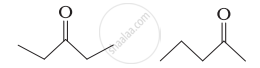
Concept: undefined >> undefined
Advertisements
What is the relationship between the members of following pairs of structures? Are they structural or geometrical isomers or resonance contributors?
\[\begin{array}{cc}\ce{^+OH}\\||\\
\ce{H - C - OH}\end{array}\]
\[\begin{array}{cc}\ce{OH}\phantom{.}\\|\phantom{...}\\
\ce{H - C^+ - OH}\end{array}\]
Concept: undefined >> undefined
Which of the following statements is correct about the reaction given below:
\[\ce{4Fe(s) + 3O2(g) -> 2Fe2O3(g)}\]
Concept: undefined >> undefined
Which of the following reactions is not correct according to the law of conservation of mass.
Concept: undefined >> undefined
Which of the following is not an actinoid?
Concept: undefined >> undefined
The electronic configuration of gadolinium (Atomic number 64) is ______.
Concept: undefined >> undefined
The elements in which electrons are progressively filled in 4f-orbital are called ______.
Concept: undefined >> undefined
In the modern periodic table, elements are arranged in order of increasing atomic numbers which is related to the electronic configuration. Depending upon the type of orbitals receiving the last electron, the elements in the periodic table have been divided into four blocks, viz, s, p, d and f. The modern periodic table consists of 7 periods and 18 groups. Each period begins with the filling of a new energy shell. In accordance with the Arfbau principle, the seven periods have 2, 8, 8, 18, 18, 32 and 32 elements respectively. The seventh period is still incomplete. To avoid the periodic table being too long, the two series of f-block elements, called lanthanoids and actinoids are placed at the bottom of the main body of the periodic table.
The element with atomic number 57 belongs to ______.
Concept: undefined >> undefined
In the modern periodic table, elements are arranged in order of increasing atomic numbers which is related to the electronic configuration. Depending upon the type of orbitals receiving the last electron, the elements in the periodic table have been divided into four blocks, viz, s, p, d and f. The modern periodic table consists of 7 periods and 18 groups. Each period begins with the filling of a new energy shell. In accordance with the Arfbau principle, the seven periods have 2, 8, 8, 18, 18, 32 and 32 elements respectively. The seventh period is still incomplete. To avoid the periodic table being too long, the two series of f-block elements, called lanthanoids and actinoids are placed at the bottom of the main body of the periodic table.
Which of the elements whose atomic numbers are given below, cannot be accommodated in the present set-up of the long form of the periodic table?
Concept: undefined >> undefined
In the modern periodic table, elements are arranged in order of increasing atomic numbers which is related to the electronic configuration. Depending upon the type of orbitals receiving the last electron, the elements in the periodic table have been divided into four blocks, viz, s, p, d and f. The modern periodic table consists of 7 periods and 18 groups. Each period begins with the filling of a new energy shell. In accordance with the Arfbau principle, the seven periods have 2, 8, 8, 18, 18, 32 and 32 elements respectively. The seventh period is still incomplete. To avoid the periodic table being too long, the two series of f-block elements, called lanthanoids and actinoids are placed at the bottom of the main body of the periodic table.
The elements with atomic numbers 35, 53 and 85 are all ______.
Concept: undefined >> undefined
Electronic configurations of four elements A, B, C and D are given below:
(A) 1s22s22p6
(B) 1s22s22p4
(C) 1s22s22p63s1
(D) 1s22s22p5
Which of the following is the correct order of increasing tendency to gain electron:
Concept: undefined >> undefined
Illustrate by taking examples of transition elements and non-transition elements that oxidation states of elements are largely based on electronic configuration.
Concept: undefined >> undefined
In both water and dimethyl ether \[\ce{(CH3 - \overset{\bullet\bullet}{\underset{\bullet\bullet}{O}} - CH3)}\], oxygen atom is central atom, and has the same hybridisation, yet they have different bond angles. Which one has greater bond angle? Give reason.
Concept: undefined >> undefined
Assertion (A): Though the central atom of both \[\ce{NH3}\] and \[\ce{H2O}\] molecules are sp3 hybridised, yet \[\ce{H -N - H}\] bond angle is greater than that of \[\ce{H - O - H}\].
Reason (R): This is because nitrogen atom has one lone pair and oxygen atom has two lone pairs.
Concept: undefined >> undefined
For the reaction \[\ce{H2 (g) + I2 (g) ⇌ 2HI (g)}\], the standard free energy is ∆GΘ > 0. The equilibrium constant (K ) would be ______.
Concept: undefined >> undefined
On increasing the pressure, in which direction will the gas phase reaction proceed to re-establish equilibrium, is predicted by applying the Le Chatelier’s principle. Consider the reaction.
\[\ce{N2 (g) + 3H2 (g) ⇌ 2NH3 (g)}\]
Which of the following is correct, if the total pressure at which the equilibrium is established, is increased without changing the temperature?
Concept: undefined >> undefined
At 500 K, equilibrium constant, \[\ce{K_c}\], for the following reaction is 5.
\[\ce{1/2 H2 (g) + 1/2 I2 (g) ⇌ HI (g)}\]
What would be the equilibrium constant \[\ce{K_c}\] for the reaction
\[\ce{2HI (g) ⇌ H2 (g) + I2 (g)}\]
Concept: undefined >> undefined
For the reaction : \[\ce{N2 (g) + 3H2 (g) ⇌ 2NH3 (g)}\]
Equilibrium constant `K_C = ([NH3]^2)/([N_2][H_2]^3)`
Some reactions are written below in Column I and their equilibrium constants in terms of Kc are written in Column II. Match the following reactions with the corresponding equilibrium constant
| Column I (Reaction) | Column II (Equilibrium constant) |
| (i) \[\ce{2N2 (g) + 6H2 (g) ⇌ 4NH3 (g)}\] | (a) `2K_c` |
| (ii) \[\ce{2NH3 (g) ⇌ N2 (g) + 3H2 (g)}\] | (b) `K_c^(1/2)` |
| (iii) \[\ce{1/2 N2 (g) + 3/2 H2 (g) ⇌ NH3 (g)}\] | (c) `1/K_c` |
| (d) `K_c^2` |
Concept: undefined >> undefined
Match standard free energy of the reaction with the corresponding equilibrium constant.
| Column I | Column II |
| (i) ∆GΘ > 0 | (a) K > 1 |
| (ii) ∆GΘ > 0 | (b) K = 1 |
| (iii) ∆GΘ = 0 | (c) K = 0 |
| (d) K < 1 |
Concept: undefined >> undefined
